Tag: Past Event
No video results found.
Drawings for Projection
PROJECTSOh To Believe in Another World
Thick Time
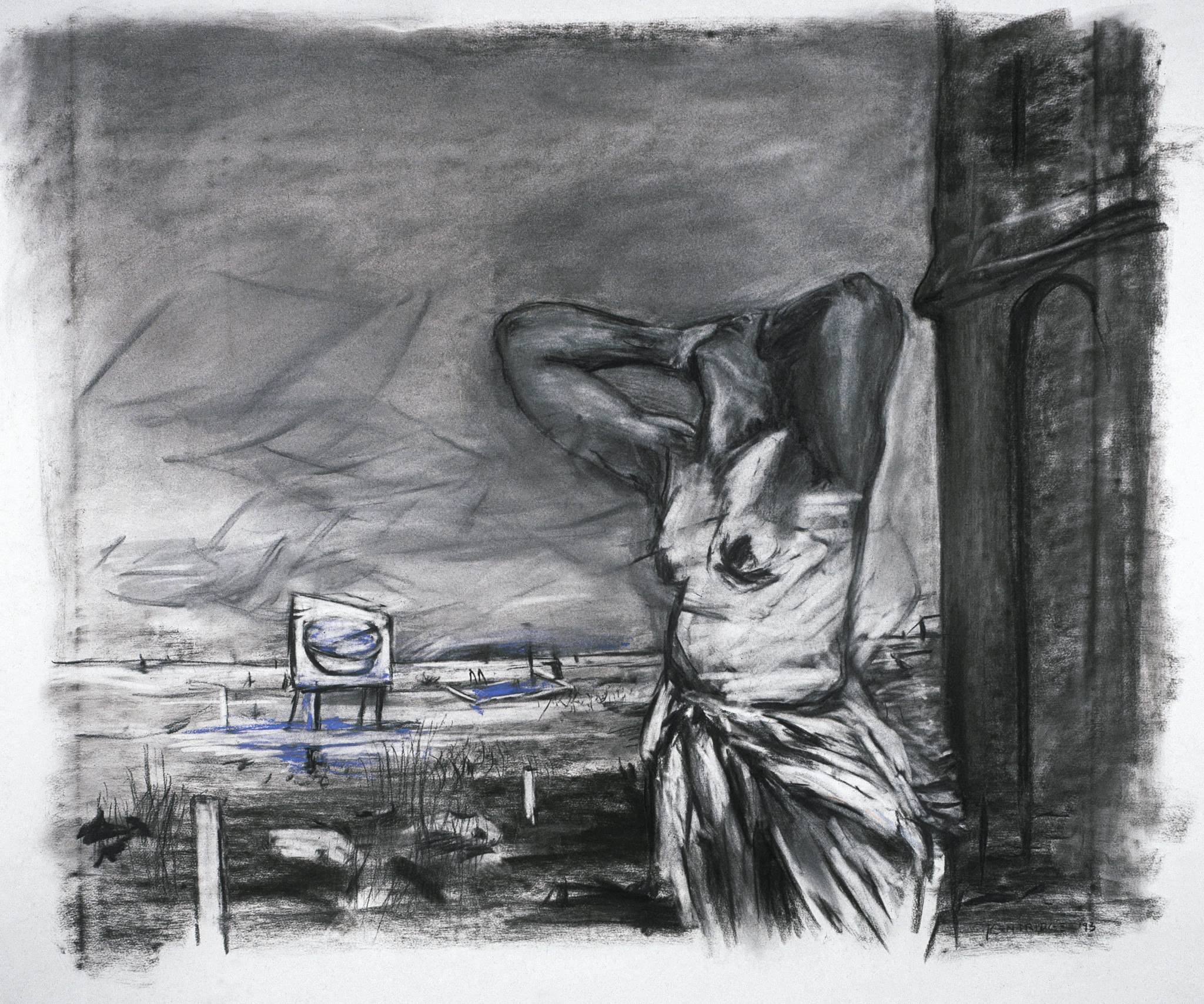
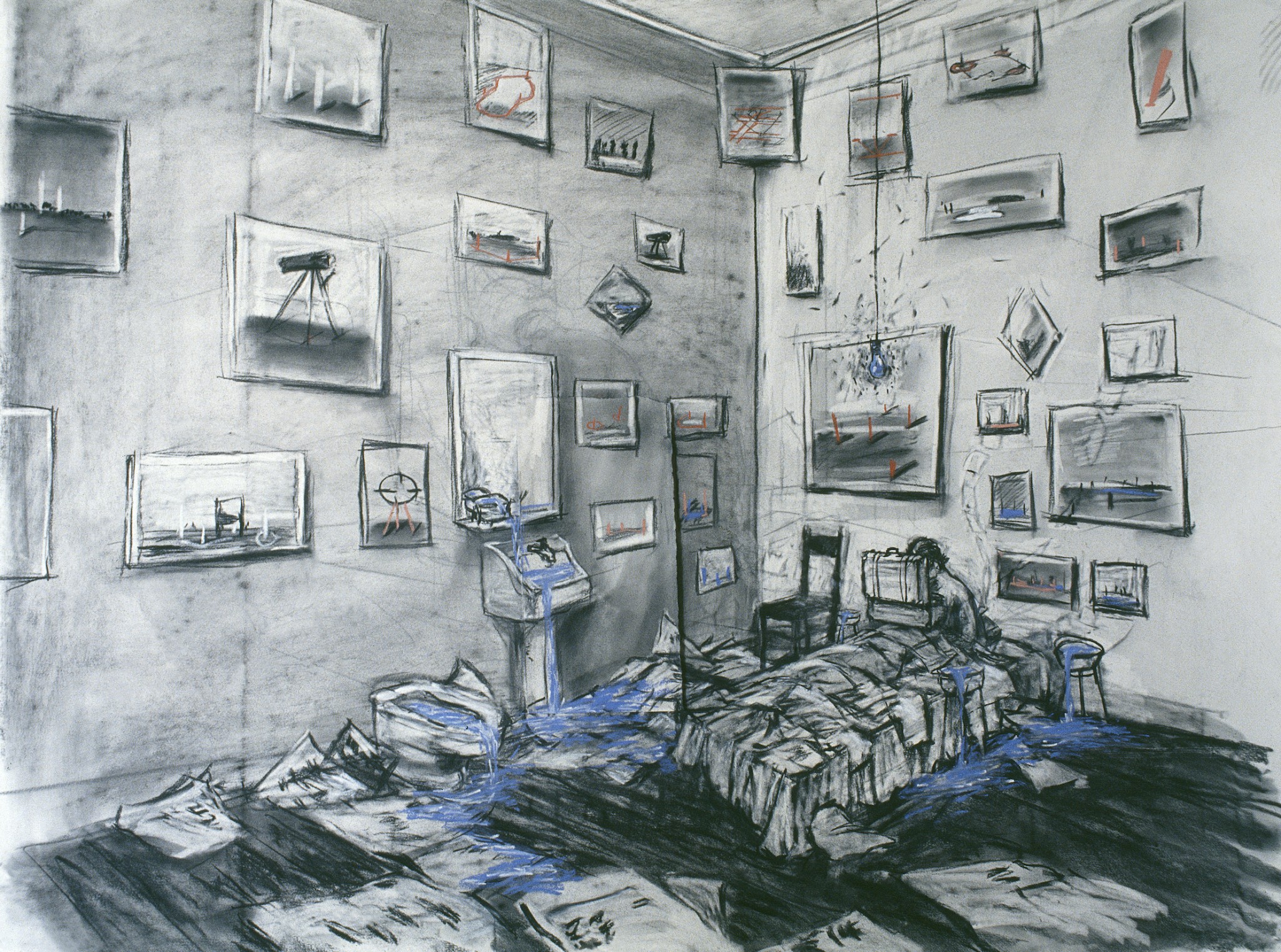
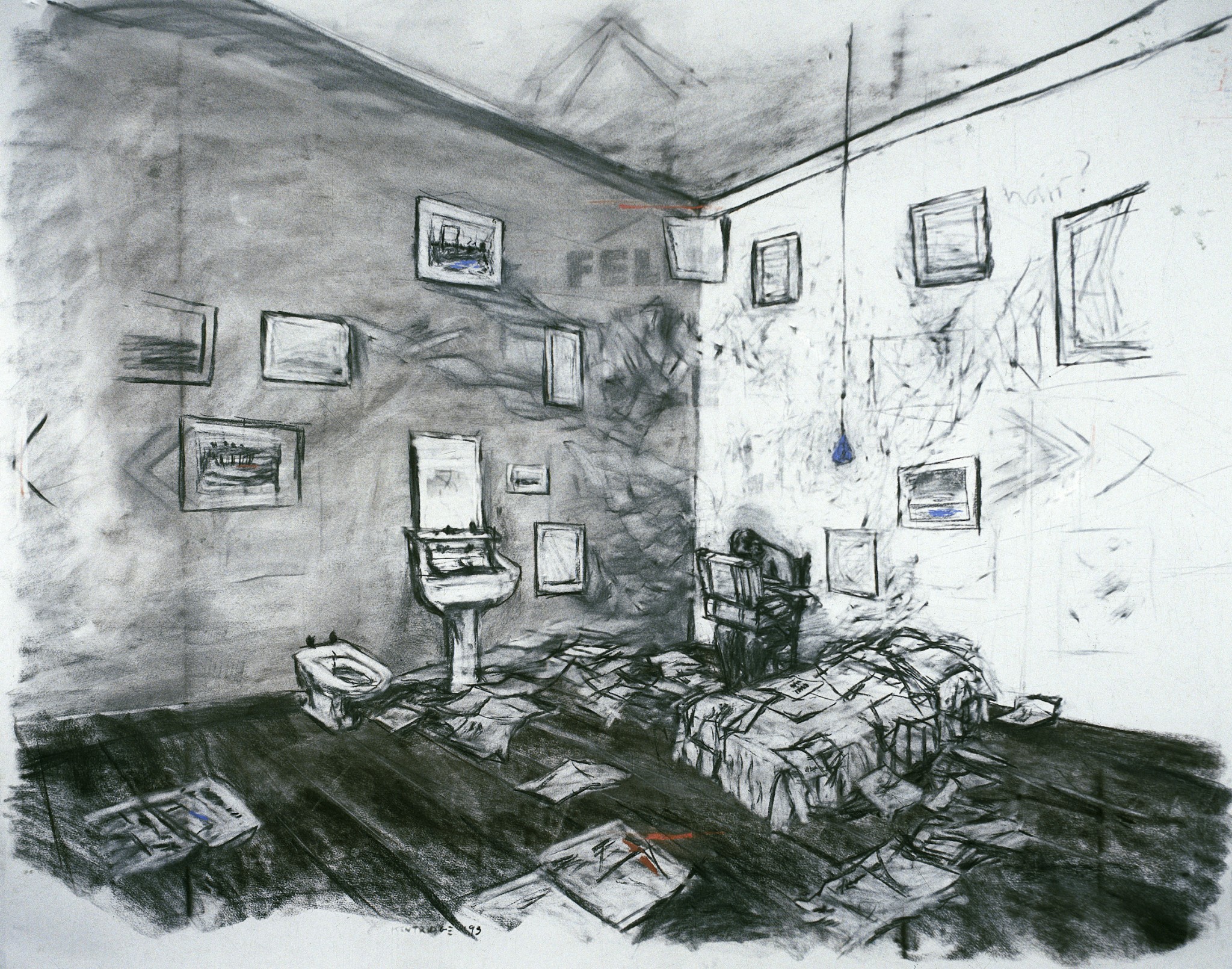
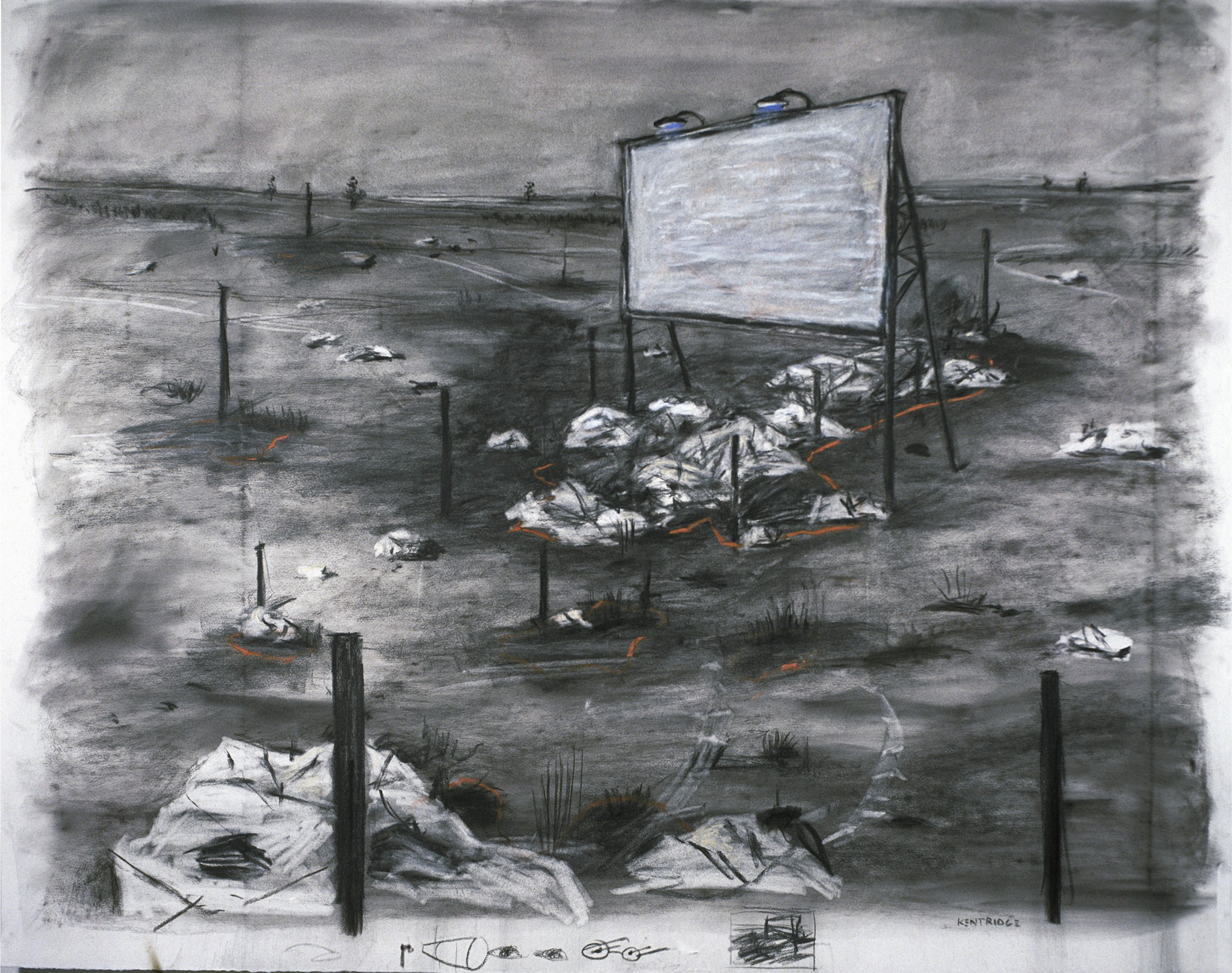
Everything can be saved. Everything is provisional. A prior action is rescued by that which follows. A drawing abandoned is revived by the next drawing.
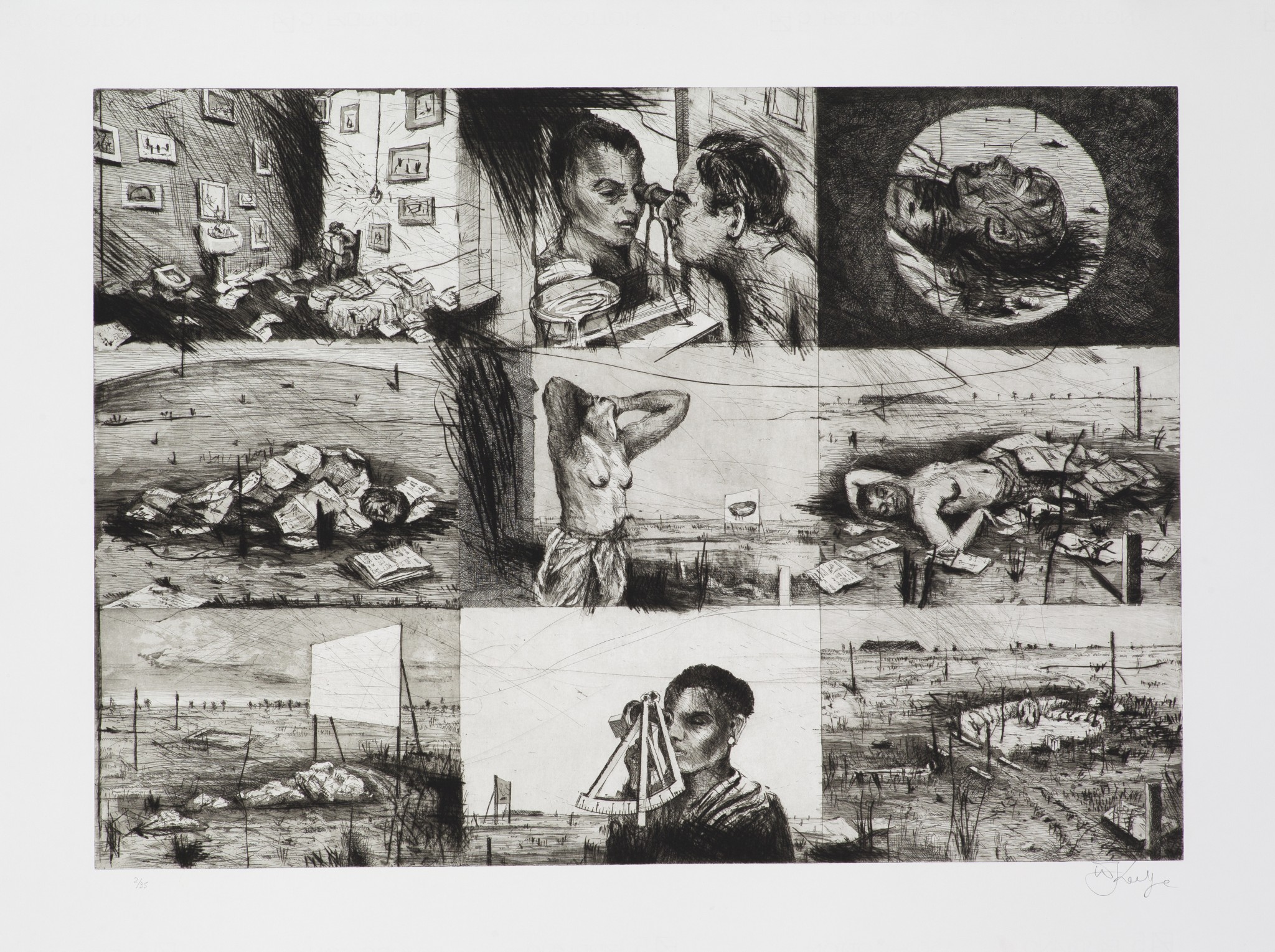
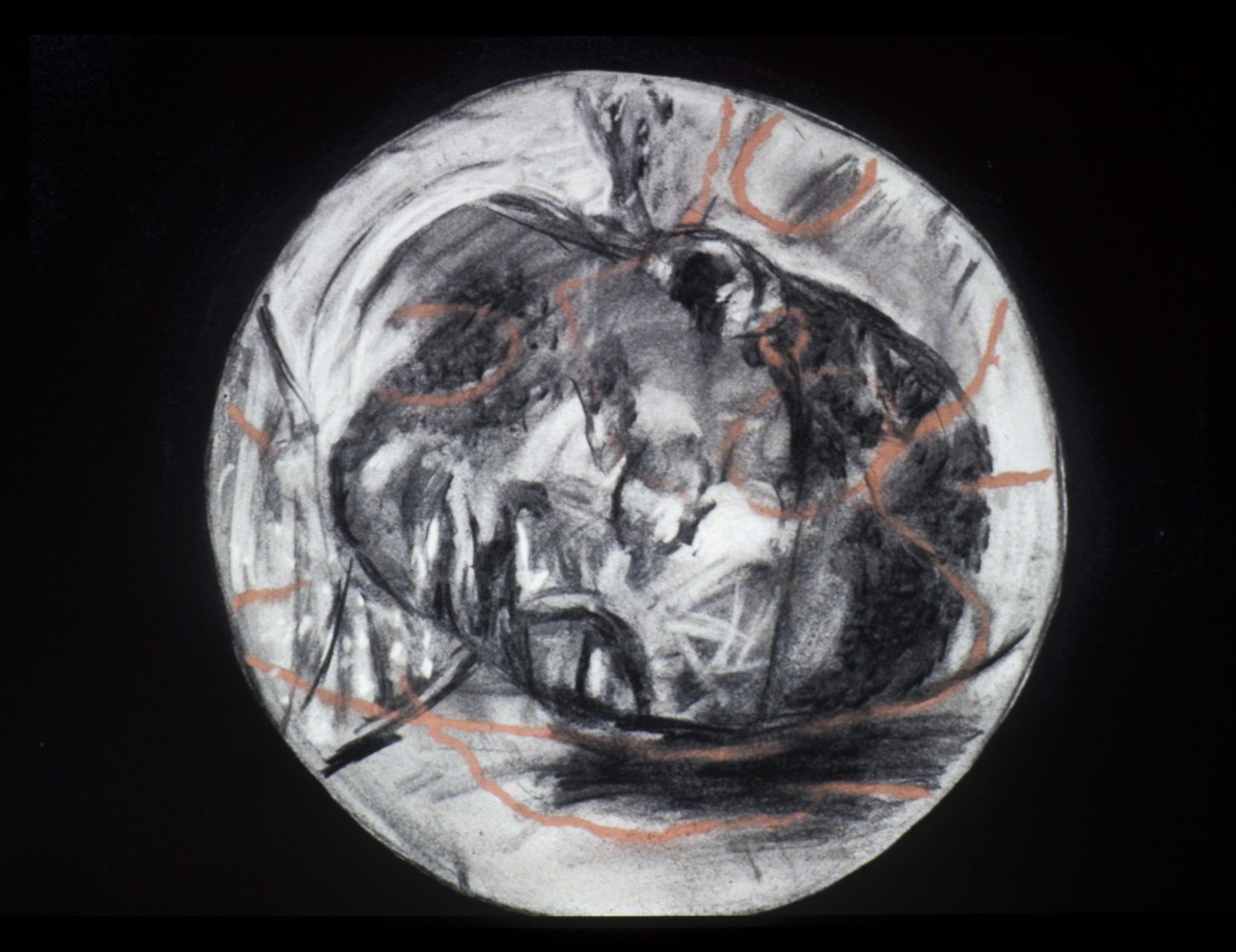
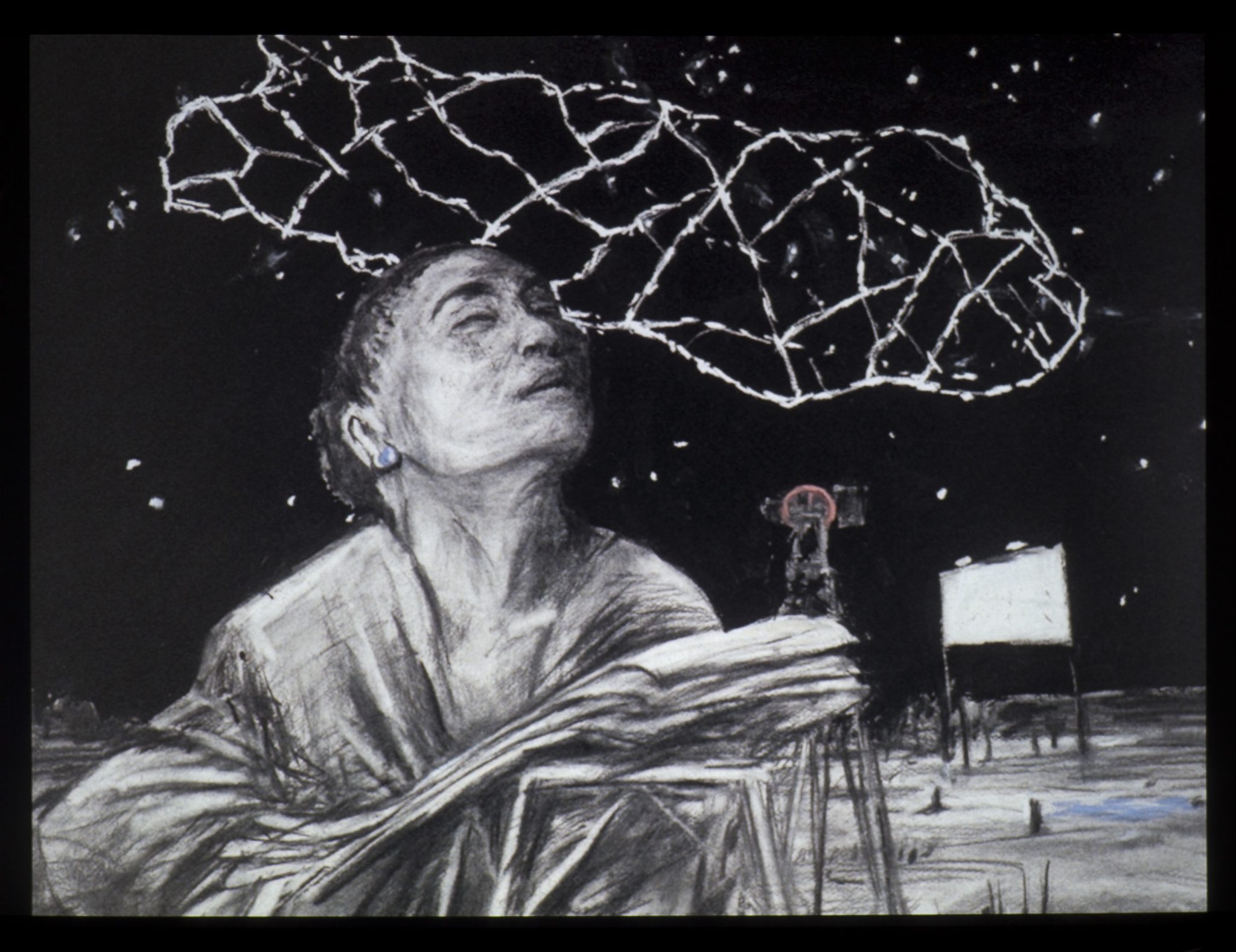
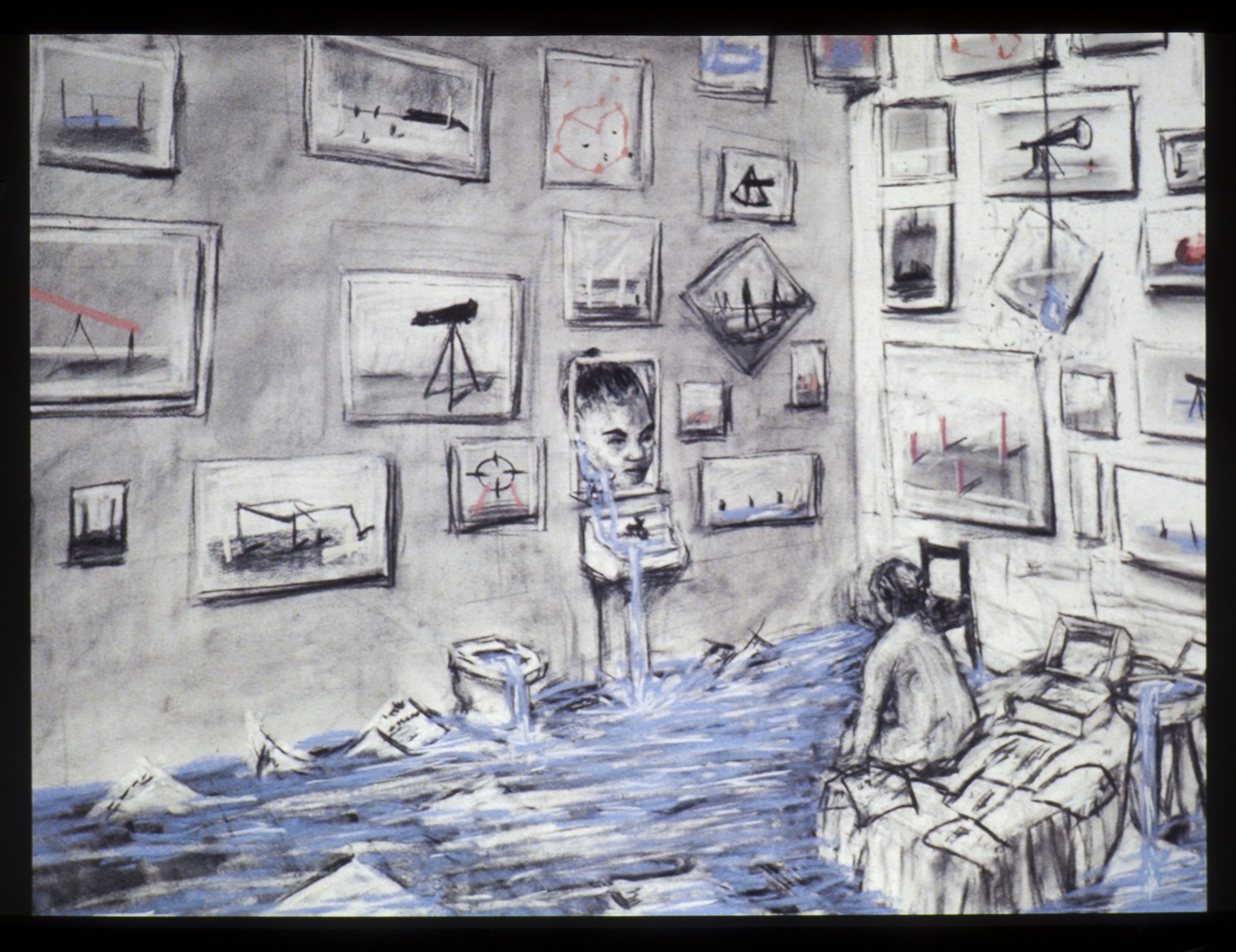
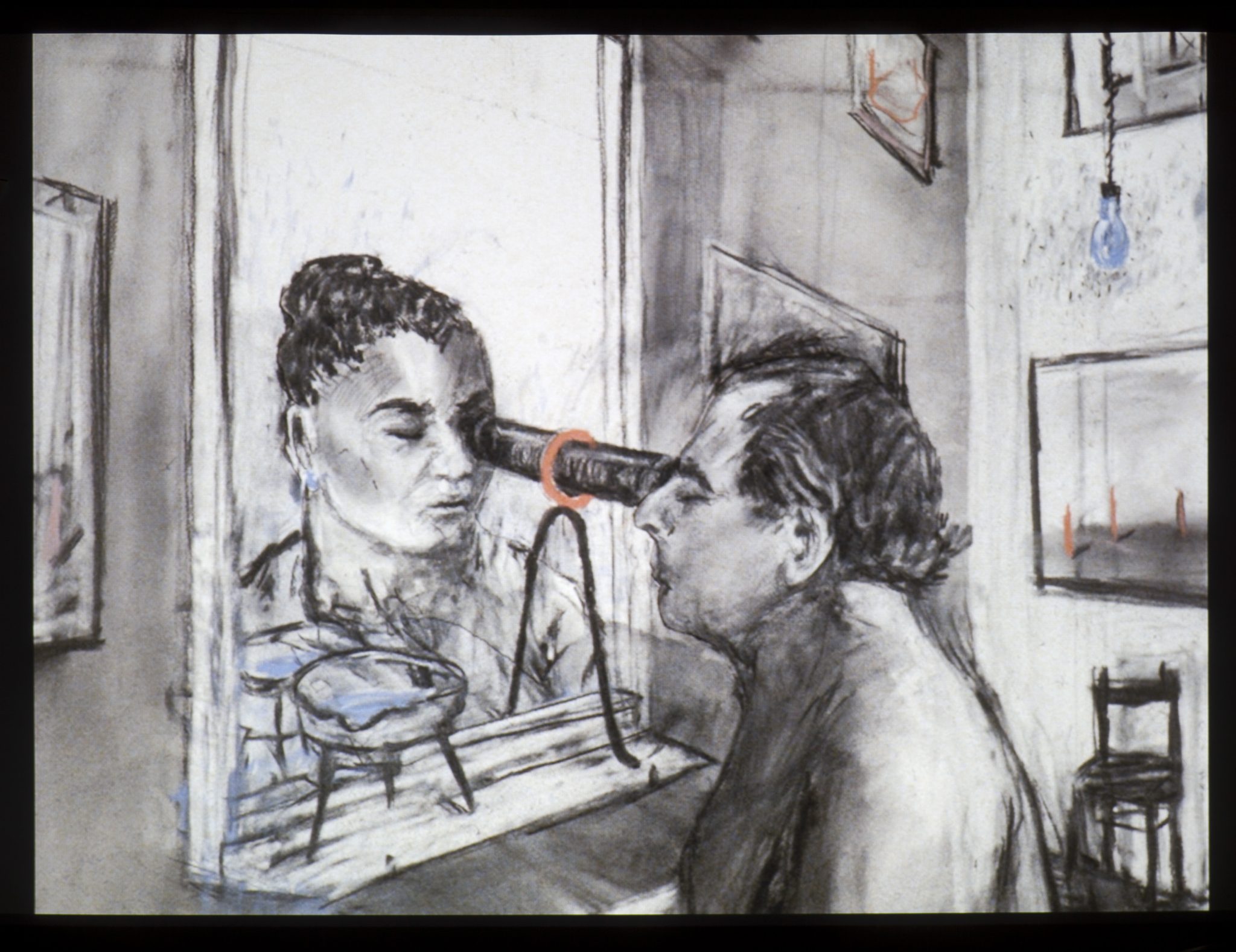
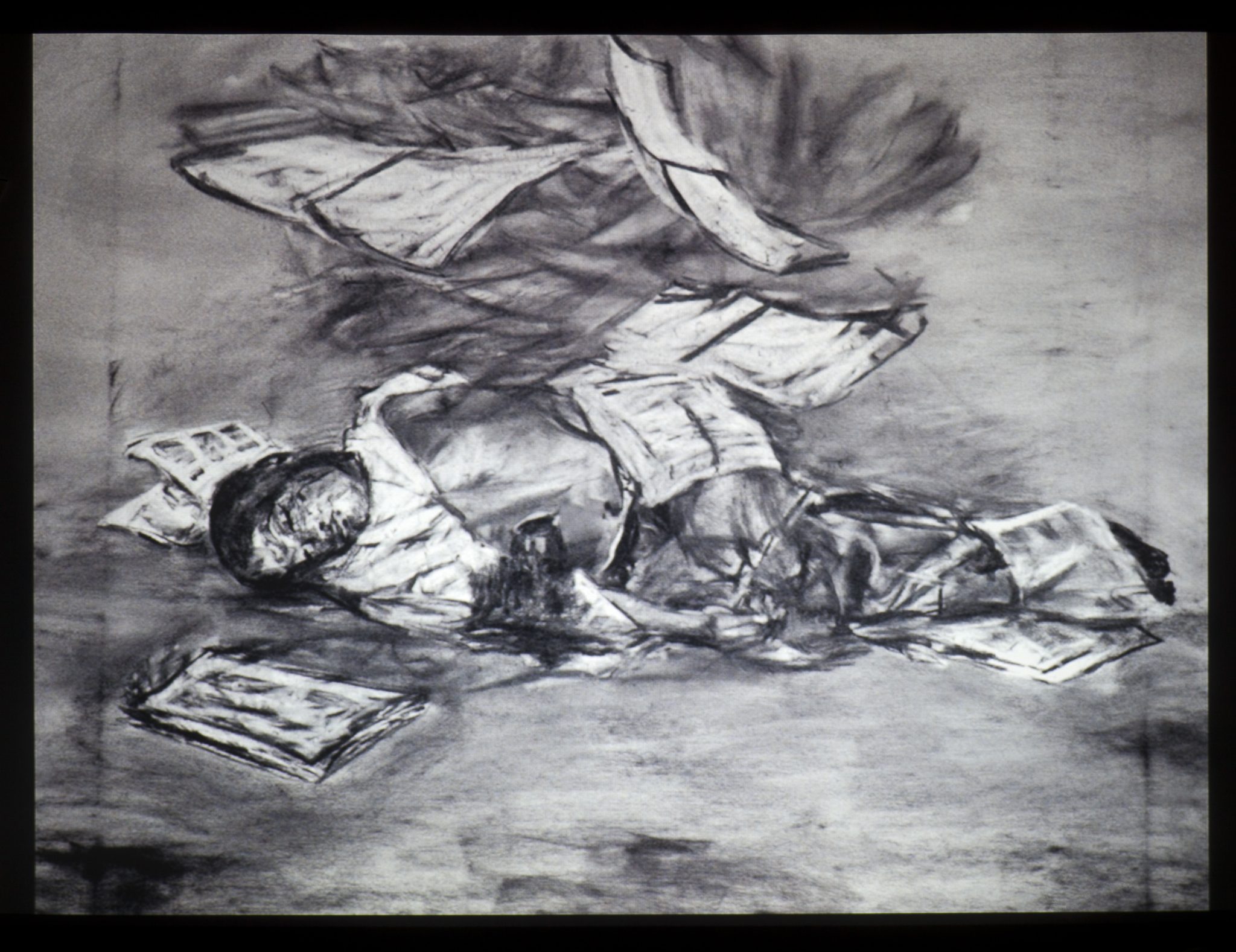
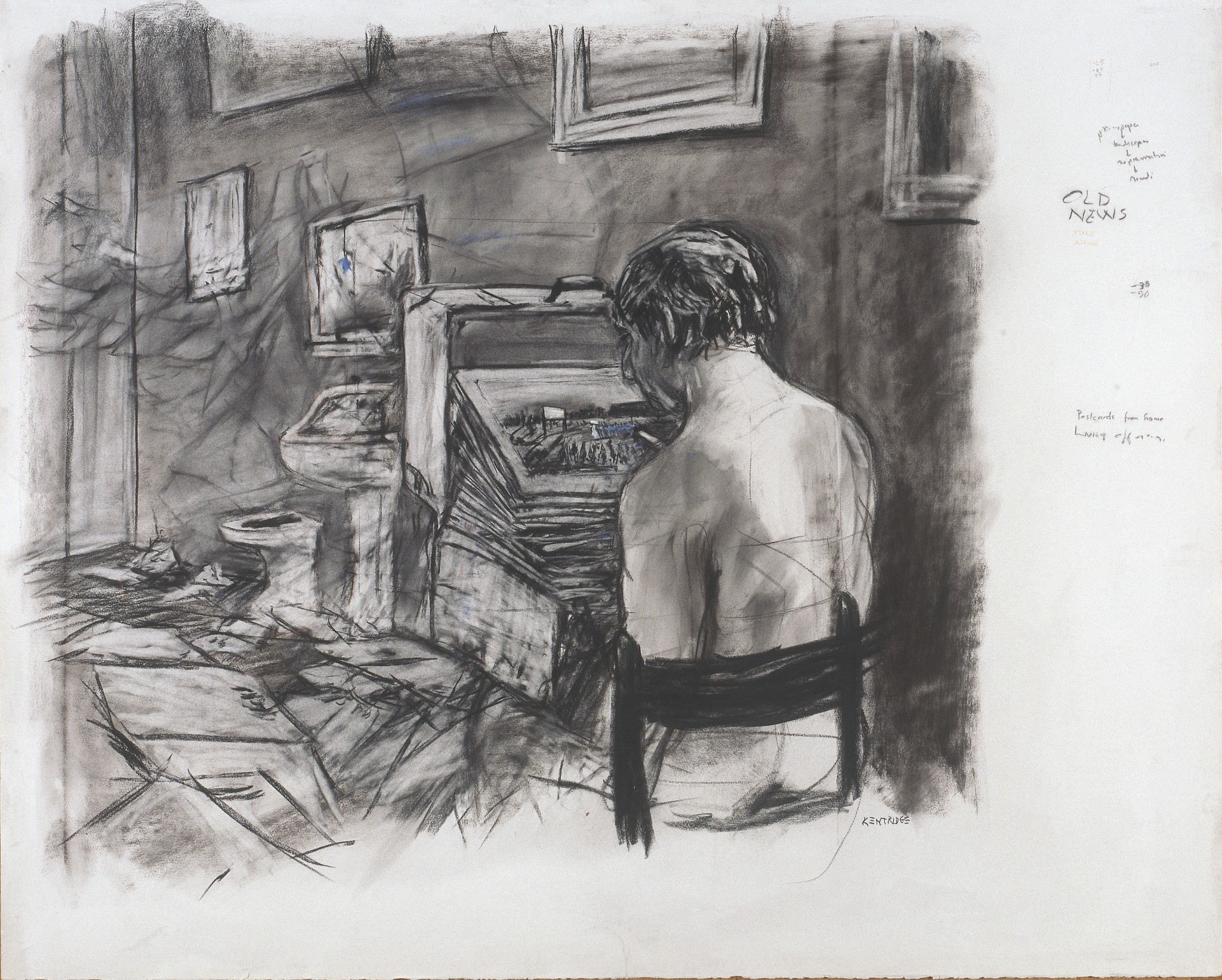
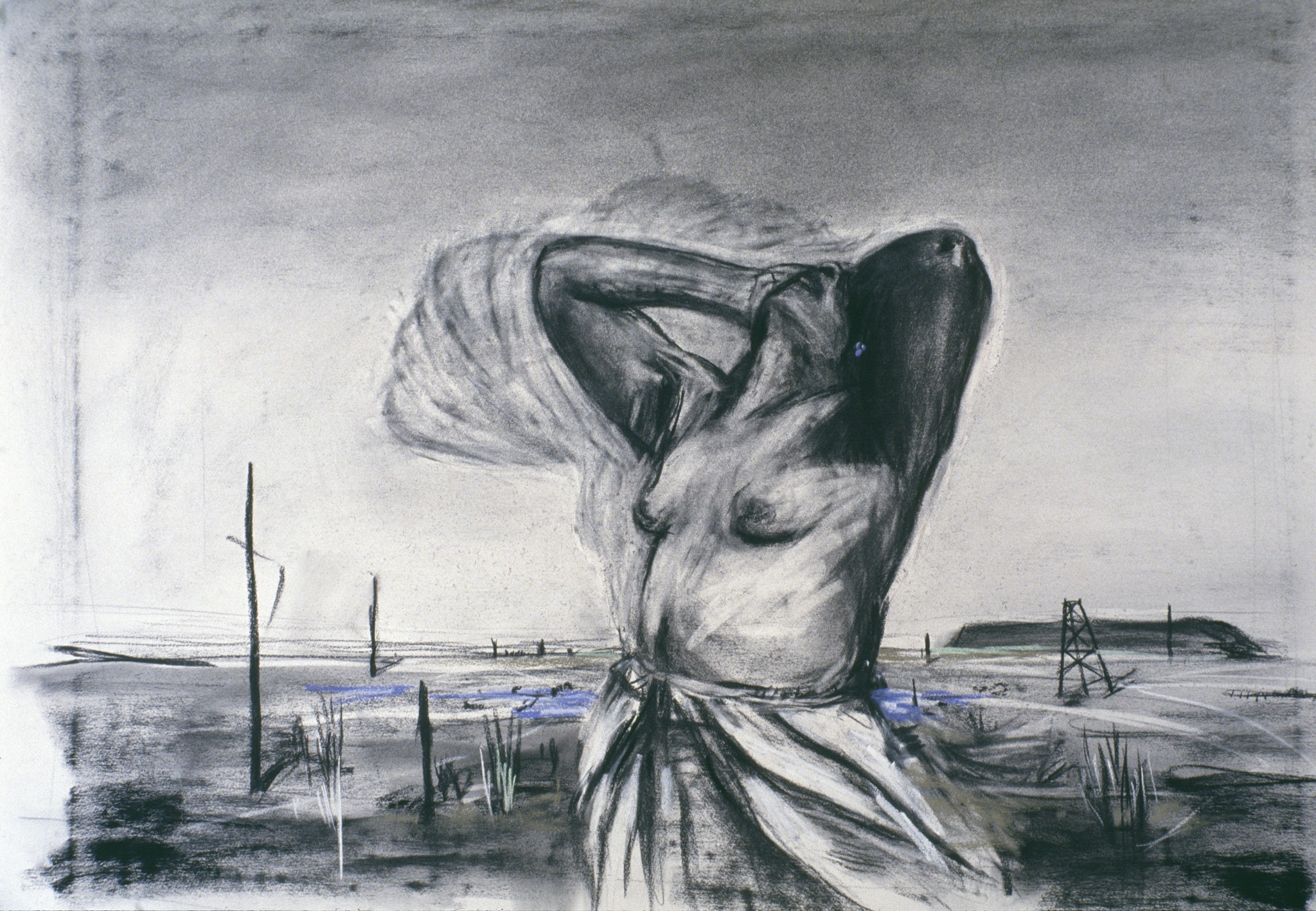
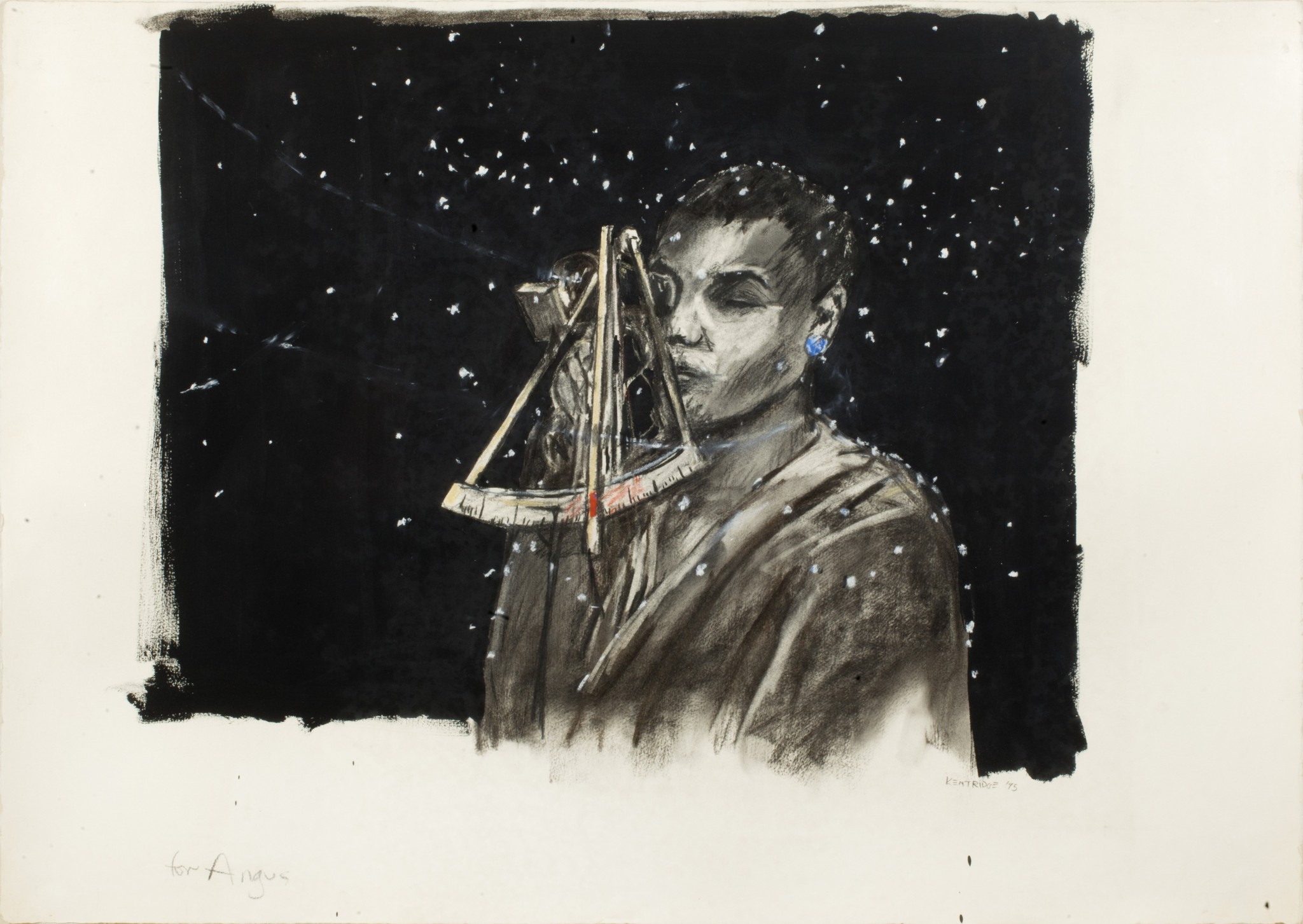
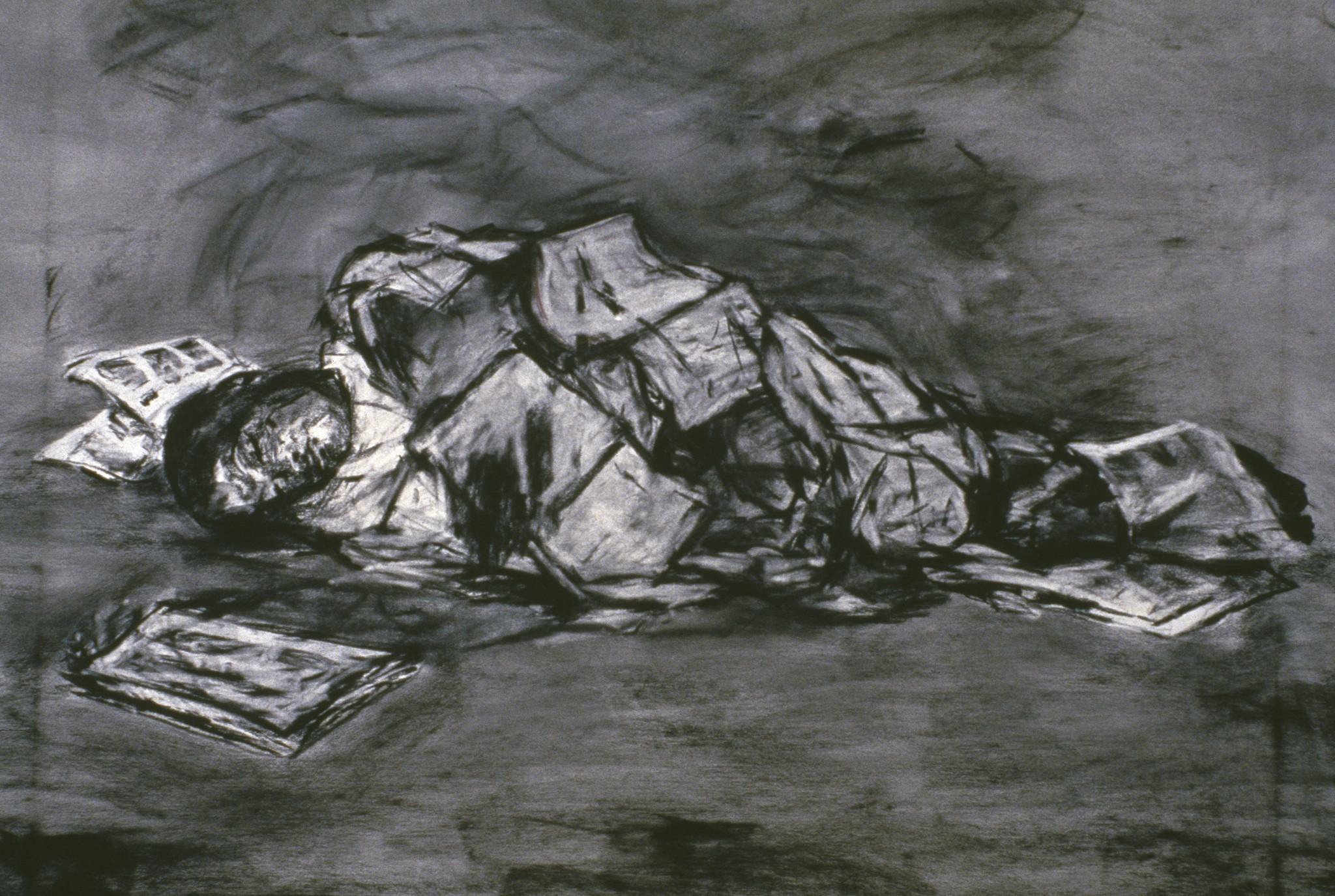
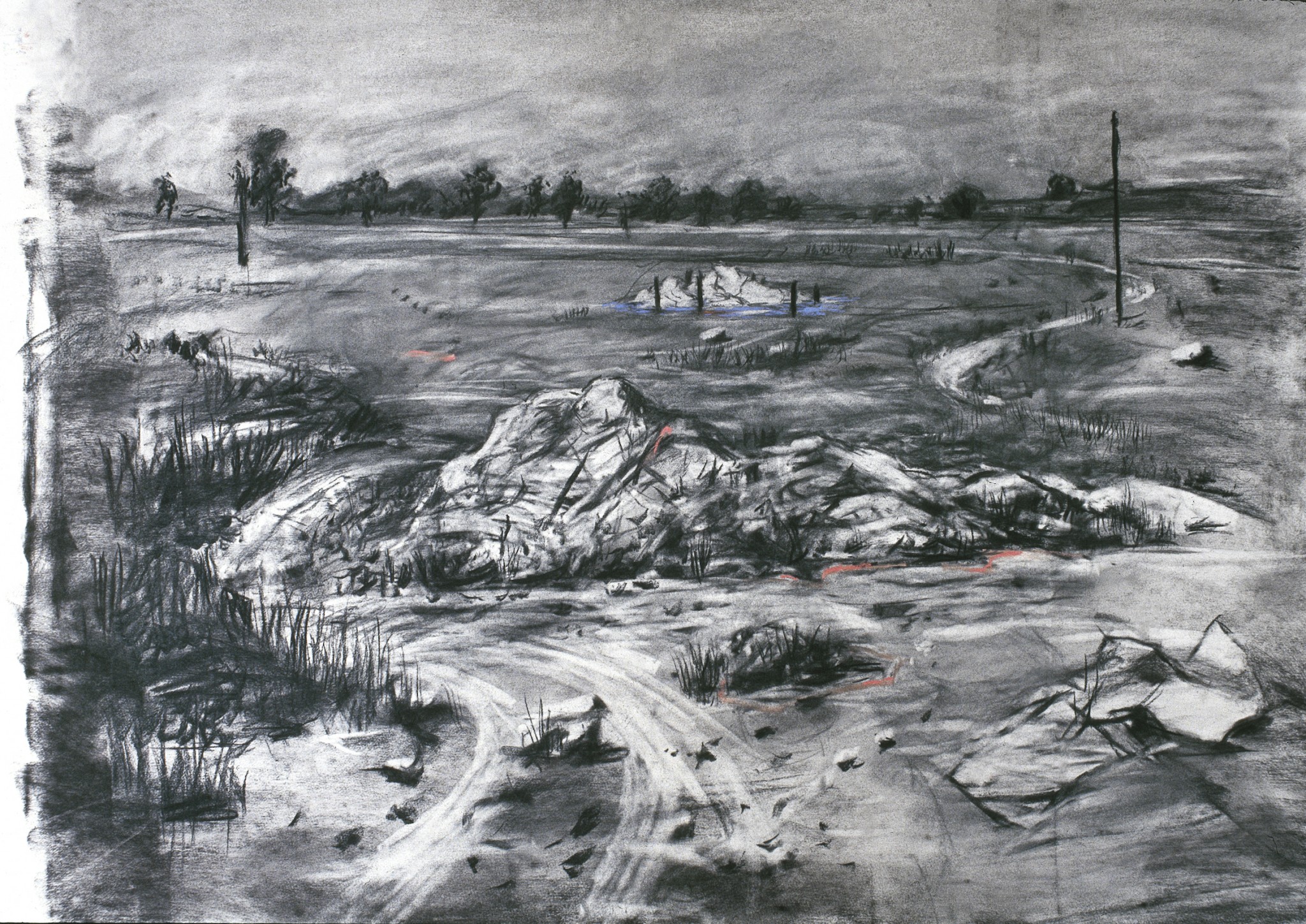
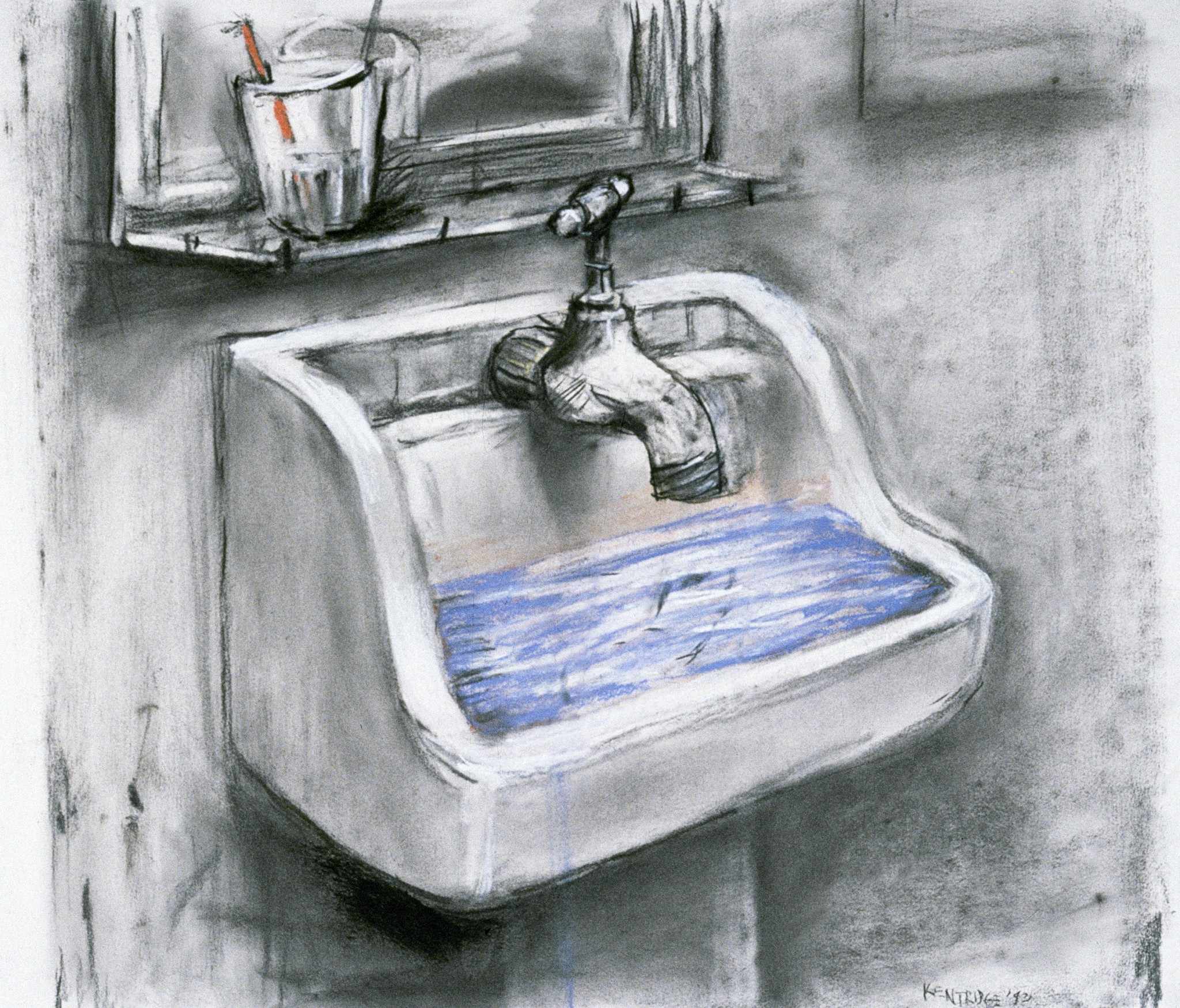
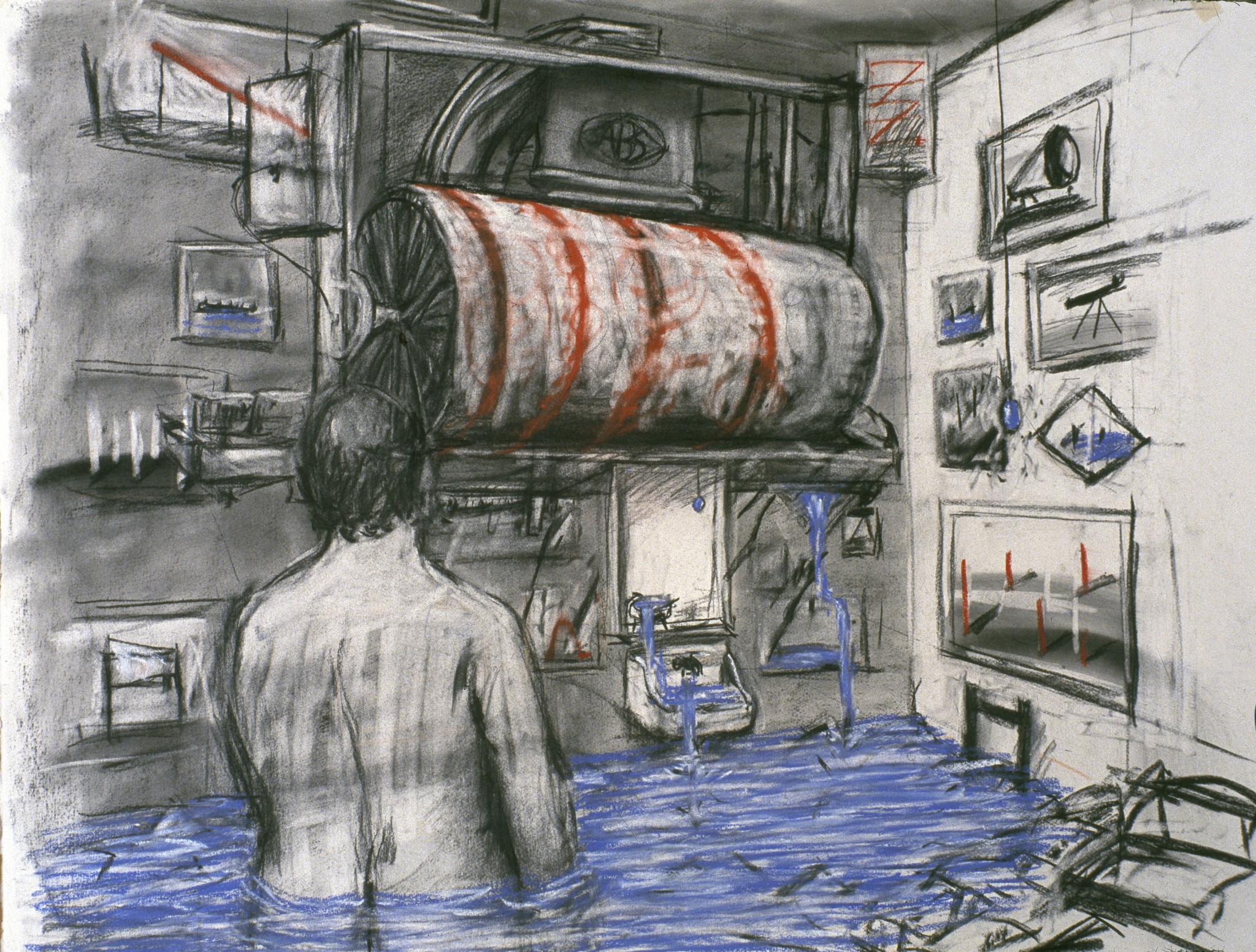
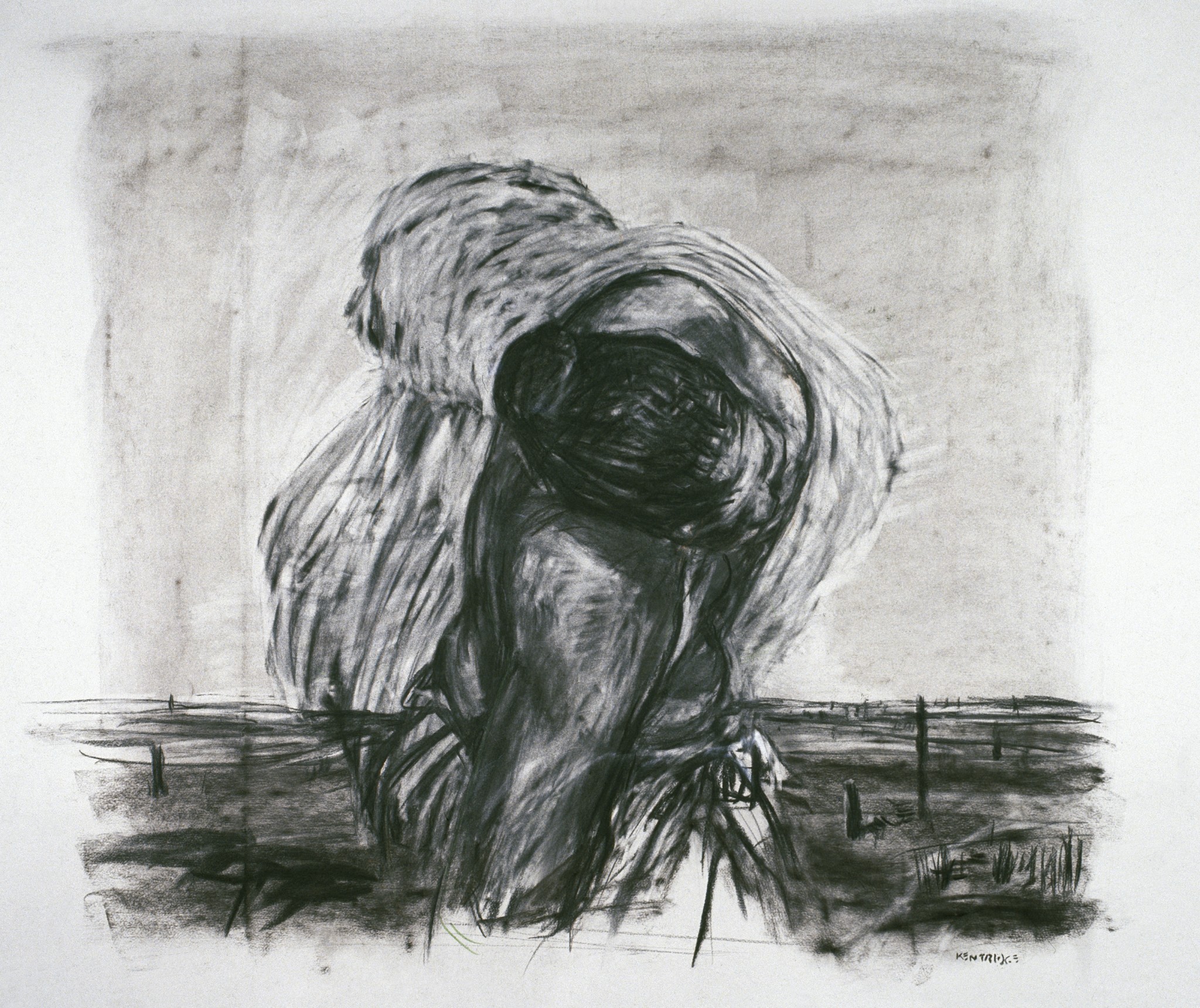
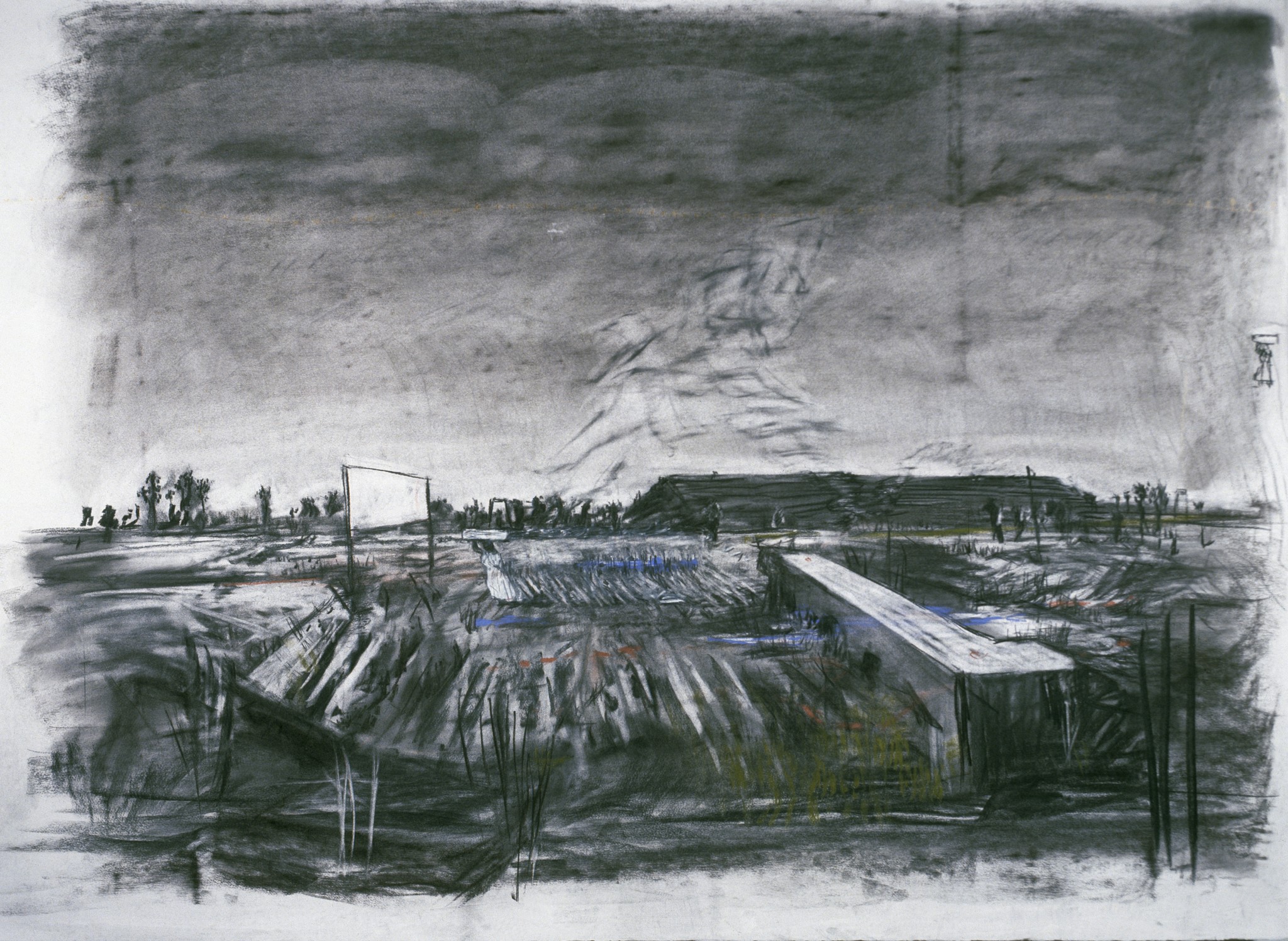
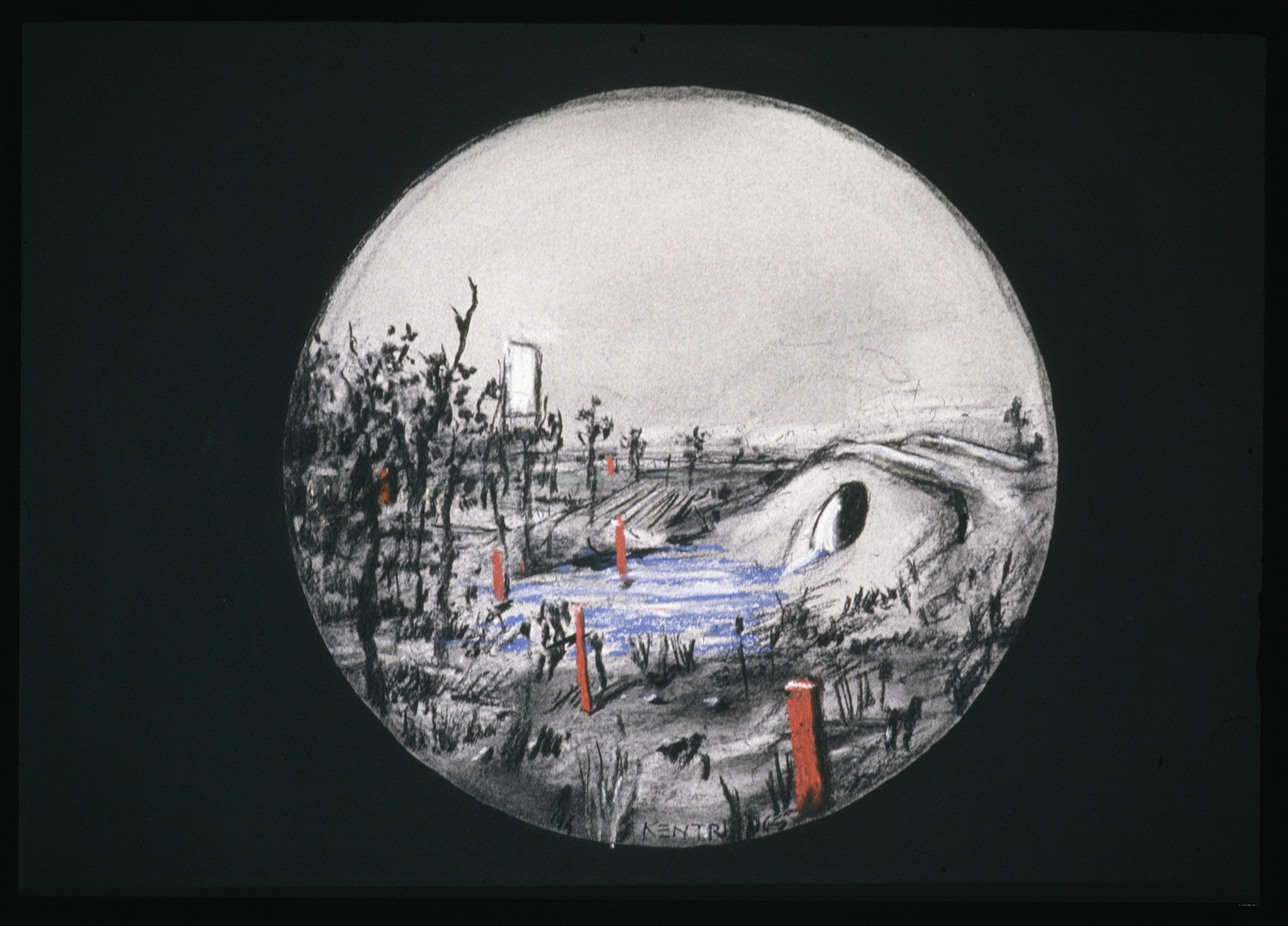
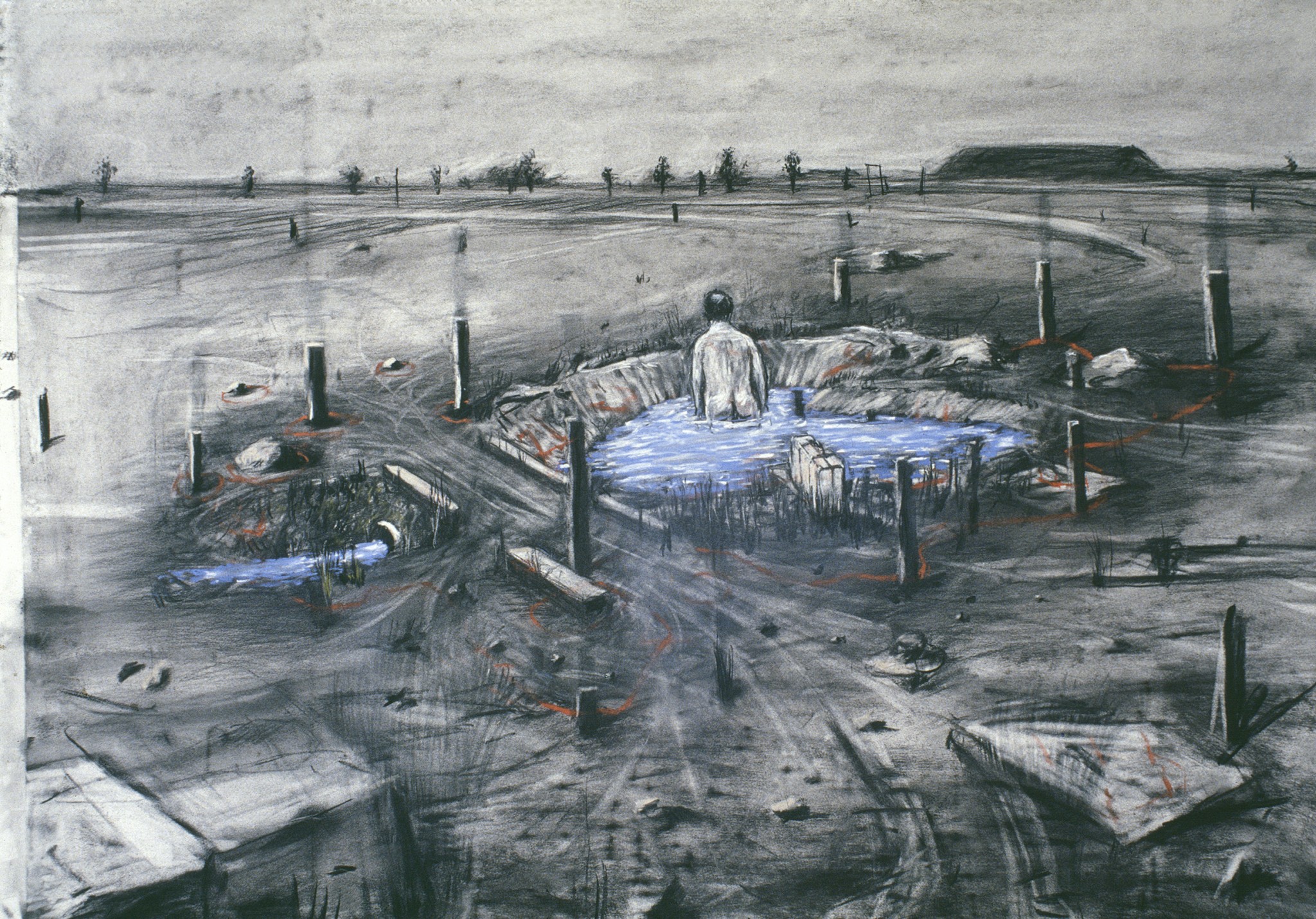
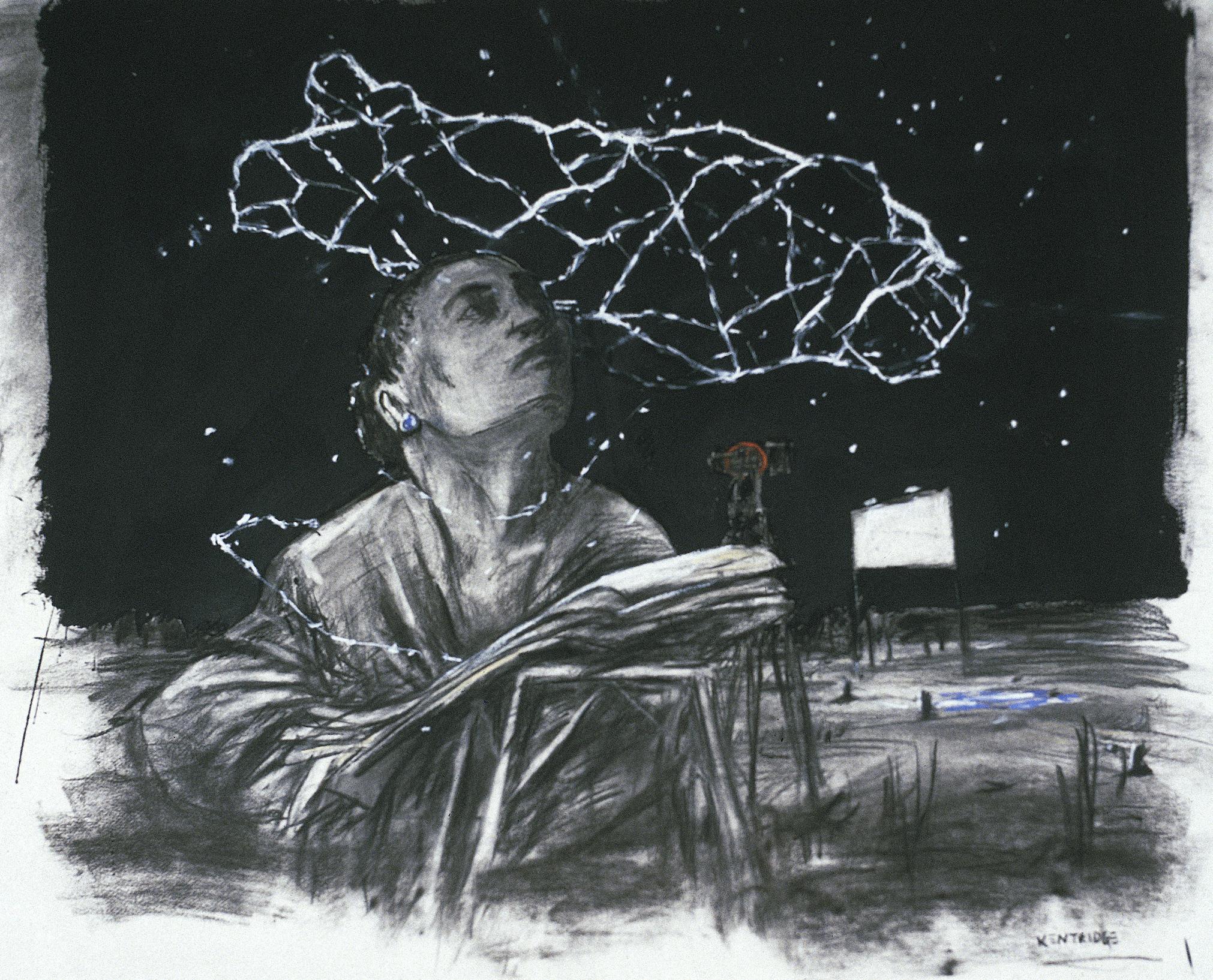
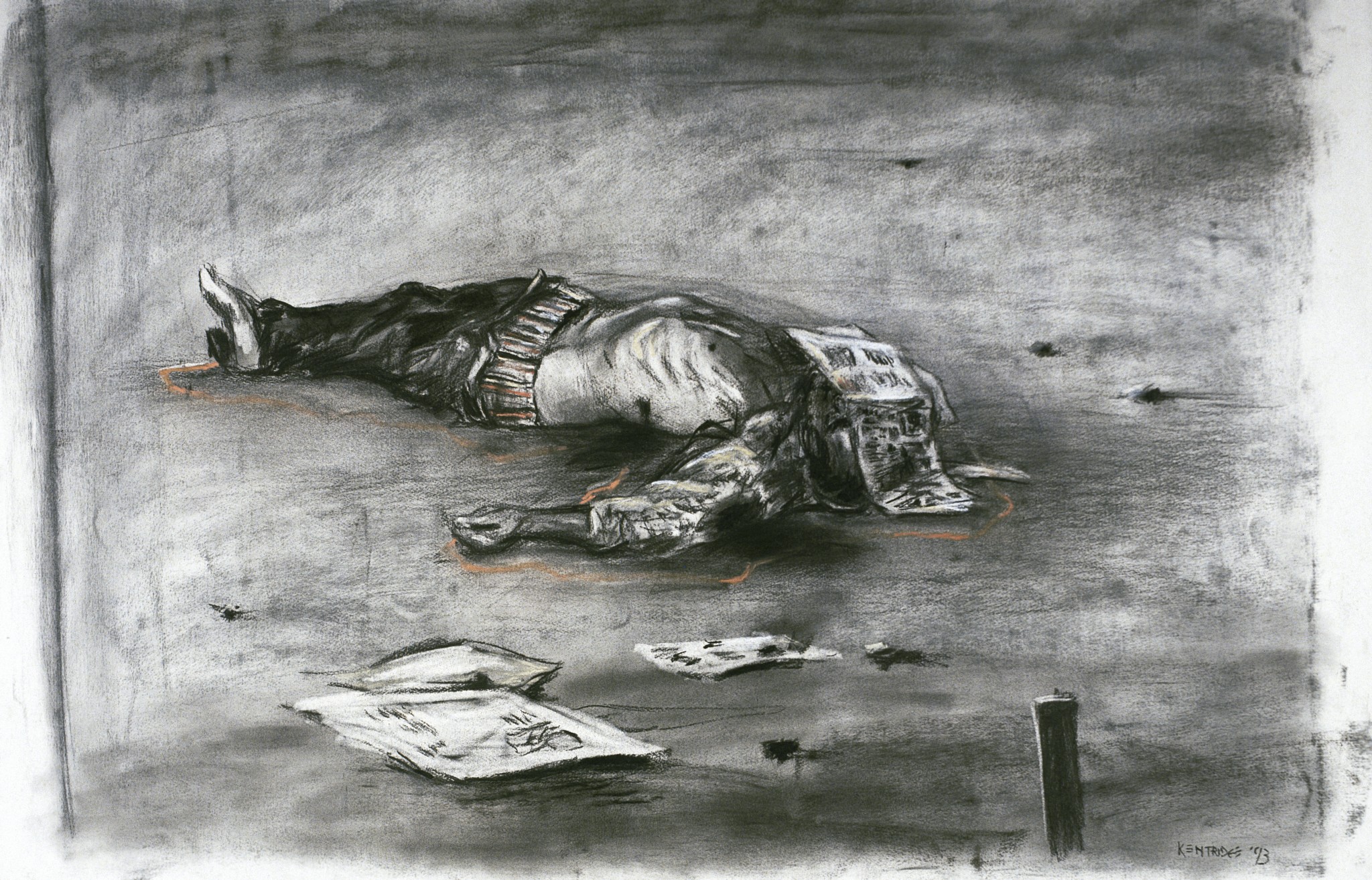
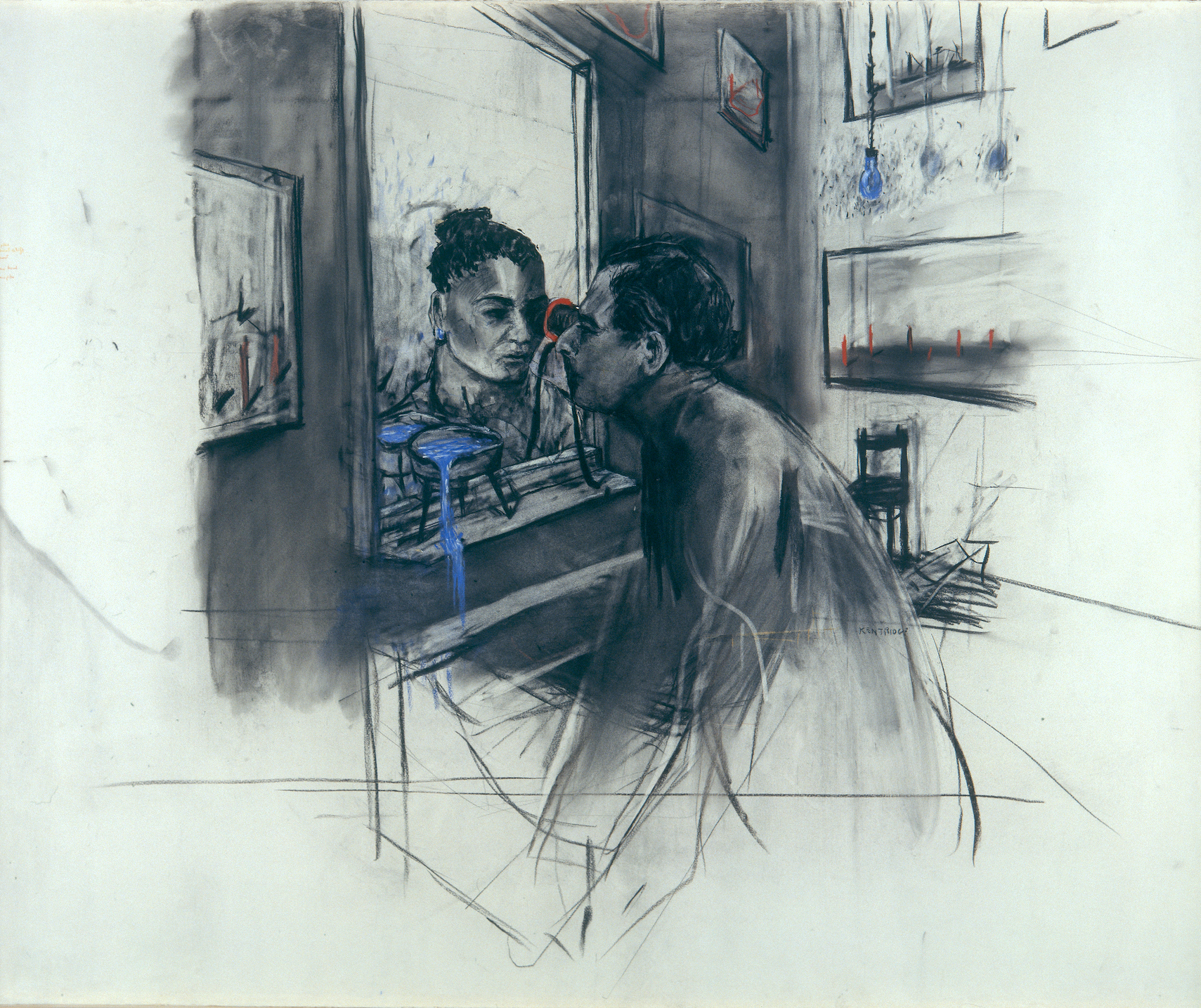
The films of Soho Eckstein and Felix Teitlebaum were all made with the principle of NO SCRIPT, NO STORYBOARD. The making of each film was the discovery of what each film was. A first image, phrase, or idea would justify itself in the unfolding of images, connections, and ideas spawned by the work as it progressed. The imperfect erasures of the successive stages of each drawing become a record of the progress of an idea and a record of the passage of time. The smudges of erasure thicken time in the film, but they also serve as a record of the days and months spent making the film—a record of thinking in slow motion.
Johannesburg, 2nd Greatest City After Paris
1989
16mm film transferred to video
8 minutes 2 seconds
Editing
Angus Gibson
Sound
Warwick Sony with music by Duke Ellington; choral music
Monument
1990
16mm film transferred to video
3 minutes 11 seconds
Editing
Angus Gibson
Sound
Catherine Meyburgh
Music
Edward Jordan
Mine
1991
16mm film transferred to video
5 minutes 50 seconds
Editing
Angus Gibson
Music
Dvorak’s Cello Concerto in B Minor, Opus 104
Sobriety, Obesity and Growing Old
1991
16mm film transferred to video
8 minutes 22 seconds
Editing
Angus Gibson
Music
Dvorak’s String Quartet in F, Opus 96; choral music of South Africa; M’appari aria from Friedrich von Flotow’s Martha, sung by Enrico Caruso
Felix in Exile
1994
Animated film
35mm film transferred to video
8 minutes 43 seconds
Editing
Angus Gibson
Sound
Wilbert Schübel
Music
Philip Miller, String Trio for Felix in Exile (musicians: Peta-Ann Holdcroft, Marjan Vonk-Stirling, Jan Pustejovsky); Go Tlapsha Didiba by Motsumi Makhene (sung by Sibongile Khumalo)
History of the Main Complaint
1996
35mm film transferred to video
5 minutes 50 seconds
Editing
Angus Gibson
Sound
Wilbert Schübel
Music
A madrigal by Monteverdi
Weighing… and Wanting
1998
35mm film transferred to video
6 minutes 20 seconds
Editing
Angus Gibson and Catherine Meyburgh
Sound
Wilbert Schübel
Music
Philip Miller (musicians: Peta-Ann Holdcroft, Marjan Vonk-Stirling, Ivo Ivanov)
Stereoscope
1999
35mm film transferred to video
8 minutes 22 seconds
Editing
Catherine Meyburgh
Music
Philip Miller (musicians: Peta-Ann Holdcroft, Marjan Vonk-Stirling, Ishmael Kambule, Minas Berberyan)
Sound
Wilbert Schübel
Making art is a uniquely human endeavour and an artist, the maker of art, is someone who distills what they feel and think about the world and expresses this visually. This requires one to read, to see, to listen, to feel, to question and be curious; to know, and yet to doubt; to have humility and to be brave.
William Kentridge does all this by creating ‘a safe space for uncertainty’, and his work instructs us in this.
All texts below are extracted from conversations and interviews with William Kentridge, or texts written by him.
History as collage is an important way of understanding the world. A single narrative always comes from a single viewpoint and there are always other viewpoints. I am sceptical of the certainties which come with a single narrative of history.
Excerpt from Six Drawing Lessons (Drawing Lesson 5: In Praise of Mistranslation), 2012
What is it that we do when we see?
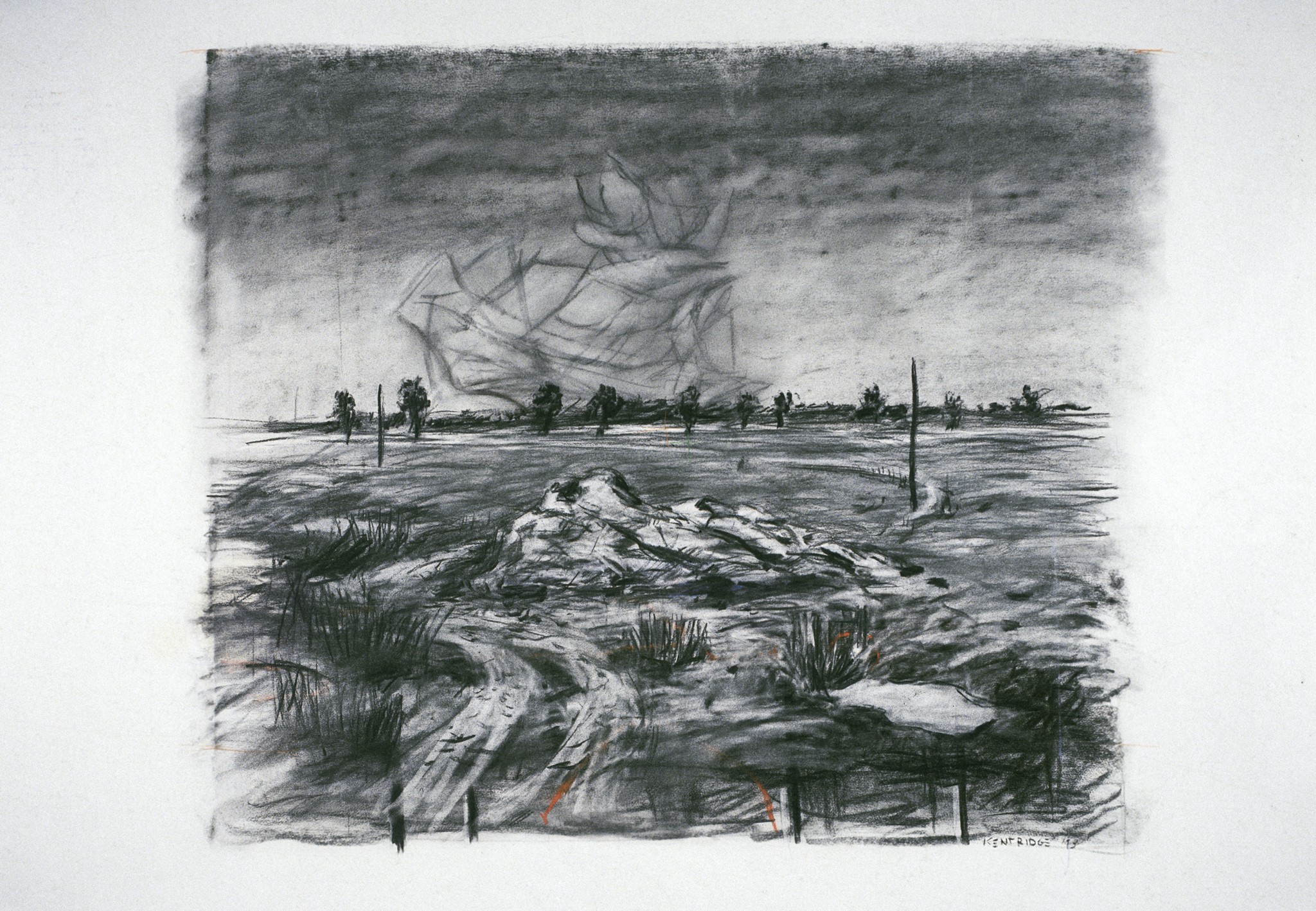
In Johannesburg, we have dry winters. In summer we have heat, and thunderstorms in the afternoons. Our sublime arrives in the form of huge cumulus nimbus clouds that pile themselves up over the city. With every day, when we have a storm, a new mountain range, a new Alps, is built for us again. In that way the mine dumps can exist, be erased, be rebuilt, so from a clear sky the cathedrals of clouds construct themselves. We see two things in the clouds. Shapes: a dog’s head, an old man’s face with protruding chin, the back of a head on a shoulder. This is not our ability to see things. It is not an act of generosity to see them. It is about not being able to stop ourselves from seeing the shapes. The man’s head comes to you. Once recognised, you cannot stop yourself from seeing it. This is one element of the clouds. The other is the changing itself, their shifting form, an awareness of the engine in the clouds. Lying on one’s back, looking at the clouds in the late afternoon, there is a seed of understanding that a child gets, of the nature of provisionality. Something is growing within, changing the outside form, becoming itself.
I’m interested in machines that make you aware of the process of seeing and aware of what you do when you construct the world by looking. This is interesting in itself, but more so as a broad-based metaphor for how we understand the world.
How much do we need to understand or know of the world, to understand? You have, for example, an assortment of torn paper shapes. They rearrange themselves in the form of a horse. Fragments leave the screen, reducing the horse until it is made up of four pieces of paper – a neck, a back, two legs.
Making a Horse, video fragment from studio work in progress, 2021
I film my eight year-old son. He takes a jar of paint, a handful of pencils, some books and papers. He throws the jar of paint over the wall, scatters the pencils, tears the papers and scatters the shards. We run the film in reverse – and there is utopian perfection. The papers construct themselves, perfectly, every time. He gathers them all. He catches twelve pencils, all arriving from different corners in the same moment. In the jar he catches all the paint, not a drop spilt. The wall is pristine. His joy at his own skill is overflowing. Can I do it again, he asks? Yes. But first we have to clean the studio, clean the paint off the wall, pick up the torn paper, gather the pencils.
Excerpt from performance of Refuse the Hour, Cape Town, South Africa, 2015
To live with a tree for fifty years is a sign of privilege and surplus. To not need the tree for either wood or fire is a luxury. When I was nine years old we planted two white stinkwoods in the garden. All my childhood I waited for the trees to grow, to be strong enough to to hold a hammock. They refused. Twenty years later I returned to live in the house with my family and the trees were mature. Fifteen years later, the trees were magnificent. And then one of them was struck by lightning and died. The shock, not just the hole in the shade canopy, the gap in the garden, but rather the shaking of the belief that a tree is a gift for future generations or – if not for future generations – then at least for other people… its lifespan should be so much longer. How could the tree die before me? No. If the tree could die, how vulnerable are we or am I?
Excerpt from Felix in Exile, 1994
An essential quality of an artist is to have an openness to devour the world.
Excerpt from Lexicon – Greek/Latin 37″. Ref: 26/08/2010 (Drawing Lesson 45), 2010
LIFE
Establishes second, larger studio at Arts on Main precinct in central Johannesburg, used mainly for larger sculptural work and performance workshops
WORK
Creates Carnets d’Egypte, two cycles of films titled Carnets d’Egypte (Salle 26), suite of ten films, and Carnets d’Egypte (les livres), suite of four films, both video, using drawing, animation, live acting by WK; premieres at Stuttgart Festival of Animated Film
Directs The Nose, opera by Dmitri Shostakovich, The Metropolitan Opera, New York; travels to Festival d’Aix-en-Provence and Opera de Lyon, revival at Metropolitan Opera in 2013
Creates Telegrams from the Nose, collaboration with Francois Sarhan (composer), performed by Francois Sarhan and the Ictus Ensemble, Happy New Festival, Kortrijk; travels to Holland Festival, Amsterdam, Musée du Louvre, Paris, and Centre Pompidou, Metz
Sounds from the Black Box, concert of music composed by Philip Miller for WK’s films, performed live by Ensemble Pi, Palazzo Reale, Milano; travels to World Financial Center Winter Garden, New York
Performs in Playing on Image, live concert with projected films and performances, with Philip Miller and Jill Richards, Arts on Main, Johannesburg
EXHIBITIONS
William Kentridge: Ambivalent Affinities (solo), Krannert Art Museum, University of Illinois
William Kentridge: Carnets d’Egypte (solo), Musée du Louvre, Paris
William Kentridge: Breathe, Dissolve, Return (solo), Marian Goodman Gallery, Paris
AWARDS
Honorary Doctorate of the Royal College of Art, Royal College of Art, London
Kyoto Prize for contributions in the field of Arts and Philosophy, Inamori Foundation, Kyoto
WORK
Makes Anti-Mercator, 35mm film and video using drawing, animation, live actors, video transfer, 9:45 min
Makes Other Faces, 35mm animated film, video transfer, 9:54 min, tenth animated film in series Drawings for Projection
Creates Refuse the Hour, collaboration with Philip Miller (composer), Dada Masilo (choreography and dance), Catherine Meyburgh (video construction and editing) and Peter Galison (dramaturge) theatre piece using projections, a dancer, actors, machines, live musicians and singers, 80:00 min, premieres at The Market Theatre, Johannesburg; travels to Quartier d’Éte festival, Paris, ImpulsTanz, Vienna, SchauspielHaus, Hamburg, Design Indaba, Cape Town, BAM, New York, Perth International Arts Festival, Foreign Affairs: International Performing Arts Festival, Berlin
EXHIBITIONS
View…
William Kentridge 1990s Chronology
1990 to 1999 1990WORK
Makes Monument, 16mm, video transfer, 3:11 min, second animated film in series Drawings for Projection
EXHIBITIONS
William Kentridge: Drawings and Graphics (solo), Cassirer Fine Art and Gallery on The Market, Johannesburg
William Kentridge: Drawings (solo), Gallery International, Cape Town
WORK
Makes Mine, 16mm, video transfer, 5:50 min, third animated film in series Drawings for Projection, which wins Weekly Mail Short Film Competition
Makes Sobriety, Obesity and Growing Old, 16mm, video transfer, 9:00 min, fourth animated film in series Drawings for Projection
EXHIBITIONS
Little Morals (group), with Deborah Bell and Robert Hodgins, Taking Liberties Gallery, Durban
Cape Town Triennial (group), South African National Gallery, Cape Town
AWARDS
Rembrandt Gold Medal, 1991 Cape Town Triennial
LIFE
- The Tapestries
Since 2001, William Kentridge has completed a series of seventeen tapestries, each in multiple copies or versions. They originate in the artist’s collages of black silhouettes cut and glued over reproductions, mostly from nineteenth-century geographical atlases. The weavers then use a photograph of the collage as the basis for turning the image into tapestry. The tapestry series is the result of a successful collaboration between the artist and Marguerite Stephens and her workshop. Her tapestry studio, established in 1963 in Swaziland, promotes the significance of tapestry through technical excellence, the use of the hand-carded and-spun mohair grown in South Africa, and a careful rendering of the drawings supplied by artists. Interpreting and adapting Kentridge’s compositions, Stephens and the members of her workshop have made it possible for a body of remarkable images to acquire a new status through an ancient practice.
Tapestry is one of the oldest forms of woven textiles and probably the procedure most suited to creating pictures by weaving.[1] Known since antiquity in Egypt (fig. 6), Asia, and Pre-Columbian America, the production of tapestries developed more or less independently in each of these areas. While their basic function has always been that of wall-covering, and while their textures have changed little through the ages, tapestries may present multifarious visual features―from abstract patterns and symbolic representations to eloquent narratives and colorful decorations―and may answer needs of a religious and spiritual nature or simply satisfy the demands of interior decoration.
Tapestry’s fortunes have fluctuated in the West. Surely, they formed an important part of the visual environment in urban antiquity. As the Greeks and the Romans invaded neighboring territories or were exposed to Eastern cultures, they started treasuring tapestries from Babylon, Egypt, Persia, and India, bringing an appreciation of the technique to the West. In modern Europe, the destiny of tapestry depended upon shifts in taste and changing perceptions of the roles played by the weaver and the artist-designer. For instance, medieval tapestry transformed the medium both by augmenting the narrative connotations of the pictures and by leaving weavers free to create their own images, usually adapted from illuminated manuscripts. The early sixteenth century saw a reversal of these priorities, as working sketches by artists became full-sized drawings, or cartoons, which the weavers had to copy with utter precision. This practice is epitomized by Raphael’s cartoons for The Acts of the Apostles (fig. 7), a group of tapestries intended to hang on the lower walls of the Sistine Chapel.[2] Never before had an artist taken such complete control over the creative process. Raphael’s cartoons gave the Flemish weavers of the workshop of Peter Coecke van Aelst―who in 1515 was commissioned by Leo X to execute the tapestries―detailed specifications as to shape, size, tone, and color of the final pictures. From then on, the artist’s role in tapestry design grew as the weavers’ creative input diminished. Working now with greater creative control, numerous artists prepared cartoons for tapestries: from Raphael’s contemporaries Giulio Romano, Pontormo, and Titian to Peter Paul Rubens and Pietro da Cortona, whose impressive History of Constantine of 1623–30 is now at the Philadelphia Museum of Art (fig. 8).[3] Later artists such as Nicolas Poussin, Charles Lebrun, Henri Matisse, Fernand Léger, Mario Sironi, and Alighiero Boetti (fig. 9) at some point in their careers made designs for tapestries. Notwithstanding a handful of influential advocates for the artistic merits of tapestry ―including William Morris, Jean Lurçat, and Le Corbusier[4]―tapestry today is classed mainly in the realm of craft rather than art unless it can be associated authoritatively with the artist who designed it.
The sharp divide between art and craft has deeply affected tapestry’s reputation in the West. Renaissance artists and writers initiated this rift, privileging works in painting and sculpture as the offspring of a liberal practice intermediating between the perceptions of the outside world and the visions of the artist’s imagination.[5] The divide was fully achieved, however, only in the eighteenth century with the foundation of the beaux-arts system.[6] Following this development, ancient views of tekhnê as an all-encompassing activity and of creativity as a generic human faculty dropped from discussions of artistic phenomena.[7] These two complementary views had still been influential during the Renaissance because of its emphasis on the universal bearing of disegno, or drawing.[8] But they lost credence as eighteenth-century artists and writers on art began to value almost exclusively the semiotic and aesthetic properties deemed intrinsic to each particular artistic form. The modern system of the arts saw to it that the products of a restricted set of practices such as painting, sculpture, poetry, music, and (often alternatively) architecture, dance, and garden design, be appreciated in terms of disinterested pleasure, specific demands of their mediums, and achievements internal to their historical developments. Because they were said to evince genius and inventiveness and to prompt judgments of taste and insights into specialized areas of competence, works in painting, sculpture, and other “elevated” mediums were set apart from products made by reiterated technical operations and for utilitarian purposes. This discrimination between art and craft, artist and artisan, helped to establish the autonomy of works of art. It placed them within a realm of illusion, deliberately aloof from the dynamics of the world and reality at large, by differentiating artistic experience from other experiences and by circumscribing the potentially unlimited manifestations of human creativity to a quantified number of artistic activities. These radical distinctions made tapestry’s “artistic” status uncertain. As the beaux-arts gained prestige, the taste for and market value of tapestry waned.[9] No longer a precious collectible, tapestry was valued no more than other household items. Its appeal, when felt, was due to its decorative appearance and versatility. Subsequent calls for a revaluation of tapestry, when they came, often attempted to align it with other supposedly major arts, primarily painting, and thus implicitly ratified the very principles of the modern system that had devalued tapestry in the first place, without esteeming human creativity over and above the material basis of its heterogeneous outlets.
William Kentridge’s tapestries partake to some extent in the complex history of tapestry, which I have only hinted at above. But they also depart from it, defying some of its recurrent assumptions. While endorsing the narrative bent of Western tapestries, they do not fulfill the expectations of décor, luxury, and status commonly linked with tapestry. Their subject matter compels one to think of human mobility in its extensive sense of global outgrowth and confrontation with otherness within and without oneself. It is a subject whose visual pregnancy cannot be appraised simply in terms of disinterested aesthetic pleasure, which, since the nineteenth century, has often been invoked to rescue tapestry from its declassed status as craft.[10] Nor would it be sound to ascribe to Kentridge’s tapestries the ambition to secure a place for tapestry in the beaux-arts system. Like his other works, Kentridge’s tapestries demonstrate a capacity not only for blurring the gap between craft and art, but also for subverting the pretence of placing artistic phenomena within fixed categories.
In suggestive ways, Kentridge’s tapestries revive and address issues germane to his other work to date.[11] They conjure a scenario of human movement and proximity on a planetary scale; reclaim the cinematic core of Kentridge’s images; question the ambivalence of “shadows” in Western theories of knowledge; and posit the activity of drawing as a potentially unlimited experience. Arguably, here as in other of his works, Kentridge’s imagery unfolds through unceasing mediations (formal, cultural, historical, etc.) and yet does not presuppose or confide in any strict identification between a work of art and its physical and semiotic outlook. Rather it points to the flexibility of human creativity and calls for a renewed grasp of its unconditional nature.
- Images of People on the Move
Kentridge’s tapestries tell of a world of people on the move. The foregrounds show one or two black silhouettes against overall reproductions of maps representing various parts of the planet. I will discuss the silhouettes’ shadowy character below, but here I wish to deal with their immediate thematic implications. The black silhouettes or shadows are reminiscent of sequences of multiple figures in procession found in Kentridge’s videos, artist’s books, and sculptures as early as Art/Procession Study (1989) and Art Procession: Develop, Catch Up, Even Surpass (1990), and thereafter in Shadow Procession (fig. 10), Portage (fig. 11; plate 2), and Procession (2000). Though figures appear in the tapestries only one or two at a time, they are nevertheless caught in what seems like a procession. Their positions and postures suggest a momentary halt within motion. Except for Office Love (plate 17), the tapestries share the informal title Porter Series, with changing subtitles. The porter is a favorite motif with Kentridge. The job of a porter–somebody carrying a load on his or her back or head–exemplifies labor in its basic demand for physical energy. Key to the associations evoked by the tapestry series are the maps in the background. Depicting Spain, the Atlantic, Asia, the Arctic, and other places, the maps date to the first half of the nineteenth century, a period that witnessed a significant increase in human mobility and migration, which to varying degrees has characterized the planet since hominization.[12] The maps hint that the silhouettes and territories may be somewhat related. This pairing sets the narrative tone of the woven pictures by evoking situations of routing and resting, encounters and seclusion, solidarity and exploitation. In short, the Porter Series both entails and inspires a meditation on the ineluctable flux of human transits, industry, and contacts.
What can one say, however, about these porters moving across the earth? As depicted in the tapestries, their race, gender, and citizenship are ambiguous. They may be female or male, of African, European, or Asian ancestry. In one tapestry, Noah, the map’s inscription reads: “Geographie des Hebreaux” (plate 27). Diaspora, the name for the Jewish condition of dispersal enshrined in Deuteronomy 28:25, seems to apply to them all. No longer pertaining to a single people, diaspora has become a way of life for all individuals and groups who migrate across geocultural borders. The Porter Series allows one to imagine that, in their migration, the porters may cover long or short distances in a trail of arrivals and departures that began long before their time. Thus perceived, the Porter Series is a reminder that―whether mass or small-scale; willed or forced (and often it has been the latter); wheter propelled by open-mindedness and longing for unknown lands or compelled by famine, discrimination, and hope for a better life―migration is a decisive feature of modernity. In the three centuries after Columbus’s voyage in 1492, some two million Europeans crossed the Atlantic to settle in the Americas, while nearly eight million Africans were brought there, most of them in slavery.[13] Migration has affected modernity in its concomitant dramas of colonization and decolonization and has driven the globalization of the twentieth century.
Both experientially and conceptually, migration challenges the belief in progress that is one of the foundations of the nation-state—a culturally homogeneous society occupying a distinct territory, governed by a unitary lawful structure. Created in part as a deterrent to the distressing effects of migration, the notion of the nation-state gained full currency in Euro-American societies in the nineteenth century, when the maps reproduced in the Porter Series were compiled. Despite these geopolitical interdictions, the protagonists of Kentridge’s tapestries undertake transnational moves by walking (defiantly? dangerously?) across the frontiers marked by the maps. Their cinematic postures upset static configurations of the world while infringing spatiotemporal barriers.[14] The random graphemes inscribed on the black silhouettes signal points of tension caused by forces presumably sprung from the transient entanglement of bodies and territories. Moreover, the fact that the porters carry an assortment of objects (a bed, chairs, a telephone, a megaphone, a gigantic compass) and that one of them is metamorphosing into a tree indicates that their physical exertion does not preclude their mental and emotional engagement. Indeed, the telephone and megaphone are anachronistic; their inclusion not only contradicts the historical dates of the maps, but also insinuates that the porters may be heralds of futures yet unseen, or perhaps agents of other experiential times undetectable within the totalizing scheme of humankind’s chronological progress. The idea of progress implied by the maps has been put to harsh use by modern countries imposing models of Western development upon people supposedly without history. Thus the anachronisms in Kentridge’s images testify against uniform conceptions of progress. They hint, implicitly, that the changing of patterns of life on earth—results of a contest between monopolistic power and human freedom—manifest themselves as much in changing uses of space and territory as in perceptions of time and history.
Yet the Porter Series keeps the porters’ identity complicated. It is hard to discover what exactly motivates the porters in their motion. It could be a vexing search for a means of survival as much as a restless exploration of new horizons. The black silhouettes might stand for settlers, nomads, slaves, refugees, or invaders. On the one hand, they can be seen as stateless outcasts, people who find themselves excluded from the privileges of citizenship and reduced to a “bare life” in subsisting in a zone alienated from subjective rights and juridical protection.[15] Following this line of reasoning, the porters bring to mind the condition of subalternity endured by workers and colonized subjects oppressed by hegemonic powers in many countries and at many periods in history. On the other hand, the porters’ movements may also answer a positive need to make one’s voice heard (with a megaphone?) or to chart (with the compass?) global spaces where habitual perceptions about centers and peripheries would be superseded by the recognition that people’s closeness to and distance from environments are always being negotiated. The porters, that is, announce that there are no permanent zones of indistinction, that the relationships between sovereignty and territoriality can be reconfigured.[16]
But the multiple meanings of the porters’ identity is probably essential to what the Porter Series seeks to envision. Migration is qualified by instability, by the traumas, mutations, and epiphanies occurring through territorialization and deterritorialization. Transits affect both bodies and minds. Human beings enter into what contemporary anthropologists call “contact zones”― areas where individuals, hitherto geographically and historically separated, clash and interact within uneven relations of power.[17] The Porter Series alludes to the tremors of these contact zones. It visualizes what has become apparent in our new global cultural economy: that increasing diasporas of people cause hybridization among subjectivities, cultures, and languages; grant relations that both recognize and safeguard the opaqueness of others; stimulate rhizomic aggregations that reshape the earth and its inhabitants, whose feelings of community are now attached to imagined worlds and “ethnoscapes.”[18] Finally, frustrating interpretations of the porters’ identities as specimens of “otherness,”[19] the Porter Series may suggest that the black silhouettes resist detection because they represent individuals whose lives run parallel to those of the dominant social classes and yet remain impervious to their codes. Precisely by being imponderable, the porters epitomize what is today perceived as an emerging collective intelligence, which needs no head to lead its political body since it is itself the enlightened, immaterial heart of the global system of production. Through its perpetual exodus, the collective of the porters therefore manages to defy and subtract itself from the forced recruitment of all the psychophysical energies of individuals to the cause of capitalism in its post-Fordist and multinational phase.[20]
The interplay between background and foreground―the porters’ opacity and the maps’ decipherability―kindles the narrative purport of the woven images without prescribing a univocal direction of sense. In doing so, it aptly thematizes the unknown elements inherent to transiting and becoming. We begin to fathom, then, one of the reasons why the porters must be “shadows.” Shadows entertain a difficult relationship with reality and yet have played a significant role in human experience since antiquity. As shadows cast over the world, the images of the porters intensify the sensitivity to oneself as ”other” and to another as oneself―a sensitivity that modernity has prepared us for and that now, in our globalized world, is a daily routine for the masses of cosmopolite workers who are increasingly exposed to new encounters and intersections with strangers. But the shadow nature of the porters also elicits an exploration of the potential alliances encircling visible and invisible domains, seeing and knowing, thoughts and imagination. Hence the Porter Series inaugurates another course of associations, which verge upon the metaphysical dilemma of distinguishing the true from the illusory world―a dilemma that shadowgraphy both exploits and frustrates.
- Shadowgraphy and the Overcoming of Platonism
Shadowgraphy, or the making of images by throwing shadows, ranges from the simple trick of conjuring a rabbit’s shadow with one’s hands to the sophisticated devices used in theater, painting, viewing machines, photography, and cinema. Humans seem to have an enduring fascination with shadows. In ancient and modern cultures alike, they have been regarded as double, virtual bodies or as reflections of the soul, and they have been studied in both science and art for what they can tell us about perception.[21]
Shadows, moreover, are central to two mythical accounts of origins. The first is the famous philosophical parable found in Plato’s Republic (7.514–515), in which the human condition is likened to that of prisoners trapped in a cave, who, seeing only the wall opposite the entrance, deem as real the shadows cast on the wall by figures and objects placed behind them and illuminated by a fire. Only when the prisoners are let loose and turn around can they start ascending from error to the lights of true knowledge. The second account concerns the origin of portraiture as narrated by Pliny the Elder (Natural History 35.43). He reports that Butades, a potter of Sicyon, invented clay portraiture because his daughter, in love with a young man who was going abroad, drew in outline on a wall the shadow of his face thrown by a lamp. Butades pressed clay on the outline and made a relief, which he hardened by exposure to fire, thus creating a lasting semblance of the youth. Both of these stories ascribe great power to shadows. Pliny, who had previously noted that the art of painting also was said to have begun with tracing someone’s shadow (Natural History 35.15), positively associates shadows with artistic representation, as well as the with an image’s peculiar ability to compensate for absence, if not death, by preserving someone’s effigy. For Plato, by contrast, shadows share with mirrors and pictures the deceptive power of a mere apparition or eidolon. They induce humans to trust the illusory data of the senses and to ignore the transcendental truth of ideas. Though for opposite reasons, both stories interestingly link shadows and images not only to each other, but also to the dynamics of becoming aware, whether that awareness is aroused by the creation/contemplation of a likeness or by the discovery of the intelligible order of reality. In Pliny’s text, awareness implies trusting images, or shadows, because they capture identity and difference by keeping present persons or things that are absent. In Plato’s parable, awareness means translating from appearance to reality so that mystifying differences and sense perceptions are redeemed by the cognition of trustworthy, immaterial identities.
In the Porter Series, Kentridge likewise endeavors to strike paths to awareness. His use of shadowgraphy generates images of otherness: effigies of porters whose identity remains indeterminate. As in Plato’s allegory, the tapestries exhibit shadows of figures and objects presumably located behind the onlooker and the artist himself. As in Pliny’s anecdote, the outlines impressed upon the woven pictures keep a visual memory of the departing porters.
At times, images of cast shadows alone assume a preeminent role in works of art. Writing to Émile Bernard in 1888, Paul Gauguin praised the calculated “strangeness” achievable in painting “if instead of a figure you put the shadow only of a person.”[22] Gauguin’s prescription, which could be applied to modern paintings ranging from Jean-Leon Gérôme’s Golgotha of 1867 (fig. 12) to works by Giorgio de Chirico (fig. 13), Marcel Duchamp, and Pablo Picasso (figs. 14), reflects contemporary vogues with shadow and silhouette in Japanese prints, théâtre d’ombres, and pantomime. It proposes that contoured shapes should replace chiaroscuro and that a painting of shadow better demonstrates the artist’s delving into hidden realms. This interest in shadows coincided with developments in photography[23] and protocinematic practices, particularly phantasmagoria. The latter, an entertainment popular after the French Revolution, consisted of a modified magic lantern projecting images of skeletons, demons, and ghosts onto walls or screens. Phantasmagoria made the moving image a vehicle for intimate exploration beyond physical space into something multidimensional: the phantasmal imagery of the mind itself, with its rather unaccountable mechanisms of perception and imagination.[24] Kentridge’s Porter Series revives this nineteenth-century interest in manifold states of consciousness by accentuating the phantasmal aspects of shadows and conveying a cinematic effect of spatiotemporal flow. However, the calculated strangeness of depicting cast shadows in itself fosters both disorientation and catharsis. Staging a shadow’s revenge against Plato’s verdict, the Porter Series stipulates that becoming aware is a process of coevolutionary coupling in which imagination and intellect, cogitation and emotion, do not split but rather cooperate as soon as one dispenses with assumptions about truth and illusion.
Explaining why he uses shadows in his works, Kentridge refers to Plato’s parable of the cave and proposes a reverse journey: a descent from the brightness of the sun to the darkness of the cave. For Kentridge, Plato’s parable not only anticipates cinema’s mode of projection—the prisoners’ condition being analogous to that of spectators in a movie theater—but it also affords insights into shadows themselves. To return to the cave is to yield to shadows’ faculty for engendering awareness. Insofar as seeing “is always a mediation between this image and other knowledge,” shadows “make the mediation conscious.”[25] When human hands ingeniously evoke a shadow of something against a lit wall, we realize that the outcome is both a shadow of two hands with crossed thumbs and a shadow of an imagined rabbit or bird. We fluctuate between the realms of optics and physics and those opened up by a mindful attentiveness to the event. For Kentridge, coping with this dyad of responses, recognizing the pleasure of self-deception, is “fundamental in what it is to be a visual being.” Platonic opinion contends that the truth is limited to the crossed thumbs, but for Kentridge the fluctuation between antagonistic realms experienced by the viewer of a shadow is just as illuminating. This fluctuation heightens the sense of mediation congenital to art itself, which renders us “conscious of the precept of ‘Always be mediating.’”[26] And the precept is unrestricted. Kentridge continues, “All calls to certainty, whether of political jingoism or of objective knowledge, have an authoritarian origin relying on blindness and coercion—which are fundamentally inimical to what it is to be alive in the world with one’s eyes open.”[27] Opening one’s eyes and being alive in the world coincide with giving up one-sidedness. From shadows one learns about one’s intervention in the creation of both illusions and meanings. [28] It is no longer a matter of holding to the one or the other but rather of setting free the circularity of truth versus untruth. If shadows work akin to art, it is because they disclose ways of experiencing one’s own construction of experience. The path to awareness indicated by shadows does not treat vision and knowledge as distinct activities. It uncovers the intertwining of sight and insight, fantasy and thought, feelings and perceptions, that makes up the multidimensional sphere of a consciousness.
Kentridge’s attempt to overcome Platonism can be linked with the stance of Friedrich Nietzsche, one of the first Western philosophers to dismantle Plato’s dualistic mode of thought. The effect of this dismantling became apparent to Nietzsche in a sudden brainstorm, which he wrote down in 1888: “The true world is gone: which world is left? The illusory one, perhaps? . . . But no! we got rid of the illusory world along with the true one!”[29] Nietzsche perceived that the true and illusory worlds are two sides of the same coin. Getting rid of the true world must doom the other as well. Nietzsche’s insight paralleled his meditations on art and artists. Because there are no definite truths, artistic creation is evidence of a will freely willing its own becoming. Maintaining that art intensifies and re-creates existence, Nietzsche could move beyond the two worlds and break the boundaries separating knowledge, creativity, and life itself. In a similar vein, Kentridge ascribes to art the ability to trespass boundaries and enhance experiential fluidity or mindfulness of mediation. Shadows inspire one to question both appearance and reality. Neither the effigy made by Butades nor the transcendence promised by Plato is enough. The schism of appearance and reality may be superseded by the awakening of forms of attentiveness that simultaneously pose and interlock imagination and intellection.
By refuting Platonism through shadowgraphy, the Porter Series stirs such attentiveness. Given that the tapestries thematize a world of people on the move, the porters can now be seen as transitional figures not only by virtue of their cinematic postures and their rather indeterminable referential attributes but also because as shadows they prompt modes of looking and understanding that override assured parameters of truth and illusion. They are likenesses liable to being taken alternatively for perceptions or inventions, or both. The sense of otherness conveyed by the porters cannot be controlled through univocal categorizations. Otherness is revealed as asymmetrical, unconscious, and yet open to dynamics of proximity and intercourse—provided that we acknowledge the active contribution that otherness makes to our being or becoming attentive to the worlds of others as well as to our own introspective worlds. Otherness, that is, is not remotely outside, nor can it be entirely absorbed within. It is a shifting factor construed within a relation that may divert, entangle, and define the emergence of the self and the other. In fact, the concealed elements that qualify the porters’ identities may equally qualify the identities of those facing them, because the recognition of others parallels the realization of concealed elements within and outside of oneself. If the geographic maps function as the wall of Plato’s cave, if the tapestries’ backgrounds are screens for cinematic projections of shadows, then the onlookers (and, initially, the artist himself) oscillate between believing and disbelieving the pictures of the Porter Series. Their position comes to correspond to the arena of the unconscious, understood as a mutable place of transmigration in which who one is or becomes is inextricable―perceptively, emotionally, and mentally―from a state of attentiveness to otherness.
The Porter Series suggests that a world of people on the move now constitutes the arena in which such encounters with oneself and between oneself and others take place. Though the maps indicate a past moment in human migration, the series attests the predicaments and hopes that characterize life in a postcolonial, globalized world. Just as more and more people are transiting the planet, so are they destined to meditate about unknown horizons of existence and human existence itself. In the world of the Porter Series, awareness proceeds from the making of symmetries, albeit mutable, between conscious and unconscious dimensions of life, the genetic fate of being human and the personal history of one or more individuals. Whereas in Plato and Pliny, shadows validate myths of origins, in the Porter Series shadows unsettle any certitude about origins. As silhouettes of people on the move, shadows summon up the repeated self-(re)creations that humans enact in order to continue life within the transindividual sphere of the world. These (re)creations do not answer the metaphysical question about where we are coming from and going to; they do not solve the riddle of the origins of the human species. Nonetheless, they intimate that exodus and migration make the uncertainty of origin something that can be performed throughout the journey. (Re)creating themselves, people reproduce and reiterate each time anew the very uncertainty of the blank slate of human origin, so that the blank itself becomes the object of experience, the experiential fulcrum of a nascence characterized by both the lack of origin (common to the whole species) and the abundance of singularity inherent in every individual.
- The Genus of Drawing
How did Kentridge’s work come to rehearse Nietzsche’s insight about the collapse of the worlds of truth and illusion? I propose that the answer can be found in the primacy of drawing throughout his artistic production. In his animated films (i.e., Johannesburg, Second Greatest City After Paris [1989]; Mine [1991]; Felix in Exile [1994]), for example, “the process of facture remains visible”[30] because the film is constructed by shooting a series of drawings in charcoal and pastel, each repeatedly erased, redrawn, and photographed throughout its metamorphoses (fig. 15). Unlike cel animation, which employs thousands of drawings, Kentridge’s films―he pointedly calls them “drawings for projection”―merge moments of a small number of drawings visualizing a scene or sequence. They record the effluence of drawing itself: a springing forth and vanishing of visions, lines, figures, and plots. Kentridge has said, “It is only when physically engaged on a drawing that ideas start to emerge.”[31] “Drawing for me is about fluidity. . . . What I’m interested in is a kind of multilayered highway of consciousness. . . . My work is about a process of drawing that tries to find a way through the space between what we know and what we see.”[32] Begetting neither realism nor abstraction, drawing outstrips both the true and the illusory world. It is a practice whose unstipulated spectrum warrants its extraordinarily wide reverberations. “In the indeterminacy of drawing,” Kentridge comments, “lies some kind of model of how we live our lives. The activity of drawing is a way of trying to understand who we are or how we operate in the world.”[33]
Two aspects of Kentridge’s understanding of drawing bear special notice here. The first is what seems to be his intuition of a generic creativity, which drawing announces and sustains by disclosing the multidimensional nature of its applications. By “generic creativity” I mean that the emergence of creative work, and the effects it generates, cannot be exclusively linked with specialized areas of competences nor can it be sufficiently explained according to pregiven taxonomies―formal, linguistic or conceptual. To emphasize the “generic” aspects of creativity is to revive the ancient understanding of tekhnê as any kind of human capacity to bring something into existence. As a generic human trait, creativity belongs to the very fact of being alive[34]. It acts as a sort of primary agency mediating between heterogeneous reciprocal dimensions of occurrences and experiences.
The second aspect, which may be called “coevolutive coorigination,” describes the dynamics of this creative reciprocation, in which seemingly independent realms—such as those of subject and object, individual and signs, energy and matter, seeing and knowing—are revealed as codependent by the very coupling through which they both arise.[35] Kentridge hints at a generic quality of the creative act when he speaks of drawing’s indeterminacy and associates drawing with the very way we live our lives. He alludes in turn to a process of coorigination when he indicates the fluid character of drawing and states his interest in a “multilayered highway of consciousness,” which I take to be an interest in the many concurrent forces that manifest consciousness as such. Both generic creativity and creative coevolving are key to grasping drawing’s capacity to manifest to the senses the extrasensory agencies of the mind and the imagination. Drawing thus becomes a potential model of being and becoming in the world. Touching the dynamics of life itself, drawing for Kentridge names a generic artistic expertise that augments awareness in its visual, emotional, cognitive, and existential components.
Kentridge’s understanding of drawing brings us back to a moment before the eighteenth-century foundation of the beaux-arts system. It echoes the concept of disegno elaborated by writers and artists of the Italian Renaissance, from Lorenzo Ghiberti to Giorgio Vasari and Federico Zuccaro. Through the pivotal concept of disegno, or drawing, these authors reworked ancient views of tekhnê as an all-encompassing activity and of creativity as a generic human faculty. They regarded disegno as a matrix that both engendered and surpassed the arts of architecture, painting, and sculpture. By permitting the artist to envision images adaptable to various mediums, drawing formed the practical and theoretical basis for any painting, sculpture, or other work of art, and thus legitimated for the first time their intellectual worth as products of liberal arts. Vasari, blending Plato and Aristotle, equated disegno with idea, meaning that drawing produces not so much representations of a pre-existing reality but events of consciousness that are lived and reified in the signs jotted down on a sheet.[36] Michelangelo contended that there is only one art or science—drawing or painting—because “if one considers well all that is done in this life, one will find that everybody unconsciously is engaged in painting this world.”[37] Through the concept of disegno, Renaissance authors placed art and knowledge on equal footing, appreciating creativity as lived experience guided by mutual transmigrations of subjects and objects, images and existence. Disegno, that is, repeatedly reprises the archetypical nexus between the inventive enactment of a technical and artistic know-how and the process of becoming human.[38] Disegno demonstrates that this nexus is not unidirectional. Rather it signifies a coevolutive correlation between individuals and environment, artificial and natural things. In a period before the calcification of the modern beaux-arts system, disegno nourished the intuition of a generic creativity whose universal bearing not only explores unlimited avenues of coorigination, but is also evidence of a multidimensional “extra” that escapes the categories of the arts, which disegno nevertheless helped to define.
The affinities between Renaissance disegno and Kentridge’s understanding of drawing immunize his works against the strains of the beaux-arts system and its corollary discrimination between art and craft. Once grasped in its generality, disegno thwarts rigid classification of artistic phenomena in terms of production and reception focused on the characteristics of distinct mediums. It would be reductive to appreciate a work of art only according to the values it attaches to a specific material, its aesthetic stimulation of a specific sensory organ, or its endorsement and/or transformation of an art-historical sequence based upon an ascertained artistic form. Tellingly, Kentridge pursues various practices―film, video, printmaking, theater, sculpture―in which the sense of drawing as a virtually all-encompassing activity is valued both for the imagery it breeds and for the freedom it grants him in experimenting with diverse materials. For instance, when Kentridge produces works in bronze, thus linking himself with an ancient form of representation laden with art-historical overtones, the outcome is a work that conflates time-honored attributes of sculpture, such as tactility and mass, with the fleeting qualities of cinematic vision. Kentridge’s bronze figures may look surprisingly flat―like hefty imprints of a film or sheet of paper―and quite different depending on the angle from which one views them (fig. 16). This loosening of the boundaries among preordained uses and fruitions of sculpture and cinema makes the images refer back and forth to the harmonic, multidimensional space of drawing. It suggests that a work of art’s raison d’être should be sought over and above the coded system of the arts, if not over and above whatever mediums have been or can be devised by artists in the making of a work.
Kentridge’s works do not seek to further particular privileged practices or artistic traditions, nor are they simply about inventing new mediums.[39] Informed by the “indeterminacy” of drawing, Kentridge’s practice correlates images, physical supports, and dimensions of life OK??? in ways that preserve and bolster the intuition of a generic creativity . In the Porter Series, the woven images are not so much a revaluation of the “craft” or “art” properties of tapestry as an intensification of its bond with the pervasive agency connatural to the experience of drawing. Along with thematizing issues of transnational citizenship, frustrating judgments of taste attached to tapestry, and confounding dualistic assumptions of appearance and reality, the Porter Series explores generic creativity in its artistic and non-artistic implications. Thus, another course of associations is triggered by the Porter Series―this time bringing us full circle.
- Paths Laid Down in Walking
The Porter Series restores tapestry to the dignity it enjoyed before the divide between arts and crafts, without complying with the demands of eminent patrons or magnifying religious and historical traditions. Produced for the free global market of contemporary art, Kentridge’s tapestries celebrate nameless constituents of humanity. They present images of anonymous people, whose lives are divorced from the affairs of national geopolitics and indiscernible from the viewpoint of a seemingly mandatory course of world history. The nomadism of the porters resonates with the nomadic nature of tapestry itself―which is an extremely portable artwork: it can be easily rolled and carried under one’s arm, thus offering a way of making and/or using images that are suitable to conditions of both travelling and dwelling.[40] Once all this is clear, it is likewise apparent that Kentridge’s tapestries do not merely seek to elicit disinterested responses and rankings of formal achievement. Furthermore, the polysemy of the porters’ identities, the transits they epitomize, the cinematic effect of their postures, and their shadowy lack of substance can all be seen now also as evoking Kentridge’s experience of drawing. The Porter Series actualizes this experience because the movement across different dimensions and the metamorphoses it generates pertain to the porters as well as to the viewers of the tapestries and to the artist himself. In various degrees, one may partake of the sense of indeterminacy that Kentridge ascribes to the activity of drawing while linking it with “how we live our lives.” As shadows of bodies absolved from spatiotemporal coordinates, and through the narratives of travel and migration that they conjure, the porters exemplify indeterminacy both visually and thematically. For viewers it is a matter of recognizing otherness―the porters, the shadows, the maps, the image itself―as affecting what happens to them vis-à-vis the woven pictures. For the artist, it is a matter of interposing images and experience, vision and intellection, within a production where the forms of life and the forms of art coevolve, sharing both arbitrariness of rules and uncertainty of origins.
All this suggests that after globalization, in the world that the Porter Series anticipates, artists have the same destiny as everybody else on the move. A world of human transits implies the mobilization of absolutely generic human traits such as creativity and language. These traits provide resources for exchange, struggle, and transformations among different cultures. Generic creativity is the trait that admittedly qualifies the moving porters, who, whether travelers, exiles, migrants, or workers, must be not only flexible in channeling the unmitigated forces of their bodies and minds, but also ready to reactivate continuously the conditions of their own coming into existence as human beings.[41] This reactivation guarantees them opportunities of proximity, confrontation, and survival within the planetary sphere. Similarly, artists’ contributions cannot be merely knowledgeable additions to the internal histories of particular arts, nor to the introduction of new mediums. In a world of people on the move, an artist must always stand ready to correlate signs and events, unrestricted introspectiveness and situated energies. These correlations depend not so much on expertise rooted within specialized traditions as on deepening the generic expertise of creativity. Generic creativity is a resource that an artist can rely upon and expand whenever a radical restaging of received procedures and means of expression is felt necessary for cultural, ethical, and political reasons. Responding to the challenges and promises of a globalized planet, Kentridge effects this restaging by making the experience of drawing the beacon of his practice.
A know-how that is both generic and unconfined, drawing expands into productions in which the process does not disappear but rather is made public within the product. This is probably why Kentridge, emulating the attitudes and deceptions of the pioneering director Georges Méliés, in Journey to the Moon (2003) films himself in his studio while walking, stalking the drawings, making and erasing forms, grabbing flying pages and scrutinizing them, lifting a chair as if by magic, discovering what one sees using a coffee cup as a monocle, being followed by a woman invisible to him in the flesh but previously spotted in her sketched likeness in a book (fig. 17). The filming of these performances illustrates that Kentridge’s modus operandi is situated: a first-person event enveloping all those dynamics―conscious and unconscious, imaginary and perceptive―by which images come into existence through embodied experience. But there is more. Like the porters in the tapestries, Kentridge walks in his studio infringing spatiotemporal boundaries. His transits through dimensions, like those of the porters, are unpredictable in that they occasion moments of fracture, mediation, and contact among states of being and becoming unknown beforehand but identifiable precisely within the transiting. Both porters and artists share a disposition to strike paths that exist only as they are laid down in walking.[42] These paths objectify the multidimensional “extra” of generic creativity while designing trajectories of awareness.
The Porter Series proposes that becoming aware in a world of people on the move is a process that flows from the coevolutive couplings of vision and knowledge, imagination and thought, emotion and intellect. Just as a confrontation with the enigmatic power of shadows may result in a mindfulness of mediation, so a confrontation with the destabilizing realization of otherness may turn into encounters with oneself and between oneself and others. The concealed elements inherent to human beings on the move ultimately characterize not only migration and interaction among individuals or groups, but also introspection and creation. In different but concurrent modes, these elements animate attentiveness and project a consciousness into the unconscious. Experiencing the world, not as a datum that can be codified in subjective or objective terms, but as the fabric of dependent coorigination between deeds and doers, people and environments, consciousness discovers itself groundless and yet intimately intermeshed with the dramas, inequalities, and aspirations of the world. Enhancing experiential fluidity, the Porter Series vindicates for artistic practice the job of reifying into images this discovery, which is so crucial for the forms of life arising after the collapse of the true and illusory worlds.
[1] Surveys of the history of tapestry making include Pierre Verlet, Michel Florisoone, Adolf Hoffmeister, and François Tabard, The Book of Tapestry: History and Technique, trans. Edita S. A. Lousanne (New York: Vendome Press, 1978); Madeleine Jarry, World Tapestry, from Its Origins to the Present (New York: Putnam, 1969); Wolfgang Brassat, Tapisserien und Politik: Funkionen, Kontexte und Reception eines repräsentativen Mediums (Berlin: Mann, 1992); Barty Phillips, Tapestry (London: Phaidon, 1994).
[2] Out of the vast literature on the subject, see John Shearman, Raphael’s Cartoons in the Collection of Her Majesty the Queen, and the Tapestries for the Sistine Chapel (London: Phaidon, 1972); Creighton Gilbert, “Are the Ten Tapestries a Complete Series or a Fragment?” in Studi su Raffaello, ed. Micaela Sambucco Hamoud and Maria Letizia Strocchi (Urbino: QuattroVenti, 1987), vol. 1, pp. 533–50; Sharon Fermor, The Raphael Tapestry Cartoons: Narrative, Decoration, Design (London: Scala Books, 1996); Thomas P. Campbell, “The Acts of the Apostles Tapestries and Raphael’s Cartoons,” in Campbell, Tapestry in the Renaissance: Art and Magnificence, exh. cat. (New York: The Metropolitan Museum of Art; New Haven: Yale University Press, 2002), pp. 187–203.
[3] The set consists of twelve panels, seven of which, based upon sketches by Rubens, were given in 1625 by Louis XIII to Cardinal Francesco Barberini. Barberini had been sent to Paris by his uncle Urban VIII as papal legate to negotiate with the king over the Valtelline controversy. Back in Rome, Barberini decided to complete the set with panels woven from designs by Pietro da Cortona and finished in 1630. See David Dubon, Tapestries from the Samuel H. Kress Collections at the Philadelphia Museum of Art: The History of Constantine the Great Designed by Peter Paul Rubens and Pietro da Cortona (London: Phaidon, 1964).
[4] For modern and contemporary attempts to redress the balance between artists and weavers and revaluate tapestry’s worth, see Hoffmeister’s essay in The Book of Tapestry, pp. 116-136; and Phillips, Tapestry, pp. 117-168. See also Jean Lurçat, Tapisserie Française (Paris: Bordas, 1947). Fresh light on the significance of tapestry was also cast by Alois Reigl in his studies of textile art, especially the paradigmatic Stilfragen (1893), in which he boldly claimed a continuity of a few fundamental motifs (i.e., the palmette, the zigzag, the rosette) in the history of ornament from ancient Egypt to modern times. Finally, it is noteworthy that le Corbusier, in Tapisseries éxécutées dans l’atelier Tabard à Aubusson (Paris: Galerie Louise Réné, 1952) n. p., called for a renewal of tapestry understood as “muralnomad” arguing that “Today’s tapestry is and will be the mural of the nomad. The painted mural one rolls under one’s arm. We are al nomads, living in rented apartments and in future Unités d’Habitation.” For the whole point, see Romy Golan, “From monument to Muralnomad: the mural in modern European architecture,” in The Built Surface, vol. 2, Architecture and the pictorial arts from romanticism to the 21th century, ed. Christy Andweson and Karen Koehler (London: Ashgate, 2002), pp. 201-5.
[5] For the new, “artistic” status of the images in the Renaissance, see Hans Belting, Likeness and Presence: A History of the Image before the Era of Art, trans. Edmund Jephcott (Chicago: University of Chicago Press, 1994), especially pp. 470–78.
[6] On this paradigmatic turn, heralded in works such as Charles Batteux’s Les beaux arts réduits à un même principle (1746) and Immanuel Kant’s Kritik der Urteilskraft (1790), see Paul Oskar Kristeller, “The Modern System of the Arts” (1951–52), in Kristeller, Renaissance Thought II: Papers on Humanism and the Arts (New York: Harper and Row, 1965), pp. 163–227; Larry Shiner, The Invention of Art: A Cultural History (Chicago: University of Chicago Press, 2001).
[7] The ancient Sanskrit root ḳ̣r- ,or words like the Vedic śilpa, the Greek tekhnê, and the Latin ars allude to a general human ability to know how to do, make, perform, and create in a variety of more or less specialized activities. For the gap between ancient and modern conceptions of “artistic” activity, see Kristeller, “The Modern System of the Arts”; and Shiner, The Invention of Art. See also Lionello Venturi, “Per il nome di arte” (1929), in Saggi di critica (Rome: Bocca, 1956) pp. 121–28; Tullio De Mauro, “Per la storia di Ars ‘Arte’,” Studi Mediolatini e Volgari, vol. 8 (Bologna: Libreria Antiquaria Palmaverde, 1960), pp. 53–68. Martin Heidegger, in Nietzsche (1961), trans. David Farrell Krell (New York: HarperCollins, 1991), vols. 1–2, pp. 80–82, made insightful comments on tekhnê as a knowledge inspiring any sort of human endeavor to bring forth something in the midst of beings. On the gradual conflating of the concepts of tekhnê, poiesis, and creativity in Greek thought, see Cornelius Castoriadis, “Technique,” in Les carrefours du labyrinthe 1 (Paris: Seuil, 1978), pp. 289–95.
[8] I will say more about Renaissance disegno in the fourth section, where I discuss Kentridge’s own experience of drawing.
[9] Gerald Reitlinger, The Economics of Taste, vol. 2, The Rise and Fall of Objets d’Art Prices since 1750 (London: Barrie and Rockliff, 1963), pp. 68–69, relates that, in 1778, a late-fifteenth-century Arras or Tournai tapestry, until then at the Old Somerset House, went on sale at a remarkably low price. A few years later, the Cathedral Chapter of Angers failed to sell the fourteenth-century Apocalypse designed by Jan Boudolf and woven in Robert Poinçon’s workshop―now among the most admired tapestries in the West.
[10] Eugène Müntz, one of the first art historians to trace tapestry’s history, commended it as “an essentially sumptuous art . . . intended to charm, captivate, and dazzle far more than to move or instruct. It is not its vocation to depict suffering or abnegation, austerity or high philosophical conceptions.” Müntz, A Short History of Tapestry: From the Earliest Times to the End of the Eighteenth Century, trans. Louisa J. Davis (London: Cassell, 1885), pp. xiv–xv.
[11] On Kentridge’s work, see Carolyn Christov-Bakargiev, William Kentridge, exh. cat. (Brussels: Société des Expositions des Beaux-Arts, 1998); Dan Cameron, Carolyn Christov-Bakargiev, and J. M. Coetzee, William Kentridge (London: Phaidon, 1999); Rosalind Krauss, “‘The Rock’: William Kentridge’s Drawings for Projection,” October 92 (Spring 2000), pp. 3–35; Neal Benezra et al., William Kentridge, exh. cat. (New York: Harry N. Abrams in association with Museum of Contemporary Art, Chicago, and New Museum of Contemporary Art, New York, 2001); Carolyn Christov-Bakargiev, ed., William Kentridge, exh. cat., Castello di Rivoli, Museo d’Arte Contemporanea (Milan: Skira, 2004).
[12] See Patrick Manning, Migration in World History (New York: Routledge, 2005), which also contains valuable bibliographies for specific periods, groups, and countries.
[13] Studies on African migrations and slavery include Isidore Okpewho, Carole Boyce Davies, and Ali A. Mazrui, eds., The African Diaspora: African Origins and New World Identities (Bloomington: Indiana University Press, 1999); Paul E. Lovejoy and David V. Trotman, eds., Trans-Atlantic Dimensions of Ethnicity in the African Diaspora, (London: Continuum, 2003). For the global implications of slavery in modernity, see also Patrick Manning, Slavery and African Life: Occidental, Oriental, and African Slave Trades (Cambridge: Cambridge University Press, 1990).
[14] For cinema’s characteristic condensation of motion and emotion, and its link with travel culture, see Giuliana Bruno, Atlas of Emotion: Journeys in Art, Architecture, and Film (New York: Verso, 2002).
[15] For the inhuman condition of the globally excluded who have been denied citizenship, see Giorgio Agamben, Homo Sacer: Sovereign Power and Bare Life, trans. Daniel Heller-Roazen (Stanford: Stanford University Press, 1998).
[16] With regard to East and Southeast Asian countries, Aihwa Ong argues that neoliberalism favors an interactive mode of social organization based on marketable skills rather than state citizenship; see Ong, Neoliberalism as Exception: Mutations in Citizenship and Sovereignty (Durham: Duke University Press, 2006).
[17] For Mary Louise Pratt, “contact zone” names the shifting spaces of colonial encounters and struggles; see Pratt, Imperial Eyes: Travel Writing and Transculturation (London: Routledge, 1992), pp. 4–7. See also James Clifford, Routes: Travel and Translation in the Late Twentieth Century (Cambridge, Mass.: Harvard University Press, 1997), pp. 188ff.; and Clifford’s 1999 interview with Alex Coles in Clifford, On the Edges of Anthropology (Chicago: Prickly Paradigm Press, 2003), pp. 33–35.
[18] For the ways in which difference and hybridization affect people living at the borders of heterogeneous cultures, see Homi K. Bhabha, The Location of Culture (1994; reprint, London: Routledge, 2004). The encounter with others as recognition/preservation of their being as they are in their opaqueness is at the core of Édouard Glissant’s meditations on the cultures borne out of creolization; see his Poetics of Relation, trans. Betsy Wing (Ann Arbor: University of Michigan Press, 1997). “Rhizoma” and “rhizomatic” are key in Gilles Deleuze and Felix Guattari’s thinking of the processes intertwining organic and inorganic forces; see Deleuze and Guattari, Rhizome (Introduction) (Paris: Éditions de Minuit, 1976); A Thousand Plateaus: Capitalism and Schizophrenia (1980), trans. and foreword by Brian Massumi (Minneapolis: University of Minnesota Press, 1987). For “ethnoscape” as the transnational landscape of tourists, immigrants, refugees, and guest workers, see Arjun Appadurai, Modernity at Large: Cultural Dimensions of Globalization (1996; reprint, Minneapolis: University of Minnesota Press, 2005), esp. pp. 33–34.
[19] Western colonizing views of other civilizations were exposed by Edward Said’s 1978 classic Orientalism: Western Representations of the Orient (Harmondsworth: Penguin, 1985). For the risks run, for instance, by contemporary African artists acting or being fashioned as “others,” see Olu Oguibe and Okwui Enwenzor, eds., Reading the Contemporary: African Art from Theory to the Marketplace (Cambridge, Mass.: MIT Press, 1999); Olu Oguibe, The Culture Game (Minneapolis: University of Minnesota Press, 2004).
[20] Inexplicable within predefined categories of class, citizenship, gender, and work, the porters would thus stand for political subjects variously postulated by Italian operaismo and postcolonial Indian historiography. See, for instance, Mario Tronti, Operai e capitale (1966; reprint, Rome: DeriveApprodi, 2006); Michael Hardt and Antonio Negri, Empire (Cambridge, Mass.: Harvard University Press, 2000); Paolo Virno, A Gramar of the Multitude, trans. Isabella Bertoletti, James Cascaito, and Andrea Casson, forword by Sylvere Lotringer (Cambridge, Mass.: Semiotext(e), 2004); Gayatri Chakravorty Spivak, “Can the Subaltern Speak?” in Marxism and the Interpretation of Culture, ed. with an introduction by Carl Nelson and Lawrence Grossberg (Urbana: University of Illinois Press, 1988), pp. 271–313; Dipesh Chakrabarty, “Subaltern Histories and Post-Enlightenment Rationalism” (1995), in Habitations of Modernity: Essays in the Wake of Subaltern Studies, foreword by Homi K. Bhabha (Chicago: University of Chicago Press, 2002), pp. 20–37.
[21] For shadows as souls or parts of someone’s self, see James G. Fraser’s The Golden Bough (1922; reprint, New York: Touchstone, 1996), pp. 220–22. For shadows in the visual arts, see Ernst H. Gombrich, Shadows: The Depiction of Cast Shadows in Western Art (London: National Gallery, 1995); Michael Baxandall, Shadows and Enlightment (New Haven: Yale University Press, 1995); and Victor I. Stoichita’s manifold study, A Short History of Shadows, trans. Anne-Marie Glasheen (London: Reaktion Books, 1997). For shadows’ continuing appeal in art, culture, science, and religion, see Max Milner, L’Envers du visible: Essai sur l’ombre (Paris: Éditions du Seuil, 2005).
[22] Lettres de Paul Gauguin à Émile Bernard, 1888–1891 (Geneva: Pierre Cailler, 1954), pp. 63–64. For Gauguin’s statement, its context, and the work of other contemporary painters depicting the shadow alone, see Nancy Forgione, “‘The Shadow Only’: Shadow and Silhouette in Late Nineteenth-Century Paris,” Art Bulletin 81, no 3 (September 1999), pp. 490–512. See also Gombrich, Shadows, p. 55.
[23] William Henry Fox Talbot, one of its inventors, called photography “the art of fixing a shadow”; see his “Some Account of the Art of Photogenic Drawing . . . ” (1839), in Photography: Essays and Images; Illustrated Readings in the History of Photography, ed. Beaumont Newhall (New York: Museum of Modern Art, 1980), p. 25.
[24] For phantasmagoria, see Martin Quigley, Magic Shadows: The Story of the Origin of Motion Pictures (Washington, D.C.: Georgetown University Press, 1948), pp. 75–79; Jonathan Crary, Techniques of the Observer: On Vision and Modernity in the Nineteenth Century (Cambridge, Mass.: MIT Press, 1992), pp. 132–36; Terry Castle, The Female Thermometer: Eighteenth-Century Culture and the Invention of the Uncanny (New York: Oxford University Press, 1995), especially chap. 9; Bruno, Atlas of Emotion, p. 146.
[25] Quoted from Kentridge’s 2001 lecture, “In Praise of Shadows,” published in Christov-Bakargiev (2004), p. 159. In linking cinema with Plato’s cave, Kentridge endorses an oft-made point in cinema studies. See, for instance, Jean-Louis Baudry, “The Apparatus: Metapsychological Approaches to the Impression of Reality in the Cinema,” in Narrative, Apparatus, Ideology: A Film Theory Reader, ed. Philip Rosen (New York: Columbia University Press, 1986), pp. 299–318.
[26] Kentridge, “In Praise of Shadows,” p. 159.
[27] Ibid., p. 161.
[28] As Kentridge remarks: “The child who plays with shadows delights not just in seeing the image of a creature on the wall, but also in watching and grasping the illusion, in learning how shadows of hands can be transformed into animals. This awareness of how we construct meaning, and this inescapable need to make sense of shapes, seems to me very central, indeed essential, to what it means to be alive—to live in the world with open eyes.” See William Kentridge, “Black Box: Between the Lens and the Eyepiece,” in William Kentridge: Black Box / Chambre Noire, exh. cat., introduction by Maria-Christina Villaseñor (Berlin: Deutsche Guggenheim, 2006), p. 47.
[29] Friedrich Nietzsche, “Twilight of the Idols, or How to Philosophize with a Hammer,” in The Anti-Christ, Ecce Homo, Twilight of the Idols, and Other Writings, ed. Aaron Ridley and Judith Norman, trans. Judith Norman (Cambridge: Cambridge University Press, 2005), p. 171 (emphasis in original). Though I cannot expound on the point here, it is noteworthy that shadows inspired Nietzsche’s thought, as with “The Wanderer and His Shadow” (1880), which constituted the second part of Human, All Too Human (1886).
[30] Christov-Bakargiev, William Kentridge (1998), p. 12.
[31] William Kentridge, “Mine” (1991), in Christov-Bakargiev, William Kentridge (1998), p. 68.
[32] Kentridge’s interview with Christov-Bakargiev, in Cameron, Christov-Bakargiev, and Coetzee, William Kentridge, pp. 8, 30, 33.
[33] Ibid., p. 35.
[34] This was clearly perceived by psychoanalist Donald W. Winnicott who claimed that creativity “belongs to being alive. It belongs to the aliveness of some animals as well as of human beings.” For Winnicott, “The creative impulse is therefore something that can be looked at as a thing in itself, something that of course is necessary if an artist is to produce a work of art, but also something that is present when anyone―baby, child, adolescent, adult, old man or woman―looks in a healthy way at anything or does anything deliberately.” See Winnicott, “Creativity and its Origins,” in Playing and Reality (1971, Reprint, Philadelphia: Brunner-Routledge, 2001) pp. 67-68 and p. 69 (emphasis in original).
[35] On the dynamics of coorigination, codependance, and coarising as pivotal in overcoming dualistic models of knowledge and experience, see Francisco J. Varela, Evan Thompson, and Eleonor Rosch, The Embodied Mind: Cognitive Science and Human Experience (Cambridge, Mass.: MIT Press, 1991).
[36] See Vasari’s definition of disegno in the general introduction to the 1568 edition. Vasari, Le Vite de’ più eccellenti pittori, scultori ed architettettori: Nelle redazioni del 1550 e 1568, ed. Rosanna Bettarini (Florence: Sansoni, 1966), vol. 1, p. 111.
[37] Francisco de Hollanda, Diálogos em Roma (1538): Conversations on Art with Michelangelo Buonarroti, ed. Grazia Dolores Folliero-Metz (Heidelberg: Universitätsverlag C. Winter, 1998), p. 93. Hollanda’s reliability has been called into question. For these doubts and the view that the Diálogos are trustworthy whenever consistent with later writers on Michelangelo, such as Vasari, Condivi, and Danti, who didn’t know the Diálogos and reported the artist’s own ideas, see David Summers, Michelangelo and the Language of Art (Princeton: Princeton University Press, 1981) pp. 26–27, 466 n. 60. For a discussion of Michelangelo on the universality of disegno, see ibid., pp. 257–61.
[38] André Leroi-Gourhan investigated the nexus between technique and hominization in prehistory in Geste et la parole (1964–65), published in English as Gesture and Speech, trans. Anna Bostok Berger (Cambridge, Mass.: MIT Press, 1993.) For the “invention of man” as coequal with technical inventions, see also Bernard Stiegler, La technique et le temps. I. La Faute d’Épiméthée (Paris: Galilée, 1994), especially pp. 145-187.
[39] Rosalind Krauss credits Kentridge’s Drawings for Projection with inventing another medium by opening a gap with film and stressing the specificity of “a type of drawing . . . extremely reflexive about its own condition.” Krauss, “‘The Rock,’” p. 10. Inspired by Stanley Cavell’s attempt to redeem the idea of medium from its attachment to the physical bases of various arts and think of it in terms of automatisms or artistic discoveries of conventions, genres, and techniques―see Cavell’s “Automatism” in The World Viewed: Reflections on the Ontology of Film (Cambridge, Mass.: Harvard University Press, 1979), pp. 101–8―Krauss’s argument overlooks the sense of generic creativity conveyed by Kentridge’s understanding of drawing.
[40] As le Corbusier proposed, tapestry is the “muralnomad” of the future. See above note 4, and especially Golan’s comments in “From monument to Muralnomad.” The idea of a “portable” work of art intrigued twentieth-century artists, as in the paradigmatic case of Marcel Duchamp’s several versions of Box in a Valise (1935-1941), one of which is now in the Museum of Modern Art in New York, but it may also be traced back to medieval and early modern artefacts such as reliquaries, travelling icons, illuminated books of hours, and portrait miniature.
[41] For “anthropogenesis,” or the recreation of one’s own origin, referring not to historical crises but to ordinary experience in contemporary societies and organizations of labor, where human nature must explicate its own conditions of possibility, see Paolo Virno, Quando il verbo si fa carne: Linguaggio e natura umana (Turin: Bollati Boringhieri, 2003), pp. 75–88.
[42] The idea of these paths existing only as they are laid down in walking as well as the possibility of a mindful experience of our own mental life or consciousness were at the core of Francisco Varela’s paradigmatic attempt to bridge the gaps among cognitive sciences, Buddhist meditative psychology, and philosophical traditions of phenomenology. See, among others, Varela, Thompson, and Rosch, The Embodied Mind; Natalie Depraz, Francisco J. Varela, and Pierre Vermersh, On Becoming Aware: A Pragmatics of Experiencing (Amsterdam: John Benjamins, 2003).
View…
On Defectibility as a Resource: William Kentridge’s Art of Imperfection, Lack, and Falling Short
Introductory essay toWilliam Kentridge, book prepared on the occasion of the exhibition William Kentridge at the Castello di Rivoli Museo d’Arte Contemporanea, Rivoli-Turin, 10 January to 29 February 2004; K20 K21 Kunstsammlung Nordrhein Westfalen, Düsseldorf, 27 March to 31 May 2004; Museum of Contemporary Art Sydney, 1 September to 28 November 2004; Musée d’Art Contemporain de Montréal, Montreal, 10 February to 23 April 2005; Johannesburg Art Gallery, Johannesburg, 1 July to 31 October 2005. Published here with minor revisions.
In 1997 I asked William Kentridge to comment Theodor Adorno’s assertion of 1949 that, after Auschwitz, it would be barbaric to write poetry.[1] He replied: “Alas there is lyric poetry. ‘Alas’, because of the dulling of sensibilities we must have in order to make that writing or reading possible. But of course, also, thank goodness that such poetry can still be read. The dulling of memory is both a failure and a blessing.”
Kentridge often uses the word “dulling” to indicate a state of insensibility towards what should be, or could be, intensely and “authentically” experienced. His creative impulse stems from exploring the effects of that “dulling”.
Just as Kentridge sees “dulling” as a two-sided coin – the “alas” but “thank goodness” for poetry – the world of drawing itself is for Kentridge also a double-sided practice. For Kentridge it comprises both of intentionality and chance, making marks and erasing them, revealing how vision is constructed while encouraging the loss of oneself in the fiction he stages.
There is an atmosphere of deep sadness, a sense of loss, and an acute sensibility to pain in much of his art, and yet there is also humour, an appreciation of pleasure, weakness and whim. His work also expresses a healthy sense of self-doubt, of constantly falling short of an ideal.[2]
From a feminist perspective, the self he projects is that of an almost perfect man of the future: shying away from any form of grand scheme, he keeps masculine power and the patriarchal gaze in constant check. He welcomes imperfection, failures, shadows, oblique glances rather than direct views, provisional moments of beauty rather than attempts at grand accomplishments. This attitude runs parallel to his artistic practice itself: he is a truly experimental artist, but prefers not to be an innovator. His interests are broad, and the techniques he employs to make his works vary from charcoal on paper to chalk drawings onto the landscape, from shadow puppetry to etchings, from 16 or 35 millimeter film to digital video, from torn paper figures directly applied to walls to traditional tapestries and bronze sculptures (based on his son’s broken Rambo-esque plastic dolls), from live-action film to reversed film based on drawings made by ants crawling over sugar poured onto paper in his studio. Yet, for all this variety and openness to experiment, he does not value innovative practice, per se, nor art-historical breakthroughs in style or technique, preferring the realm of obsolescence[3]. In sum, he defects from rather than enlists in the vanguard.
When Adorno made his famous statement, it seemed impossible to render the horrors of the Holocaust through the mediation of language, as well as ethically unjust to create an aesthetic experience out of such brutal real-life events. In the face of the nightmare, witnessed directly or indirectly, through personal testimonies, documentary footage and photographs, silence and mute stupor seemed the only viable and appropriate responses. This ushered in the philosophy of Existentialism and a generation of abstract artists associated with European Art Informel, or American Abstract Expressionism and Action Painting. The artist’s gesture became synonymous with gaining a sense of absolute presence, of identification between self and world as the only tenable mode of existence. Franz Kline’s large-scale black and white gestures, Jackson Pollock’s drip paintings, Jean Dubuffet’s Art Brut, Wols’ tentative and intimate marks and graffiti, or Alberto Burri’s torn and sutured sacking, were examples of this response to the overwhelming nature of historical events.
In Western art, this attitude marked the decline of figuration and Expressionism, as well as of the satirical and oppositional art of the pre-war years, such as that of Max Beckmann, Hannah Höch, or George Grosz. Advanced artists felt that a direct representation of concentration camp scenes – barbed wire, striped camp uniforms, brutal guards, watchtowers, etc.- ran the risk of banalising the horror into into predictable and over-explicit images and spectacle. By abstracting that representation, art, it seemed, became more universal, and therefore more true. Furthermore, figurative art was identified with pre-war ‘arts of power’, such as Italian Novecento, or post-war Social Realism.
A notion of authenticity, already present in post-war abstraction, continued to be central to art throughout the 1960s in Europe and America. And even Pop art, which questioned the notion of avant-garde ‘originality’, could not adopt traditional, mimetic representation. Figuration could be used only in so far as the image was already a ‘sign’ in and of itself prior to the artist’s appropriation of it, in the form of billboards, posters and magazine advertisements. In Minimalism, Land Art and Arte Povera, representation was also rejected as inauthentic: in many cases, the site itself determined the artwork. In other cases, the artist’s body or raw and found organic and inorganic materials were used by artists in lieu of representation. As the title of a well-known exhibition in Bern in 1969 suggested, “attitudes became form.”[4]
Conceptual art emerged in the late 1960s and 1970s out of dissatisfaction with the ability of Pop and Minimalism to radically disrupt society, and posited critical thought itself as artwork. Based on the politicised cultural critique associated with the New Left and the School of Frankfurt, it rejected the isolated, ‘auratic’ art object and treated critical language in terms of its physicality, its modes of production and communication and engagement with the urban environment. However, even though much Conceptual practice was based on active political engagement, it remained the aloof product of intellectual and artistic circles on the one hand, and was co-opted by advertising and media on the other. In some ways it failed to reach its objectives. As Jeff Wall has remarked: ‘Conceptual art’s feeble response to the clash of its political fantasies with the real economic conditions of the art world marks out its historical limit as critique. Its political fantasy curbs itself at the boundary of market economy.’[5] This created a context for the questioning of the radical nature of Conceptual art by artists working on the periphery of the international art world in places where the effects of lack of planning, uncontrolled free market theories and racism on daily life were all too real.
In Europe, by the late 1970s, Conceptualism had also reached a form of solipsistic isolation from the audience, and a sense of the collapse of its utopian avant-gardism ushered in a return to tradition and romantic forms of atelier painting with New Painting, the Transavangard and Neo-Expressionism in the early 1980s. Advanced and politically committed artists both in the West and in postcolonial contexts, although sharing dissatisfaction over Conceptual art’s aloofness, could not engage in this practice, however, since it was felt that it reinstated Romantic notions of authorship and heroism, far from any sense of art’s direct role in society. New painting was also associated by the more radical with the commercialisation and institutionalisation of contemporary art during the 1980s.
In South Africa, Kentridge perceived Conceptual art as too cryptic, over-intellectualised and removed from the reality of human suffering. His simple, immediate drawings are a rebellion against the anonymity and homogeneity of ‘contemporary’ languages of representation, as well as the non-representational abstract art developed during modernism. Yet his refusal to engage in illusion, his need to acknowledge the medium, method and process by which the representation is achieved owes something to a modernist notion of authenticity.
At that time, Kentridge was a young artist who had studied Politics and African Studies at college, taken art classes, admired the radical ink drawings by South African artist and activist Dumile, and was actively engaged in anti-Apartheid activities. He was interested in Hogarth’s satires, Goya’s Disasters of War (1810-1820, first edition 1863) and Beckmann’s satires of Weimar society in the early twentieth century. Neo-Expressionist, heroic and bohemian atelier painting was certainly not an option for him to pursue. It is perhaps precisely because Kentridge’s art developed at a distance from Europe and America, and from these debates during the late 1970s and 1980s that he was able to take a fresh look at the progressive and socially critical tradition of pre-war Expressionism and figuration without resorting to nostalgia. He could therefore question both the anti-iconic nature of modernist, avant-garde abstract art, as well as the Conceptual legacy, while avoiding Neo-Expressionism. Humour, a sense of process, poor materials such as charcoal and paper, as well as the provisional nature of each image kept those neo-Expressionist elements at bay.
Born in Johannesburg in 1955, at an early age Kentridge became aware of the brutality of South African society and of the possibility one had to actively oppose it. His maternal great-grandfather emigrated to South Africa just before the Boer war in the late 1800s, driven out of Eastern Europe by the Pogroms. He grew up in a liberal South African household. Kentridge’s father, Sydney, is among the most renowned lawyers in the country, particularly engaged in defending victims of abuse during Apartheid and involved in key political cases of the 1960s, 70s and 80s, including the inquest into Steve Biko’s death in 1977, the Treason trials and the Mandela trials. [6] Kentridge’s mother, also an advocate, has been influential in the birth of the Legal Resources Centre. This organisation, which survives on grants and donations, provides legal assistance for people with no money to pay for it. Kentridge took part early on in drama workshops and art classes, which he had begun even as a teenager at the Johannesburg Art Foundation. Established in 1972, during apartheid, the JAF was founded on non-racial principles, offering art training and opportunities to different groups, with bursary funding for students unable to support their studies. For several years, Kentridge taught etching there, and although he made a number of early paintings, it was on the ‘poorer’ media of drawing and printmaking that he soon focused his attention. His first exhibition in 1979 included a number of monoprints and some drawings. These dark grey, claustrophobic works show figures in pits being watched from above by faceless individuals, a vision of people living in a closed society from which there is no escape. They prefigure later images of enclosure, such as the curtains around the hospital bed in History of the Main Complaint (1996), or Felix’s hotel room in Felix in Exile (1994), or Soho’s double and enclosed space in Stereoscope (1999). Experiencing feelings of inadequacy as a visual artist, however, Kentridge stopped making art for some years, and pursued film and theatre – with which he had already been actively involved since the mid-1970s as a member of the Junction Avenue Theatre Company, Johannesburg (he will continue to be majorly involved in theatre up to today, and has created numerous performances with the Handspring Puppet Company.) In 1981-82, he went to Paris with his wife Anne Stanwix, an Australian medical doctor, where he studied mime and theatre. It was not until 1984 that he returned to drawing, engaging in a series of large works on paper, sometimes narratively grouped in triptychs such as Dreams of Europe (1984-85). These sketchy drawings present charged, haunted settings. Multi-layered and dynamic, they combine deep, abysmal spaces with compressed perspectives. From these drawings of the 1980s up to his animated films of the mid-1990s, Kentridge’s works were marked by the urgency of taking part in truly momentous historical events – the civil rights movements in South Africa, and the urge to make sense of the violence that characterised the last period of Apartheid in the country.
Kentridge’s Lithuanian and German-Jewish origins had always meant navigating an uncomfortable position in South Africa, of associating with the oppressed yet also finding oneself in a privileged, white community:
In South Africa, which has always been defined by its rulers as a very Christian country, to be Jewish was to be other. There were always prominent Jewish people in the anti-apartheid movement, in the Communist Party or the ANC or the liberal party. But a central irony exists for South African Jews. Our Passover ceremony every year commemorates the Jews as slaves in Egypt. And there was always an understanding that here we are in South Africa talking about having been slaves in Egypt, yet in the present we are certainly not slaves. This contradiction did not change the fact that Jews had a historical context to understand the desire to be free of fetters. But in the present, we are absolutely not part of those most oppressed. We are part of the privileged whose lives are made comfortable by an immediate sense of the society we are living in. That remains an uncomfortable irony to live with.[7]
Kentridge’s dilemma from the outset was that he did not want to pursue the fiction of making South Africa look like a ‘white’ Arcadia, in the manner of the colonial painters of South Africa such as Jacobus Pierneef – yet he could not easily speak for the ‘black’ either, nor provide a platform or voice for the ‘other’. He could only explore a zone of uncertainty and shifting meanings through the portrayal of a ‘double-bind’ where guilt and expiation express the condition of the privileged.
The denunciatory works belonging to this ‘revolutionary’ period in South Africa include the short animated films Kentridge called ‘drawings for projection,’ begun in 1989, and for which he has become most known: Johannesburg, 2nd Greatest City after Paris (1989), Monument (1990), Mine (1991), Sobriety, Obesity & Growing Old (1991) and Felix in Exile (1994).[8] These films present the evils of avidity and power and the struggle for emancipation against the background of the pain and suffering of exploited miners in a ravaged landscape. They employ stock characters and miraculous transformations typical of cartoons, thus communicating on various levels and avoiding the heroics of ‘high art’. The films chronicle the rise and fall of a white Johannesburg magnate, Soho Eckstein. Always seen wearing a pin-striped suit, Soho buys land, builds mines and develops his ‘empire’, which finally crumbles. He is counterpoised with Kentridge’s alter ego, the naked, sensual artist, lover and dreamer Felix Teitlebaum.
The technique used for what the artist has called ‘stone-age filmmaking’ of these works, is based on creating a series of drawings in charcoal and pastel on paper; each is successively altered through erasure and re-drawing and photographed at the many stages of its evolution. Thus, rather than being constructed from thousands of drawings, as in traditional Cel animation, Kentridge’s films are made up of hundreds of moments in the ongoing progress of a small number of drawings, from about twenty for shorter films to about sixty for longer ones, so that each left over drawing corresponds to the final stage of a scene in the film. Narrative emerges through a sequence of broadly related scenes and recurring ‘personae’ reflecting different perspectives on the world and various parts of the artist’s own self.
Numerous essays on Kentridge’s work, as well as his own lectures and interviews, have over the years pointed out how this technique engenders a time-based, open form of ‘process’ drawing, a form of drawing that can never be ‘definitive’. This openness to change, and un-finiteness of language is an aesthetic position that is based on a political perspective- a refusal of all authoritarian and authoritative forms of communication embedded in most usages, from advertising to politics. The process of facture remains visible, establishing a jerky effect (tempered by music) that causes the viewer to perceive the spatial and temporal disjunctures of the drawing, rather than creating an illusion of fluid movement. And, because erasure is necessarily imperfect, traces of the preceding stages of each drawing can still be seen. These smudges and shadows reflect the way in which events are layered in life, how the past lingers in the mind and affects the present through memory.
The technique of filming consecutive moments of erasure and drawing was not a novelty in the field of animation and had been variously used in the age of early film and the history of animation. But the way in which Kentridge would use it as a metaphor for a new, flexible model of parallel thinking, a model of radical thought made up of indirect gazes, shadows, and of continuously ‘falling short’, is grounded in a basic duality and ambivalence that is particularly topical today. ‘Erasure’ in his art is used as a metaphor for the loss of historical memory – the amnesia to which injustice, racism and brutality are subject to in society. (Often Kentridge depicts scenes of bodies lying on the ground, becoming erased and ‘absorbed’ into the landscape through transformation into mere rocks or bumps in the barren environment punctuated by the detritus of civil engineering.)
Yet ‘erasure’- as opposed to pristine, exact line drawing- is also a metaphor for the healthy questionning of the certainties and preconceptions lying behind human relations and society, in what might only apparently be a more interactive and democratic world of the digital age. It questions the notion that any definitive statement is ever possible; it denies the value of complete or binary theories of politics or social relations (or of any finished artwork, for that matter). Kentridge’s device of erasure allows the emergence of a palimpsest – a synchronic image which contains its own diachronic denial through a layering of traces of different, preceding drawings that have been erased.
This ambivalence, joined with an astounding draftsmanship, is what brought Kentridge to the fore as one of today’s most significant artists. His work is uniquely personal and yet also expresses the field of contradictions of culture today, at a delicate moment in which modernity, the West and post-colonial realities must evolve dynamically in order for globalisation not to become a degenerative moment in world history.
Kentridge’s choice of using figuration as an avant-garde and radical practice ties into this acknowledgement of cultural amnesia. Rather than representation – which actually distances the viewer from experience by focusing on content and information, as it had been in pre-modernist practice and in much conservative art of the twentieth century – figuration and narrative became a way of relating the inner landscape (personal memory) with the outer landscape of social and political events at large. Even when politically radical, as in much neo-conceptual documentary work of today, documentary footage allows for a detached gaze (the viewer identifying with and protected by the camera’s eye, as in news broadcasts). Kentridge’s hand-drawn scenes of individuals and their daily, mundane activities – petting a cat, sitting at a desk at work, walking along a path and picking up a stone, having coffee, shaving in front of a mirror – portrayed against a background of extreme and outrageous events – a dog’s head with earphones exploding into bits, bodies being beaten and shot, terminal illness in a hospital ward, cows starving and dying along the beach – connect the specificity of daily life that every viewer can identify with to the broader moral and ethical issues of active citizenship. This recalls the way writer James Joyce managed to ground his writing so specifically in Dublin that it paradoxically became universal. It is the local nature of so much of what Kentridge draws that allows the work to engage so intimately with viewers everywhere. It is the specifics of pain and the minutiae of the intimate lives depicted against the backdrop of events in South Africa that transforms them into scenes that could be happening almost anywhere. We recognize our own weaknesses, our dreams, desires, and fears.
In many ways, Kentridge’s themes recall the preoccupations of Holocaust survivors, just as his drawings sometimes echo those of labour camp prisoners. The hard physical toil and the notorious ‘boxes’ – bunk-beds stacked one above the other – depicted in one of his earliest animated films, Mine (1991), which follows a day in the life of the mines, bring to mind drawings by artist prisoners in labour camps. Further associations arise through the imagery of gassing or burning: the crematorium chimney, smoke, the sombre, charcoal atmosphere. And his procession of the dispossessed suggests not individuals, but the de-humanised masses incarcerated in the camps. Yet the Holocaust – and Apartheid – transcend their original meaning and become a symbol of the tragedy of modernity as a whole.
As a consequence, guilt, complicity and indirect responsibility are key themes in his art. In connection with this he also portrays the intolerable position of being a survivor and a witness. In Sobriety, Obesity & Growing Old (1991), Felix is a witness of protest marches; in Felix in Exile (1994), he watches abuses and the shooting of the female character Nandi from his hotel room. And in History of the Main Complaint (1996) Soho observes violent brutality through the windshield of his car. In Stereoscope (1999), he is overwhelmed by the echoes of troubles going on outside his enclosed space to the point of splitting his ‘self’ into two separate but adjacent rooms, representing the collapse of stereoscopic vision, and therefore of consciousness. In a series of unique prints on book pages titled Sleeping on Glass (1999), the artist drew trees splitting down their trunks accompanied by words such as, “This is how the tree breaks” and “Terminal hurt / terminal longing”.
The 1994 elections in South Africa brought an end to Apartheid and introduced a period of inquiry and national reconciliation represented by the Truth and Reconciliation Commission. In this process, amnesty was given by the new government for crimes committed in the service of the Apartheid government, in return for full disclosure of those crimes by their perpetrators. Not by chance, in the years following Apartheid, Kentridge’s drawings and films began to express the weight of having been one of the privileged and the implications and notion of indirect responsibility. During the period of the Commission where horrendous atrocities were recounted and legally forgiven, Kentridge made Ubu Tells the Truth (1996). This film, and the related theatre production Ubu & the Truth Commission (1997), depart from the Soho films and mark the height of his explicit engagement in South African affairs. They do this through the use of documentary footage that alternates with rough chalk drawings in an outrageous work of human outcry. In this period his work became acutely self-critical, with a series of large self-portrait drawings (including for instance a work titled The Flagellant), inspired by Alfred Jarry’s tyrant Ubu roi (1888).
In 1998, just four years after the African National Congress (ANC) was elected into power in South Africa and Nelson Mandela became the first President of a post-Apartheid nation, Kentridge stated, “There is a sort of wilful amnesia, a refusal to accept accountability, that comes from the naturalization of outrageous systems in the world. But I’m more interested in the question of historical memory – of what happens when people forget so quickly.[9]” In more recent years, Kentridge’s art has focused on the attempt, on both the levels of form and content, to reach through this form of post-revolutionary ‘dullness’ towards some ‘core’ experience. In the late 1990s, when Felix and Soho fuse into two sides of the same persona, Kentridge’s characters and suggested narratives take on a more introspective gaze. In this post-revolutionary period things seem to happen primarily in the brain of his characters, as the artist begins to analyse the dulling of memory, guilt and how we negotiate our past. History of the Main Complaint (1996), WEIGHING…and WANTING (1998) and Stereoscope (1999) portray intimate, psychological and personal scenarios about consciousness and how to deal with memory and guilt in a post-apartheid era. Images of medical pathology recur in the works, functioning as metaphors for the diseased body politic.
Early in 1999, Kentridge began to create a new series of works that combined projected images with three-dimensional objects. While his character Soho was retreating into his inner universe of remembering and forgetting, the artist Kentridge himself was grappling in the real world with how to give more substance to the immaterial world of what goes on in the mind. For an exhibition on the theme of memory in Rome in 1999, he created the animated film transferred to video Sleeping on Glass, which was rear projected onto the mirror of an old wooden chest of drawers. This new interest for shadows and for projections onto objects was followed by other works such as Medicine Chest (2000), projected onto the mirror of a cabinet, and Learning the Flute (2003) projected onto a blackboard. The world of shadows, shadow puppetry and shadow projections began to capture his interests, both in theatre and in his art projects. Shadows imply an indirect gaze and suggest that it is better, at times, to look aslant, and to remain off centre. Kentridge has cast shadows of objects in animations such as Shadow Procession (1999), in the small bronze sculptures titled Procession (2000), and in his torn black paper Stair Procession (2000). (See Jane Taylor’s essay in this catalogue, pp. 50-57).
Kentridge’s exploration of different forms of non-linear techniques and processes has included an investigation into the effects of reversal. In Day for Night (2003), for example, he used the negative film as opposed to the positive, while in his video-reversal drawings (2002) he projecting recordings backwards rather than forwards.
In his new live action film and video experiments titled Fragments for Georges Méliès (2003) he performed actions backwards and then reversed the direction of the projected film so that apparently normal actions appear oddly out of synch. In other recent series of work like Studio Portrait No.1 (2003) and Large Bird Drawing (2003), which he significantly calls ‘projections for drawings’, Kentridge reverses his habitual technique of making drawings for large projections, instead projecting images of mundane objects onto his studio wall, and making drawings from these projections.
Tide Table (2003), Kentridge’s most recent animated film, pulls his audience again through the veil of dullness, which now becomes one of its themes. At the seaside, Soho muses from the balcony of his hotel, or sits on a deck chair at the beach. Around him events do take place: a choir and a group of people performing a baptism; cows thin and die nearby; a child plays with stones in the shallow water; a man holds a sick body that is literally washed away and turns into stones, as water is no longer the passionate blue of Felix’s world, but only the colourless agent of erasure; some beach huts become a hospital ward filled with patients; the skull of an animal and an old wheelbarrow are washed up to shore.
Yet there is a sense of being removed from events, experiencing events only indirectly, as Soho sits alone in his chair and reads the tide tables in the newspaper. He is detached from all that surrounds him, no one notices him, and he dozes through most of these happenings. He is in a public space, and there is a community of people nearby, but he might as well be in his enclosed office or in his home – no sense of collective endeavour emerges. He is not as productive as he was in his office in the early films, nor even as connected with the outside world as he was when he lay terminally ill in a hospital ward in History of the Main Complaint. He is a guest at a hotel, an outsider, a temporary resident.
From the hotel balcony three generals (who also resemble Soho) watch the landscape below through binoculars. They patrol the scene with their surveillance apparatus, yet there are no demonstrators below, no terrorists, no enemy or armies for them to combat. There is only the daily drama of illness, starvation, and dying. We think of the horror of AIDS claiming millions of lives in Africa,yet marginalised by Western media. Tide Table suggests a sense of solitude even in the public sphere, of not knowing what to do, of an enforced holiday. Retrospection and memory are ineffective; they bring only alienation even from one’s own past. Soho is unable to recognize his own childhood self, portrayed in the film as a boy skipping stones. In a moment of brief respite from solitude, a woman in a headscarf, portrayed from behind, holds his hand for a moment while he sleeps.
It is interesting to note that this melancholy film was made in the fall of 2003, after a period of intense and energetic experimentation with various techniques of drawing and recording in film and video that coincided with a residency at Columbia University in New York in 2001-2002. These experiments in the mechanics of making art and constructing vision were a continuation of a persistent investigation, evidenced in optical devices with drawings such as his Phenakistoscope (2000); and resulted in displaced anamorphic drawings which are experienced only by looking in a mirror cylinder at their centre and in a return of interest for live action filming, combined with drawing[10].
These recent playful and dramatic works express a dynamic expansion of filming and editing techniques that move the art forward experimentally, yet with no notion of linear progression. The result is the evocation of the implausible and mad, and a reflection on the subject of studio practice itself that is reminiscent of, yet distinct from the work of Western artists of the 1970s such as Bruce Nauman, who was exhibiting at the time in New York.[11] Kentridge understood the radical impulses behind those video and performance works, yet did not share the existentialist impulse towards phenomenological reduction. “It did not seem enough,” Kentridge has commented, “for the body to be the gesture; the activity itself was not enough to justify the artist’s incessant ‘look at me, look at me’… So when I look at Bruce Nauman’s works, part of my astonishment is at his audacity to do so little and claim it is enough. A wonder and jealousy at his confidence in his place in the world, a kind of certainty that feels impossible to me.”[12]
This “madness” is achieved, even within the universe of live action film, by returning to some of the earliest techniques of cinema in the late 19th and early 20th centuries, such as the extravaganzas of Georges Méliès, who made a film, for example, where an entire apartment is pulled out of a suitcase.[13]
However in a strikingly illuminating analysis focusing on Kentridge’s short film Monument, in October magazine of Fall 2000, Rosalind Krauss has suggested that Kentridge deliberately pulls the work backwards to a pre-filmic moment.[14] She comments on how, when talking or writing about his art, Kentridge avoids directly addressing outrage over Apartheid (“the rock” as Kentridge described it in an essay of 1990[15]), shifting attention away from content towards a discussion of his drawing and creative process. He avoids denouncing injustices head on, as if suspicious of the ways in which historical memory is transformed into spectacle. He expands the field of improvisation by moving back and forth from the drawing to the camera as he records the evolving drawing one frame at a time. During the time and space of this “dance”, free associations occur – neither chance operations nor controlled actions – which ultimately determine the open narrative and the meaning of the artwork. His work emerges not out of a wish to achieve motion, to ‘animate’, comments Krauss, but rather by the impulse to interrupt the flow of film, to reach back from filmic animation to a form of palimpsest, “dragging against the flow of film”[16]. Thus he evolves a new medium of automatism where the foregrounding of procedure induces meaning. The deliberate jerkiness resists cinematic illusion, and, adds Krauss, “Kentridge’s technical alternative, his eschewal of the flip book, sets his medium – his ‘drawings for projection’- at an angle to animation, one that seems below it, which is to say even less technologically invested than the flicker book itself”[17].
The technological universe has by now so infected our bodily and graphic experiences, our subjectivity, that Kentridge’s recourse to the palimpsest – even though the palimpsest has itself been infected by the technological – becomes a way of avoiding the spectacularization of memory. The group exhibition “Animations”[18], which included Kentridge’s work, focused among other things on the recrudescence of the hand-drawn by artists in our age when popular culture is profoundly engaged with the digital. It is a form of “poor” animation, like Arte Povera’s slowing down and reduction of experience in the 1960s which emerged in antithesis to the speed and mediatization of culture in that post-war period.
However, in Kentridge’s most recent art, the hand-drawn itself becomes ambivalent. In his works up to Stereoscope, which ends with alternating images of the words “GIVE” and “FORGIVE”, text was usually present only as block letter intertitles that recalled early silent movies. In recent years the distinction between drawing and writing has blurred in the artist’s works through the growing presence of sinuous handwriting. Writing by hand is an intimate activity, and emerges in an area of the mind and body that is neither fully rational nor fully unintentional – it occurs rarely in the computer and digital age, and is an almost obsolete bodily activity of the brain moving with the arm and hand almost as an automaton. It is not usually valued as a form of draughtsmanship, belonging more to a universe of regressive doodling. Again, Kentridge defects from the grand drawings that are expected of him.
In parallel fashion, machines and mechanical devices are no longer depicted as inherently violent in Kentridge’s work. In early films such as Johannesburg, 2nd Greatest City After Paris, Soho’s business concerns were represented as calculators, typewriters and papers filled with calculations and minute notations. Cameras on tripods became machine guns that could only be deflected from their violent nature through art (Monteverdi madrigals, rather than orders and speeches, were broadcast from public address trumpet speakers, for example). Now Kentridge has embarked on a journey to disenfranchise mechanics, no longer presenting them as dehumanising instruments of control but rather challenging devices to expand vision and open up complex visual thoughts though playful experimentation.
At about this time, Kentridge also began a series of drawings and prints on pages of disembowelled books, physically overlaying the two universes of drawing and text. By the time he began to create the body of works inspired by Italo Svevo’s La coscienza di Zeno (1923), in 2001, drawing and writing had merged fully in many images, and their connection continues to be foregrounded in even more recent works such as Automatic Writing (2003) and Day for Night (2003).
Svevo’s original novel is introduced by a frame tale according to which the entire story of Zeno is a diary that character has written on the suggestion of his psychoanalyst. Aware of his own weaknesses yet unable to influence in any way the course of his own life, let alone take responsibility for his actions, the inept, guilt-ridden Zeno believes that life is a manifestation of illness, with its better and worse moments. He is weak willed, continuously resolving and failing to give up smoking, a trivial aim against the background of external events and the incipient First World War.
Kentridge’s avoidance of intentionality also recalls Herman Melville’s Bartleby the Scrivener (1853). Bartleby is an office clerk who prefers not to participate in the productive endeavours of the burgeoning 19th century modern world. He simply refuses to write in his office, yet he does not leave it, maintaining himself in what Italian philosopher Giorgio Agamben has recently termed a state of “absolute potentiality”, adopting the term from Medieval theologians. Agamben comments,
Bartleby calls into question precisely this supremacy of the will over potentiality. If God (at least the potentia ordinata) is truly capable only of what he wants, Bartleby is capable only without wanting; he is capable only de potentia absoluta. But his potentiality is not, therefore, unrealized; it does not remain unactualized on account of a lack of will. On the contrary, it exceeds will (his own and that of others) at every point. Inverting Karl Valentin’s witticism “I wanted to want it, but I didn’t feel able to want it,” one could say of Bartleby that he succeeds in being able (and not being able) absolutely without wanting it. Hence the irreducibility of his “I would prefer not to.” It is not that he does not want to copy or that he does not want to leave the office; he simply would prefer not to. The formula that he so obstinately repeats destroys all possibilities of constructing a relation between being able and willing, between potentia absoluta and potentia ordinata. It is the formula of potentiality.[19]
A similar negation of the relation between being able and willing allows Kentridge himself to produce art without being prescriptive, to be original without being innovative, to be expressive without being expressionistic. One could say he celebrates the erasure of his own drawing,and makes it a public and poetic act of defection, just as in more recent years he has celebrated not objects but their shadows, side-stepping the dilemma between making and not making.
Footnotes
[1] “It is a barbaric act to think of writing a work of poetry after Auschwitz”, “E’ un atto di barbarie pensare di scrivere un’opera di poesia dopo Auschwitz”, T.W. Adorno, Critica della cultura e società, 1949, in: Prismen. Kulturpolitik und Gesellschaft, Suhrkamp Verlag, Frankfurt am Main, , 1955 [trad. It. Prismi. Saggi sulla critica della cultura, Einaudi, Torino, 1972, p.22]
[2] “The idea of animation constantly falling short I like a lot – like the description of walking as falling and stopping yourself from falling.” (W. Kentridge, unpublished quote, 2003)
[3] “Obsolescence operates on various levels in his work. Kentridge draws upon a European legacy of oppositional art from Goya to Hogarth to Beckmann, and his work is oddly out of sync with current trends. Though he uses the prevailing technology of video projection, for example, the drawings that form the basis of his animated films retain a more old-fashioned appearance, than a documentary-conceptual one. A sense of belonging to a cultural ‘periphery’ of Europe, and therefore of geographic distance from a ‘centre’, is translated into the visual imagery of objects that represent a historical distance from today’s accoutrements. The clothes, telephones, typewriters and other items in his animated drawings recall an early 20th-century colonial world as perceived by a child in the 1950s and 60s looking at illustrated books from the 1940s. The simultaneous presence in the work of CAT scan machines and other examples of modern equipment, however, indicates the way in which experience is layered: the computer exists side-by side with the old-fashioned telephone. Similarly, Kentridge’s portrayal of antiapartheid demonstrations in the 1980s and early 1990s recalls photographs showing crowds of striking miners in Johannesburg in the previous part of the century, such as the famous strike of March 1922. The drawing style adopted by Kentridge is also reminiscent of early 20th-century oppositional vanguard art like Berlin Dada and German Expressionism. These drawings are combined with the contemporary techniques of video-projection and installation on the one hand, and music and captions recalling the distant age of silent movies on the other.” (C. Christov-Bakargiev, William Kentridge, Palais des Beaux Arts, Bruxelles, p. 11)
[4] “Live in Your Head: When Attitudes Become Form,” Kunsthalle, Bern, 1969.
[5] Jeff Wall, “Dan Graham’s Kammerspiel,” Art Metropole, 1991, pp.16.
[6] Afrikaners were Dutch, German and French colonials who reached South Africa in the 1600s. Until 1759, before British sovereignty, the territory of the Cape had been governed by the Dutch East India Company of Holland, on whose initiative the first European settlers had landed. When British rule began, the Afrikaners moved into the interior of the country, where various Boer republics were established, such as the Zuid Afrikaansche Republiek in the Transvaal. Afrikaners, who were farmers, wanted to preserve the autonomy of their community from the British Empire. Diamonds were discovered in 1867, gold in the late 1800s. Wages for the Africans who mined these resources were kept to a minimum through the use of immigrant labour. Afrikaner nationalism had grown during the 19th century in the Boer Republics and was further heightened as a consequence of the Anglo-Boer War (1899-1902) and the brutal treatment of the Afrikaners by the British. The National Party of Afrikaners came to power with the 1948 elections. Segregation, the creation of townships and separate education programmes were officially set up to encourage a multinational state in which different ethnic groups could maintain and express their own culture autonomously. Sexual relations between racial groups were banned and whites developed a form of paternalistic racism, which was proposed as positive. African migration towards industrial areas was limited by passes and separate transport. Laws were passed to classify the population into white, coloured and indigenous. The 1980s were marked by protests and States of Emergency. In 1994, the ANC was elected, marking the end of Apartheid.
[7] “Breaking Down the Wall,” William Kentridge interviewed by bell hooks, Interview, New York, September 1998, p.182 [quote revised by William Kentridge in 2003 for this essay]
[8] Animated drawings are also used as backdrops in the theatre productions that Kentridge has made in collaboration with the Handspring Puppet Company since 1992.
[9] hooks, op. cit., p.167.
[10] Kentridge had already experimented in this vein with his early Memo, 1993.
[11] January 10 – July 27, 2002, Dia: Chelsea Dia Art Foundation, New York.
[12] Unpublished quote, 2003.
[13] Le locataire diabolique, 1909.
[14] In Monument Soho presents himself to a crowd as a civic benefactor, giving a public address followed by the unveiling of a monument – the sculpture of labourer carrying a heavy load. As in Samuel Beckett’s play Catastrophe (1982) which inspired Kentridge, in the last moments of Monument, one sees that the figure with the load is actually alive. He becomes the image of a defiant reality unwilling to become subjugated to Soho’s control.
[15] “These two elements – pure history and the moral imperative arising from that – are the factors for making that personal beacon rise into the immovable rock of Apartheid. To escape this rock is the job of the artist. These two constitute the tyranny of our history. And escape is necessary, for as I stated the rock is possessive and inimical to good work. I am not saying that Apartheid, or indeed, redemption are not worthy of representation, description or exploration, I am saying that the scale and weight with which this rock presents itself is inimical to that task.” W. Kentridge, “Dear Diary: Suburban Allegories and Other Infections,” 1990, published in C. Christov-Bakargiev, op. cit. pp 7-77.
[16] R. Krauss, “ ‘The Rock’: William Kentridge’s Drawings for Projection”, October, MIT Press, Cambridge, MA, Spring, 2000, p.10.
[17] ibid., pp. 19-20.
[18] See Animations, the catalogue of an exhibition focusing on this issue, held at P.S. 1 Contemporary Art Center / a MoMA Affiliate, in Fall 2000 and toured to Kunstwerke, Berlin in 2002.
[19] G. Agamben, Potentialities. Collected Essays in Philosophy, Stanford University Press, Stanford, 1999, pp. 254-255 [1st edition 1993, G. Deleuze, G. Agamben, Bartleby. La formula della creazione, Edizioni Quod Libet, Macerata, 1993, pp.61-62].
Published in Carolyn Christov-Bakargiev, William Kentridge, Castello di Rivoli Museo Contemporanea and Skira Editore: Milan, 2004, pp. 29-38. Minor revisions were made to the text published here.
View…
William Kentridge
Introductory essay toWilliam Kentridge, book prepared on the occasion of the exhibition William Kentridge at the Palais des Beaux-Arts de Bruxelles, 15 May to 23 August 1998; Kunstverein München, 28 August to 11 October 1998; Neue Galerie Graz am Landesmuseum Joanneum, 15 November 1998 to 15 January 1999.
All quotations are from William Kentridge’s recent conversations with Carolyn Christov-Bakargiev, unless otherwise stated.
I Introduction
William Kentridge was born in 1955 in Johannesburg, South Africa, where he still lives and works. His art is an expressive and personal attempt to address the nature of human emotions and memory, the relationship between desire, ethics and responsibility. He investigates the shaping of subjective identity through our shifting notions of history and geography, looking at how we construct histories and what we do with them. An elegiac art that explores the possibilities of poetry in contemporary society, it also provides a vicious, satirical commentary on that society. It posits a way of seeing life as process rather than as fact, and constantly questions the meaning of artistic practice in today’s world.
Kentridge has always been socially and politically engaged. While acknowledging that art is historically and ideologically constructed however, he does not use the tools of deconstructive critique (an approach to art based on the linguistic paradigm, whereby the artist takes apart and reveals through rational analysis the mechanisms of underlying structures of power). Rather, his animated films appear at first glance to suggest simple narratives, adopting an apparently traditional, figurative style that recalls the world of cartoons and illustrated books. Kentridge’s work is ‘political’ without being prescriptive or polemical. He probes the diseased body politic without suggesting solutions. At most, one might say that it is a therapeutic art, not an ideological one.
Writing about Kentridge from a distant cultural perspective is problematic. The issues he raises in his works are informed by the histories of the African context from which his art emerges, but to a South African reader, the contextualisation of his art within the landscape of that country’s cultural production or in relation to apartheid would seem both to over-simplify it and to state the obvious. And discussing his work from a European point of view is particularly complex because of Europe’s historical responsibility in the emergence of apartheid and the exploitation of Africa. Added to this is the fact that Kentridge draws upon a European legacy of oppositional art from Goya to Hogarth to Beckmann, but at the same time – despite the spread of sophisticated communications systems and an increasingly global art world – his work is oddly out of sync with current trends in Europe. Though he uses the prevailing technology of video projection, for example, the drawings that form the basis of his animated films retain a more oldfashioned appearance.
“The question of naiveté has a colonial/political origin I think:
a. From the essentially domestic nature of the peripheral art scenes – art made for domestic use.
b. An anxiety not to copy styles or interests of the metropole – while acknowledging the attractio of the glossy magazines and shining galleries.
c. A need therefore to have a solid ground for the work even if this means reinventing the wheel.
d. A perceived need for the work to justify itself instrumentally – i.e. it has to be legible, understandable.”
Yet, to someone like myself, living in Rome, far from New York, London and Paris, in an ancient centre of western culture that has been slumbering on the cultural periphery throughout this century, linguistically isolated from the global language (English) of art, business and the Internet, the nature of Kentridge’s ethical and artistic endeavour has its own particular relevance. It explores a border zone where identity is hybrid, multiple and shifting, between remembering and forgetting, between belonging to a tradition of fine art and being relegated to its margins.
In the aftermath of the Cold War, since the decline of ideological confrontation and stalemate between East and West, European identity has been shattered into myriad local, provisional selves, and new waves of immigration are adding yet more diasporic dimensions to this changing situation. Economic crisis and competition for resources within Europe, as well as the weakening of universalist ideals of modernity and of the labour movement, have ushered in a renewed xenophobia, a fear of immigrants. Kentridge’s constantly changing drawings, which create merging, overlapping or dividing personae, provide commentary on analogous yet different issues of identity as they emerge on another continent. While in Europe fresh divisions appear, the irony of South Africa today is that it is striving to forge a new, post-apartheid ‘rain-bow nation’ in a post-national age in which the globalisation of world economies is having devastating effects on communities and their shifting identities.
To those living far away from South Africa, Kentridge’s work offers a point of entry, an empathetic way in to understanding the reality and complexity of life there, in contrast to the rhetorical, stereotypical and simplified view that media reports grant us of great events in that country. He presents intimate, personal narratives of daily existence suggesting the complexity of identity. By combining drawing, movement and music, his stories are suggested with fluidity. He encourages a longer time for reflection on the human condition in a fastmoving world that tends to see this approach as out of date.
Kentridge’s drawings, animated films and videos, theatre and opera productions deal with abuse and suffering, guilt and confession, subjugation and emancipation in the post-colonial, late 20th century. While evoking issues that characterise the human condition in general, his is an art particularly rooted in its place of origin, a nation wrought by racial division and the apartheid laws that prevailed until the 1994 general elections brought the ANC (African National Congress) into power. These cathartic works do not ‘illustrate’ apartheid, however, they communicate through metaphor. The analogy of medical pathology is often used to indicate a sickness both within the individual and in society. A sense of yearning for healing is expressed as a longing to flood the burnt, barren, urban wasteland around Johannesburg with blue water, slippery fish, and love. The ‘medicine’ Kentridge suggests as a cure for this pathology is to understand the complicated ways in which we construct ourselves.
Though Kentridge’s work may appear archaic, it is in fact highly contemporary. A sense of belonging to a cultural ‘periphery’ of Europe, and therefore of geographic distance from a ‘centre’, is translated into the visual imagery of objects that represent a historical distance from today’s accoutrements. The clothes, telephones, typewriters and other items in his animated drawings recall an early 20th-century colonial world as perceived by a child in the 1950s and 60s looking at illustrated books from the 1940s. The simultaneous presence in the work of CAT scan machines and other examples of modern equipment, however, indicates the way in which experience is layered: the computer exists side by side with the old fashioned telephone. Similarly, Kentridge’s portrayal of antiapartheid demonstrations in the 1980s and early 1990s recalls photographs showing crowds of striking miners in Johannesburg in the previous part of the century, such as the famous strike of March 1922. The drawing style adopted by Kentridge is also reminiscent of early 20th-century oppositional vanguard art like Berlin Dada and German Expressionism. These drawings are combined with the contemporary techniques of video-projection and installation on the one hand, and music and captions recalling the distant age of silent movies on the other. Furthermore, many of them make reference to specific works by Goya, Hogarth and other artists of the past. This procedure owes nothing to the critique of authenticity that has developed over the past two decades into postmodernist appropriation and simulation of art. For Kentridge, these memories and traces of art-historical sources provide yet another level on which to explore the mechanisms of forgetting and remembering.
Kentridge’s simple, immediate drawings are a rebellion against the anonymity and homogeneity of ‘contemporary’ languages of representation, as well as the non-representational visual art developed during the Modern Age. His use of the traditional techniques of printmaking and computer animation go beyond the modernist tactic of reduction. Yet his refusal to engage in illusion, his need to acknowledge the medium, method and process by which the representation is achieved owes something to a modernist notion of authenticity.
The animated films are achieved by creating a series of drawings in charcoal and pastel on paper; each is successively altered through erasure and re-drawing and photographed at the many stages of its evolution. Thus, rather than being constructed from thousands of drawings, as in traditional cel animation, Kentridge’s films are made up of hundreds of moments in the ongoing progress of a small number of drawings, each corresponding to a scene. The process of facture remains visible, establishing a jerky effect (tempered by music) that causes the viewer to perceive the spatial and temporal disjunctures of the drawing, rather than creating an illusion of fluid movement. And, because erasure is necessarily imperfect, traces of the preceding stages of each drawing can still be seen. Like the echoes of past art that pervade the drawings, these smudges and shadows reflect the way in which events are layered in life, how the past lingers in the mind and affects the present through memory.
Just as Kentridge has questioned the racist stereotypes of ‘white’ art produced during apartheid, particularly idyllic landscape painting, he has also carefully avoided speaking on behalf of the ‘native’. Though he has never engaged in the paternalistic portrayal of the colonised African body, he has depicted various black Africans as characters. Present in Monument (1990), in Woyzeck on the Highveld (1992) and in many early drawings, for example, is a figure sometimes referred to as ‘Harry’ in
Kentridge’s writings and lectures, representing a leader of the dispossessed and based on a homeless person who lived in the streets near the artist’s home. In Felix in Exile (1994), the black, female character, ‘Nandi’ acts as a surveyor of the land, explorer of the stars and witness of events. Other white South African artists have sometimes attempted the conceptual and critical denouncement of the stereotypical or racist representation of the black African body through its ironic presentation, parody and reversal. Perhaps aware of the contradictions that such practice might engender, Kentridge has never taken this approach. Instead, he acutely expresses a cultural dilemma, to which the only alternative would be artistic silence.
“I disagree that all portrayals – the fact of portrayal – entails paternalism. It implies that all representations are equal – that one does not have to look at them. I think Nandi is interesting in this regard. I struggled for a long time to find, not a form, but a persona for her. Victim, yes. But she had to be more, too. When she gained her theodolite and started drawing the landscape herself, she found her place in the film. Perhaps she could be a displaced self-portrait – is this imperialism to the nth degree? Maybe, but it ceased to be a problem that interested me. I was then intrigued by my personal displacement towards her – the eyes looking at each other.”
Everlyn Nicodemus and Kristian Romare have recently summed up the current position in the South African art world: ‘The post-apartheid art situation is stamped by the drastic inequality of the white and the black art scene, the latter, where it exists, being out of step to a degree that cannot be conjured away by liberal discourses or by simply leaving out the colour label (…) What Steve Biko wrote twenty-seven years ago on the games of white liberals, might prove to be applicable to the split art field today.’[1] Kentridge’s dilemma is that he cannot make modernist paintings – that is, he cannot pursue the fiction of making South Africa look ‘white’ – yet he cannot speak for the ‘black’, nor provide a platform or voice for the ‘other’. He can only explore a zone of uncertainty and shifting meanings, through the portrayal of his own personal situation, a ‘double-bind’ where guilt and expiation express the condition of the privileged.
Emancipation is therefore both a theme in Kentridge’s art and a principle underlying its form, media, technique, scale and experience.
II The Art of William Kentridge
Since the late 1970s, Kentridge has worked with a wide array of media and techniques, from charcoal drawing on paper to etching, from film to animation, from acting and set design to directing numerous theatrical productions. He has created video installations, and projected images onto buildings. He has made large-scale drawings on the landscape, and an outdoor work using fire. Often, Kentridge engages in collaborative projects with other artists. Currently, he is presenting his first opera production with Handspring Puppet Company, Il Ritorno d’Ulisse (1998), based on Claudio Monteverdi’s Il ritorno d’Ulisse in patria (1641). But however different and varied the languages he uses, they all have the simplicity and immediacy of a drawing, balancing design and control with improvisation and chance.
Kentridge is of Lithuanian and German-Jewish descent. His maternal great-Grandfather emigrated to South Africa just before the Boer war in the late 1800s, driven out of Eastern Europe by the Pogroms, and becoming a Hebrew teacher in Cape Town. His paternal great-grandfather, Woolf Kantorowitz, who was a ‘chazan’ (a chanter) and a ‘shochot’ (a ritual slaughterer), also travelled to South Africa at the turn of the century, changing his name to Kentridge. His maternal grandmother, Irene Newmark, who became Irene Geffen by marriage, was the first woman barrister in South Africa. Kentridge’s father, Sydney, is among the most renowned lawyers in the country, particularly engaged in defending victims of abuse during apartheid and involved in key political cases of the 1960s, 70s and 80s, including the inquest into Steve Biko’s death in 1977, the Treason trials and the Mandela trials. Kentridge’s mother, also an advocate, has been influential in the birth of the Legal Resources Centre. This organisation, which survives on grants and donations, provides legal assistance for people with no money to pay for it.
A student of Politics and African Studies in the 1970s, Kentridge took part early on in drama workshops and art classes, which he had begun even as a teenager at the Johannesburg Art Foundation under Bill Ainslie. Established in 1972, during apartheid, the JAF was founded on non-racial principles, offering art training and opportunities to different groups, with bursary funding for students unable to support their studies.
“I have never been able to escape Johannesburg. The four houses I have lived in, my school, studio, have all been withing three kilometres of each other. And in the end, all my work is rooted in this rather desperate provincial city. I have never tried to make illustrations of apartheid, but the drawings and the films are certainly spawned by, and feed off, the brutalised society left in its wake, I am interested ina political art, that is to say an art of ambiguity, contradiction, uncompleted gestures and uncertain endings. An art (and a politics) in which optimism is kept in check and nihilism at bay…”[2]
For several years, Kentridge taught etching at JAF, and although he made a number of early paintings, it was on the ‘poorer’ medium of drawing and rintmaking that he soon focused his attention. His first exhibition in 1979 included a number of monoprints and some drawings. These dark grey, claustrophobic works show figures in pits being watched from above by faceless individuals, a vision of people living in a closed society from which there is no escape. By association, one thinks of the walled gardens and barbed-wire-fenced homes of Johannesburg’s residential areas. These works prefigure later images of enclosure, such as the curtains around the hospital bed in History of the Main Complaint (1996) or the anatomy theatre setting of the recent Il Ritorno d’Ulisse (1998).
“When I started at art school, I used to do oil paintings, and I still make ‘Sunday paintings’. But oil painting is always, in some sense, trying to get an effect, something that looks like a nice picture. Drawing is a very different process. The speed of putting the marks down, the fact that they are dry yet changeable, and that you can alter the as quickly as you can think (you don’t have to wait for the paint to dry and then scrape it off), gives the work an immediacy. Also, I’m insecure about colour: I don’t trust my taste. Charcoal has a range of grey scales, and there are moments of colour that can come through, but the work is not constructed around the colour; it is constructed around line and tone. The drawings don’t start with ‘a beautiful mark’. It has to be a mark of something out there in the world. It doesn’t have to be an accurate drawing, but it has to stand for an observation, not something abstract like an emotion. I never say, ‘I have to make a sad drawing.’”
Experiencing feelings of inadequacy as a visual artist, however, Kentridge stopped making static works and developed his interest in film and theatre – with which he had already been actively involved since the mid-1970s as a member of the Junction Avenue Theatre Company, Johannesburg. In 1981-82, he went to Paris with his wife Anne Stanwix, an Australian medical doctor, where he studied mime and theatre at the Ecole Jacques Lecoq.
“After I had come back from theatre school in Paris, and had decided I wasn’t going to be an actor, and I wasn’t going to work as a painter, and I had to restrict myself to one craft, I thought I would be a film-maker. So I spent several years as an art director for other people’s films, learning the craft. One of the things I learned was the way the space in which people moved – film space – was so completely arbitrary and changeable. One’s normal, Renaissance sense of perspective – how rooms are created – was completely interchangeable once you started working with flats for walls, which you could shift or change. So the drawings that emerged from from the film work had to do with the freedom that came from being able to play with space.”[3]
It was not until 1984 that Kentridge returned to drawing, having learnt that the artificiality of space and lighting used in film could be applied to drawing. He engaged in a series of very large works on paper, sometimes narratively grouped in triptychs, which would later develop into the well-known animated films that he calls Drawings for Projection. These sketchy drawings present charged, haunted settings, rarely the open, barren landscapes of his later works. By entirely filling the space of the paper with different scenes, Kentridge presents multiple points of view, close to the Expressionist and post-Cubist structure of Max Beckmann’s satires. Multi-layered and dynamic, they combine deep, abysmal spaces with compressed perspectives. They are inhabited by women in pearls and men in evening dress – recalling a decadent Weimar style bourgeoisie and a carefree café society. Surrealist, allegorical images of animals and objects combine with the detritus of a recklessly urbanised wilderness. A sense of irony lies within the layers of these dramatic drawings. Works like the silkscreen triptych Art in a State of Grace, Art in a State of Hope, Art in a State of Siege (1988) frequently make reference to early, utopian vanguards such as Russian Futurism and Constructivism. By alluding to these socially engaged art movements in works that evoke to a far off, distant past, Kentridge presents a paradoxical approach to modernism, implying a nostalgia for these utopias, while suggesting that they are gone for good, that they have failed.
WK: The artists working in Weimar were working in a state of siege. In other words, the subject matter was about the possibility of failure, of attempts to transform the world, and the project is similar to mine. Iconographically, there are many images in my work that refer to men in dinner suits. In most cases, they have been either copies from photographs, or derive from people I saw one evening at the State Opera House in Pretoria. But there is also, obviously, a danger of being lost in a wonderful nostalgia for that era. What can one say about it? It was the last (with the exception of the Mexican muralist painters), great flowering of political art.
CCB: What about ideology? How does that interact with culture and politics? You speak a lot about culture and you speak about politics…
WK: …But not ideology. I think this is so, because ‘ideology’ is a word that is used to make a broad summary of the cultural activities and productions of a period. I was specifically interested, not in the simplification of that, but in expanding, elucidating its contradictions and complexities….
CCB: How do you feel about being part of South African society?
WK: It’s a mixture between feeling absolutely directly involved and committed, and the next minute thinking it’s all too hard and I must leave; and then thinking, you know, this is home; and the next moment thinking of a villa in Italy. I would like to make thoses sorts of quick internal changes coherent in my work. In other words, it’s not a question of free association or stream of consciousness, but as an image of incoherence, it represents coherent life activity.[4]
The triptych, Dreams of Europe (1984-5), is closely linked to the recent Il Ritorno d’Ulisse (1998) and stems from Hogarth’s The Rewards of Cruelty. It represents a naked body lying on a round table, being martyred by men in evening coats, smoking cigars. Indifferent to the humanity of their victim, they are intent on their quest for modern knowledge through anatomical study of the body, which becomes a pornographic spectacle.
“I only recently learned that triptychs were originally used as altarpieces. Beckmann, and particularly, Bacon, were the first artists whom I noticed employing the form. There are two different ways in which triptychs refer to panoramic, patchwork photography. Firstly, you have a series of images of the same place, but each is different because that space is occupied by a different centrepiece each time. Time has passed between each image, objects have been rearranged and even the viewpoint has changed slightly. Secondly, and far more importantly, is the dislocation of space. The impulse derives from successive images of the same place on a roll of film. The viewpoint is slightly changed and the perspective altered. Making a patchwork out of several photographs, the overlaps and dislocations are the exciting moments. You set up continuity between images and then refuse to let it happen.
Working with drawings in series also has to do with storytelling and with cooking and eating. The panels are the separate courses. If all the elements were together it would be too rich and not necessarily delicious either: asparagus and chocolate mousse in a porridge, rather than two very distinct moments in a meal. (…) There is no necessary continuity between the images. There is no allegorical, one-to-one meaning in the symbols that enables them to read like a book. But neither is it arbitrary or ‘anything goes.’ The story of the panels has to be told, finally, by the viewer. But not all are equal: there are good storytellers and bad, and like the topological transformations, there is, as likely as not, no solution. It is about the impossibility of factuality. Facts are not enough. The dancers in The Conservationists’ Ball are not on their own; whenever they dance there are always the police hyenas on roller skates outside and the flagellation in the inner chamber. Facts are not simple. They bring a whole trail of mud and slime with them, or like a comet, a train of frozen ice ahead of them. Facts are not fixed. The single viewpoint of the head-on image is on shaky epistemological ground – the deceitfulness of the view camera is a whole new area to investigate. The contradictions and dislocations are the interesting things, rather than the consistencies. It is not the strength of passion but its briefness that interests me.”[5]
In an attempt to create drawings that would ‘breathe’, and after a number of earlier experiments in film and animation, in 1989 Kentridge began to create his series of short animated films, Drawings for Projection: Johannesburg, 2nd Greatest City after Paris (1989), Monument (1990), Mine (1991), Sobriety, Obesity & Growing Old (1991), Felix in Exile (1994), History of the Main Complaint (1996) and WEIGHING…and WANTING (1998). Chronicling the rise and fall of Soho Eckstein and his alter ego Felix Teitlebaum, these films present the ills of avidity and power and the struggle for emancipation. Narrative emerges through a sequence of related scenes and recurring ‘personae’ reflecting different perspectives on the world and various parts of the artist’s own self. The magnate Soho Eckstein in his pin-striped suit buys land, builds mines and develops his ‘empire’, which finally crumbles. The sensual dreamer Felix Teitlebaum, always naked, falls in love with Eckstein’s wife and enters into a battle between good and evil with Eckstein against the background of the pain and suffering of exploited miners and land. The most recent films, History of the Main Complaint (1996) and WEIGHING…and WANTING (1998), portray more intimate, psychological and personal scenarios about consciousness and how to deal with memory and guilt in a post-apartheid era.
Kentridge’s sketchy drawing in many of the films, his chalk-line marks on black in Ubu Tells the Truth (1997), along with his ‘poor man’s’ animation technique, in which the film progresses jerkily through stopshoot techniques, recall utopian animation films of the 1960s. These anti-Disney experiments were a return to rudimentary techniques, made in an age in which animation was no longer a popular film form among adults, as it had been from the 1920s through to the 1950s. In the hands of these avant-garde artists, addressing adults and resisting the commodification of animation, this was a radical approach. When these techniques were appropriated by ads and music videos in the following decades, however, this potential was lost. But far from the ‘centre’, not hampered By the presence of these commercialised forms, Kentridge was able to reinvest these techniques with new possibilities. While most animation is made as a succession of static images, drawn on transparent celluloid and placed on a fixed background, Kentridge’s characters and backgrounds are integrated on the same sheet of paper. His bodies are not superimposed onto a setting, they are part of the landscape itself.
The fantastical world of animated film allows a sort of suspension of disbelief in viewing the work. It is a form that can easily shorten or extend time by the acceleration or slowing down of actions, and Kentridge uses this in different ways. A procession of workers, for example, fills the landscape in an impossibly short time, whilst the blinking of a character’s eyes may endure for several moments. Animation allows Kentridge to explore the transformation of things: a phone turning into a cat, water filling a room, buildings crumbling. On the other hand, because it is harder to move around an object than in live action film, Kentridge usually presents scenes frontally. More often than not, the camera is fixed to a certain spot, and only occasionally will he move it nearer to the drawing to get a close-up view, or to follow the movement of a detail like the mine shaft in Mine. Paradoxically, when Kentridge emulates the conventions of film he does so in the drawings themselves rather than in the way in which he films them (he will draw a ‘close-up’ or a ‘long-shot’ of a scene in preference to moving the camera). In Sobriety, Obesity & Growing Old, he draws a view of a building as if it were framed and filmed from below, looking upwards, a technique typical of Expressionist film.
The drawings are also influenced by the techniques of film montage. Sequences are selected and combined, cut and edited so that relationships are made by the viewer, and narrative is suggested by juxtaposing a rapid succession of sequences. Especially in the more recent films, the discourse does not necessarily flow according to chronological time. Sometimes, editing is fluid, at others, jump-cuts occur. Often, as when Kentridge alternates between Felix and Soho in the early films, or between perception and memory, reality and dream in the later ones, he shifts repeatedly between parallel scenes.
Animated drawings are also used as backdrops in the theatre productions that Kentridge has made in collaboration with the Handspring Puppet Company. The first of these, Woyzeck on the Highveld (1992), is a multi-media version of Georg Büchner’s 19th-century play Woyzeck. Transposing this story of a soldier who kills the woman he loves in a fit of jealous rage to the South African context, it explores the economic, social and personal pressures that push people to extreme acts of violence. The Handspring Puppet Company, directed by Basil Jones and Adrian Kohler, the creator of the carved puppets, was initially founded in 1981 as a puppet theatre for children. In 1989 they experimented with life-size puppets and created, in collaboration with the Junction Avenue Theatre Company, an apocalyptic vision of South Africa entitled Tooth and Nail, directed by Malcolm Purkey.
Together with Kentridge, as director and creator of animation, Handspring have made a series of unique performances including Faustus in Africa! (1995) and Ubu and the Truth Commission (1997). These combine onstage actors/puppeteers, roughly-carved, raw wood puppets or shadow puppets in ink on acetate, with projected film animation, which acts both as the scenery and as a visualisation of the thoughts of the various characters. The productions are characterised by the interrelationship and complex layering of different types of representation and narration: projected images, actors and puppets are all on stage at once and the audience is constantly shifting its attention between them. In this complex experience of different personae, the subject is not univocal or clear, but multiple, shifting. The puppets act like masks worn by the actors, and we project onto them, perceiving them as real, until, suddenly aware of the puppet handler, we snap back into an acknowledgement of the fiction. Sources for these hybrid productions are to be found in the history of English puppet theatre; in Japanese Bunraku; in the precolonial tradition of African puppet theatre, which joins oral story-telling with music, dance and sculpture; and even in education (puppets are used by the Venda as teaching tools).
Even after having broadened his practice into film, installation and theatre, Kentridge continues to conceive works as extended drawings – a pragmatic and practical form for unselfconsciously jotting down one’s ideas and experiences. Drawings can mutate and fluctuate; they can change by erasure and addition. They are an ideal medium for acting and reacting, moving back and forth between the making of spontaneous marks on the paper, and thought. They are also simple to transport, do not cost much to make, and, like prints, are easier to disseminate and communicate than oil paintings, sculpture or installation. Drawing is therefore an ideal medium for an artist working on the periphery of the art world.
As Okwui Enwezor states, ‘[The] tug of war between what is popular and widely available and what is unique and limited in distribution, has elicited varied responses from artists over the centuries. The woodcut and the printing press, followed by etching, lithography, photography, film and digital imagery, are all techniques of mass reproduction and dissemination that artists – particularly African artists – though still committed to the traditions of the unique, original work of art, have found to be an important means of reaching a wider public’.[6] Print-making, which came to the fore in South Africa in the 1970s,[7] has had a steady history there since the 1950s when the artist Katrine Harries taught it in Cape Town, promoting black and white etching and lithography in the making of books or portfolios. Artists such as John Muafangejo made linocuts that bridged sociopolitical commentary and religious storytelling in serial, narrative prints.
Kentridge has consistently studied drawings and prints by past artists. These include Goya’s Disasters of War and Hogarth’s satires, to which he dedicated the portfolio of eight etchings Industry and Idleness, shown in 1987 as part of a collaborative project ‘Three Hogarth Satires’, with artists Deborah Bell and Robert Hodgins. Kentridge has worked with Bell and Hodgins on several occasions since then: on the etching project Little Morals (1991); the computer animation and print project Easing the Passing (of the Hours) (1992-93), inspired by a phrase from Jorge Luis Borges; on the film with actors and drawings Memo (1993-94); and, under the initial impulse of Hodgins, on a series of etchings inspired by Alfred Jarry’s play Ubu Roi (1888) entitled Ubu Tells the Truth, made in 1996.
Jarry’s satire about an insane despot, grotesquely abusing his arbitrary power has provided a metaphor for several South African artists working in the wake of apartheid. Kentridge’s etchings, which layer Jarry’s drawings of Ubu with his own contrasting studies of a naked man, suggest both that a number of disjunctive selves can coexist within the same person and imply that there is an Ubu inside us all. The Truth and Reconciliation Commission, which was set up in 1996, is a series of on-going hearings at which public testimony of atrocities committed during apartheid is given by victims or witnesses seeking redress, as well as by perpetrators of abuses who confess their deeds in exchange for amnesty. Publicly screened on television in South Africa, the hearings are intended to contribute to a healing process and create a context for national reconciliation. By combining the Ubu theme with the meaning and implications of the TRC, Kentridge would develop in 1997 some of his most intense work around this theme: the film and video collage also called Ubu Tells the Truth, and the theatre production Ubu and the Truth Commission, a collaboration with Handspring Puppet Company of Johannesburg and South African writer Jane Taylor.
Kentridge does not fetishise authorship, nor glorify notions of formal and stylistic quality in art. He finds collaboration with other artists rewarding precisely because he values content and dialogue over predefined form, ethics over ‘the artist’s touch’. His way of working with others recalls a musician’s jam session, or community-oriented political and oppositional art, or the workshop theatre that emerges in contexts of social conflict through groups such as Junction Avenue Theatre Company. Collaboration provides a way of going beyond the ‘aura’ of the unique artwork without recourse to the censoring of manual art practice – the attempt to eliminate all form of subjective presence carried out by many recent artists in response to the authoritarian and reactionary nature of neo-Expressionist art. Another way to achieve this objective is to conceive the drawing as a sketch for something else, such as an animated film (an ‘applied’ drawing, as Kentridge himself has called his works, alluding to ‘applied’ versus ‘pure’ science). Focus shifts away from the drawing itself towards the advancement of the film, and preciousness of authorship is kept in check.
Memory and Geography (1995) was a collaboration with the Danish artist Doris Bloom. Conceived as a series of different works, it included an enormous, white chalk, diagrammatic line drawing of a heart in the barren landscape, to be imagined as if seen from above. This recalled the ancient rock drawings of South Africa, the country’s earliest known artistic productions, images engraved and painted on stone surfaces some 30,000 years ago. Kentridge and Bloom did not modify the landscape like many Land artists of the 1960s. They used it as a sheet of drawing paper onto which the white design of the heart functions like a gigantic emblem, a constellation projected from the sky onto the ground. By overlaying this anatomical drawing on the landscape, a metaphor is set up between the land and the body, a theme that recurs again and again in Kentridge’s animations. As part of the same project, the artists drew a gigantic utopian gate on the ground in front of the power plant in Newtown Johannesburg, which was then set alight.
Kentridge’s naturally sceptical outlook questions the optimism that harbours the ideal of a ‘Rainbow Nation’ capable of harmoniously joining many diversities in a new, post-nationalist country. His most recent film, Weighing… and Wanting (1998), far from presenting a hopeful picture of the current situation, thematises insecurity, the precarious and fragile nature of all forms of psychic, domestic or social harmony, as well as the endemic nature of conflict. In Okwui Enwezor’s words: ‘African subjectivity and white interests seem to intersect in the contest for the meaning of identity in post-apartheid South Africa. It appears that the struggle for this meaning hinges on who controls the representational intentionality of the body politic, especially its archive of images: symbolic and literal.’[8] In this context, Kentridge seems to adopt the only viable position: a retreat from the contest over which images should represent the new, decolonised South Africa, focusing instead on the intimate mechanisms of individual anamnesis, remembering one’s past illnesses, one’s indirect responsibility for the brutal conditions of apartheid, in a process of personal healing that must precede and may lead by extension to broader changes in society.
III Kentridge and South African Art
The official, colonial, ‘white history’ of modern art in South Africa begins in 1871 with the exhibitions in Cape Town organised by the South African Fine Arts Association. This group of artists was a conservative, academic off-shoot of waning European traditions, far from the new trends, such as Impressionism, that had emerged in Europe. Ironically, while European artists were looking at African art as a source material through which to develop an art of essences, to break with the tradition of European Realism, white South African artists were dismissing the cultural traditions of Africa as ‘primitive’ curiosities. The earliest colonial painters were illustrators, catering to European audiences with scenic paintings of a distant and exotic place. These images, along with prints from the colonial period commonly found in Europe in the 19th century, form the basis of Kentridge’s Colonial Landscapes (1995-96). In these charcoal drawings on paper of a lush and bountiful imaginary African landscape, red pastel surveyors’ marks indicate how such landscapes were more projections of, and onto, the land than accurate depictions.
“These drawings come from the work I had been doing on Faustus in Africa! The source was a 19th century volume of the diaries of ‘African explorers’, illustrated with engravings of the exotic other the travellers were passing through. Part of the pleasure of doing the drawings was working with the ‘code’ of engraved marks, and playing with the mediations from the raw veld, to the sketchbook of the traveller, back to London to do the professional engraving shop where the view would be re-dramatised, and engraved, to a hundred years on, looking at these yellowing pages. The new red marks are both beacons erected in the landscape and the surveyor’s theodolite markings of the image in a viewfinder.”[9]
“There is a sense of drawing a social or historical landscape. The process of actually making the drawing finds that history because the landscape itself hides it.”
In the 19th and early 20th centuries, artists such as Jan Ernst Abraham Volschenk (1853-1936) celebrated a green countryside of pastures and glens. They depicted broad, open spaces in the tradition of Romanticism and European landscape painting, showing little or no interest in depicting the human condition or the history of colonisation embedded within the landscape. This reflects the colonial vision of white South Africans prior to urbanisation, ‘accustomed to space and elbow room… traditional votaries of the freedom of the great sunlit outdoors.’[10] The landscapes that appear in Kentridge’s works question these earlier depictions, exposing the fallacy of a romantic ideal of pure, unadulterated ‘nature’ in an area of Africa where the terrain has been ecologically disrupted and abused by the growth of mining plants. He counters these Arcadian views with the reality of a barren landscape ridden with mining and civil engineering detritus, elements that represent the fact of human passage and are historical traces of the history of South Africa. The landscape appears like a ‘drawn’ scene or an imperfectly erased ‘text’ to be recovered and ‘read’ through. Furthermore, he contradicts the ideal of the empty landscape, by populating his barren wastelands of abandoned machinery and billboards with processions of labourers, thereby rendering ‘visible’ the erased and segregated population.
The land is also used as a metaphor for the body and vice versa. In Weighing…and Wanting for example, physical abuse is associated with the disruption of the landscape when the charcoal marks indicating lacerations on the back of a naked woman are transformed into parts of a civil engineering structure sited in a mining area. ‘Bodies, in South Africa, are marked spatially: the dream of the apartheid map was to fix racial identities within designated geographic spaces: ‘Separate Development’…Ultimately, much of the ideological work of apartheid was to misrepresent the movement of persons back and forth, and to create the phantom that ‘peoples’ had been fixed into given places, that somehow they belonged there for reasons of ethnic affiliation.’[11]
During the 20th century, African artists have operated in various directions, developing sources as varied as Abstract Expressionism, lyrical abstraction, academic landscape painting, Surrealism, or working with popular sign painting, neo-Primitivism and Social Realism. Kentridge’s Expressionism, however, seems to be peculiar to South Africa. Contemporary artists there who make direct references to it are developing a tradition that began with the work of Maggie Laubser and Irma Stern in the 1930s and 40s. Stern studied in Germany in the pre-war era, bringing back the legacy of Expressionism in an art of visual images distorted by subjective feelings, which she combined with a knowledge of Munch and African tribal sculpture. Similarly, Wolf Kibel (1903-1938), an Eastern European painter who emigrated to South Africa, brought information about Soutine and Chagall, and developed a raw style of sketchy, unsure contours. Kentridge would develop these Expressionist sources but never conceded to the sensuous delight in colour of the earlier white South African painters, preferring the dark tones of charcoal.
Kentridge’s grounding of his work in narrative, which essentially began with his first animated film about Soho Eckstein/Felix Teitlebaum in 1989, also draws on sources from black African, and particularly, South African, art. There may well be an indirect relationship between this approach and the tradition of oral storytelling in Africa, or the poetic narration of legends and histories by the griot. The oil and gouache scenes of Gerald Sekoto (1913-1993) show dusty streets, backyards, ramshackle houses and people engaged in the various activities of daily life in Sophiatown (a settlement on the outskirts of Johannesburg, bulldozed in 1955 in accordance with apartheid directives, its inhabitants dispersed into different ethnic communities of the Soweto conglomerate). These unpretentious images, with their simple, almost cartoon-like depictions of urban slum dwellers, their celebration of the life of the disadvantaged, find echoes in Kentridge’s drawings. Sekoto left for Paris in 1947 and spent the rest of his life in exile. His work was generally reappraised in South Africa in the late 1980s.
During the 1960s, a black urban art centring on scenes of township life emerged. Initially growing out of the Polly Street Art Centre under the impulse of Cecil Skotnes, it became known as Township Art. In part, this work was connected with the emergence of independence movements and the global breakdown of colonial power. More importantly, however, it reflected the demands of the South African art market, which would accept nothing but these township scenes (mainly watercolours, drawings and prints) from black artists. However, the art of Dumile (Mslaba Zwelidumile Fene, 1942-1991) stands apart. At a time when European and American artists were involved in Pop Art, Minimalism, Land Art, post-Minimalism and Conceptual Art, he was expanding the Expressionist and Realist tradition. He created ink, crayon and charcoal works on paper within the framework of the Black Consciousness movement as it developed through close relationships between writers, political activists such as Steve Biko and artists in the United States and South Africa. He finally emigrated to the USA in 1968.
“As a teenager I went to Bill Ainslie’s studio for art lessons two evenings a week. He was a very important figure in the Johannesburg art world of the 1960s and 1970s as a teacher. He gave considerable support to black artists who later became significant, particularly Dumile. Dumile made remarkably strong, demonic drawings, either in ballpoint pen on a small scale, or in charcoal on a large scale. That was the first time I understood the power of figurative, large-scale charcoal drawings – that they could be so striking. I saw him working at Bill Ainslie’s studio, and he ahd the capacity to express things on a scale that I thought drawings could not achieve. He is the key local artist who influenced me.”
Also during this period, the UN censored South Africa and in 1974 voted to suspend the country’s membership. The Sharpeville massacre of 1960 followed demonstrations against pass laws, leaving 69 dead and 180 wounded. This triggered repugnance for apartheid around the world. Photographs of the massacred bodies, lying bleeding on the ground, form part of the source material for Felix in Exile (1994), combined with art historical reference to Goya’s 3rd of May 1808 (1814).
“A friend who was making a documentary on the history of Soweto told me he’d come across some extraordinary police photographs of people who had been shot, lying in the veld. Without seeing these images, the idea of these images of people lying dead in the veld forced themselves on me as something that could be drawn. When I actually saw the photos themselves, they were very different from how I imagined them. There were people lying the corridors, people lying in small spaces. In fact, none of them were out in the veld. If I had actually seen the photographs first, I probably would not have made this connection with people lying out in the landscape. When I actually started making Felix in Exile, I began with these bodies lying out in the veld. And they were extraordinary photos – drawing them was an important process. The images I was shown were terrifying and impossible to look at, but the moment I started drawing them, a different process happened, in terms of what it meant to look at them. What became interesting was the way in which making drawings of the images, the activity of drawing, in a way tamed the images, made them manageable, made the events they were describing graspable. Drawing something is a way of controlling it – not in real life, but in the life of one’s mind.
Another photo came from the massacre outside Sharpeville. At the time, I was six years old and my father was one of the lawyers for the families of the people who had been killed. I remember coming once into his study and seeing on his desk a large, flat Kodak box, and lifting the lid off of it – it looked like a chocolate box. Inside were images of a woman with her back blown off, someone with only half her head visible. The impact of seeing these images for the first time – when I was six years old – the shock – was extraordinary. I understood that the world was not how I imagined it at all, that things happened in the world that were inconceivable. So I would say that although when I was drawing the bodies for Felix in Exile I did not have the Sharpeville massacre in mind – this was only a connection I made some months or years later – I’m sure that, in a sense, it was trying to tame those images.
In the same way, when I was four or five, I had been driving in a car with my grandfather, and out of the side window I saw two people kicking a third man on the edge of the road, which was also for me a shocking image of violence. I mention it because that image comes into History of the Main Complaint. To go back to the drawings of the bodies: there’s obviously the reference to Sharpeville, but the actual images that I chose to draw – because I drew maybe only eight out of hundreds of photos – were very close to images I’d seen in classical and Renaissance paintings. One of them reminded me of a figure in Goya’s 3rd of May 1808, of a person lying on the ground. Another, of a person shot in 1992, I recognised today at Brera, in the Mantegna painting of the foreshortened Dead Christ. I realised that was what made me choose that image.”[12]
In 1974, the leadership of BPC (Black People’s Convention), the political movement in which Biko was a key figure, was tried under the Terrorism act, for fomenting student unrest. In June 1976, riots broke out in Soweto and in the townships, sparked by protest against the forced use of Afrikaans rather than English in schools. More than 700 people were killed before the end of the riots. Biko was arrested and died in jail while in the custody of the security police the following year.
The progressive international isolation of South African artists in the 1970s, due to the political boycott of their country, meant that they could not exhibit in international exhibitions such as the Venice Biennale. Some responded with a sense of common purpose and engagement. Dumile’s portrayal of poverty, brutality and fear in the townships, had preceded by ten to fifteen years an Expressionist style that was to characterise a branch of South African Resistance Art. This term was coined following the Soweto uprising to refer to art politically engaged in the fight against apartheid. Artists, both white and black, including Kentridge and Cyprian Shilakoé, adopted this style in their vivid denunciations of apartheid society.
The 1980s were characterised by violence and a state of near war with vigilante squads and Casspirs (riot-control vehicles to which Kentridge has dedicated a series of ironic works called Casspirs Full of Love). Rubber bullets, water cannons and sharp ammunition were fired against demonstrators. The first State of Emergency was declared in 1985. Young people in the townships created open-air assemblages or ‘peace parks’, naming them after leaders such as Nelson Mandela. These were destroyed by police forces.
A number of South African artists went into voluntary exile. Some of those who stayed developed forms of Protest art, and there was a tendency towards co-operative community expression and collaborative projects across art forms. A key venue for these events was The Market Theatre complex in Johannesburg, with its annex, The Market Gallery, which had opened in 1976, and where Kentridge took part in both plays and exhibitions.
Art shows such as ‘The Neglected Tradition’ (1988), curated by Steven Sack, suggested a new history of South African art by reviewing the contribution of black artists since 1930. ‘Tributaries’ (1985) questioned the boundaries and significance of modernist art, and included works by black rural artists such as Nelson Mukhuba, who combined traditional carving and clay modelling with material products of contemporary urban culture. The need to address issues of cultural diversity, both in exhibition-making and in postmodernist theory, came to the forefront in South Africa, as in the international art arena, by the end of the 1980s. Also at this time the Western notion of ‘Fine Arts’, central since the Renaissance, was extended in a review of the distinction between Fine Arts and other cultural production, which up to then had been referred to as ‘craft’ or ‘minor arts’.
Following on from this development, in 1991 the Cape Town Triennale exhibition introduced new categories, distinct from painting, drawing and sculpture, in an attempt to include craft-based forms such as beadwork. As a result of this, Kentridge submitted his animated film Sobriety, Obesity & Growing Old, which subsequently won an award.
“I had submitted my film to test their boundaries. If beadwork was acceptable, why not film work? A number of the submitting artists were offended by the inclusion of both beadwork and the film.”
When apartheid finally came to an end with the election to power of the ANC in 1994, it became necessary to constitute a new national, post-apartheid identity in a post-nationalist period, through processes of individual and collective memory, shifting from a notion of objective and linear ‘history’ to the pluralist possibilities of ‘histories’. Art, it was felt, could play an important role in this healing process. The first Johannesburg Biennale, in 1995, curated by Lorna Ferguson, set out both to engage local constituencies in this process of identity-building, and to re-inscribe South African Art into the international art world. Kentridge’s work could be interpreted as a construction of an allegory of nationhood that stages the process of remembering and recognising through the theme of healing, which occurs on the part of the artist through the experience of drawing itself, and, on the part of the viewer, through viewing the film. While Resistance Art in the 1980s had been mainly characterised by images of popular struggle and battles against apartheid forces, Kentridge’s method of joining intimate stories of personal longing and desperation with broader social conflict has been constant throughout his career, even in his earlier drawings. This approach points to a more complex and personal way of representing and constructing subjectivity within the new national narrative: ‘Images of individual loss, the textures of private grief, or memory, little places of intimate longing.’[13] Although Kentridge’s work in theatre with the Handspring Puppet Company had been internationally renowned since the 1992 production of Woyzeck on the Highveld, presented at the Theater der Welt Festival, Munich and in Antwerp in 1993, it was the Johannesburg Biennial that created a first context for his appraisal by the international visual art community, and exhibitions followed in Europe, including the ‘Istanbul Biennale’ (1995), ‘Jurassic Technologies Revenant: Biennale of Sydney’ (1996), ‘Campo 6, The Spiral Village’ (1996), ‘Città Natura’ (‘997)’ the ‘Havana Biennial’ (1997) and ‘documenta X’ (1997).
IV Racism and Modernity
Kentridge’s technique of erasure echoes one of the strategies of racism in the Modern Age. Modernity is a two-sided coin: on the one hand, it values progress, reason and the universal values of the Enlightenment, such as democracy. On the other, it values individual (the person) and collective subjectivity (the nation). When State and Nation coincide, racism develops either on the basis of rendering the group it discriminates against inferior and ‘invisible’ (erased) by allocating in it the menial tasks in society (oppression), or on the basis of segregation and differentiation of a group because its cultural characteristics are perceived as dangers to the purity and integrity of the dominating group’s culture (separation).
As far back as one wants to go in history, human communities have always been aggressed by others, kept at a distance or considered inferior. However, certain specific characteristics of modern racism have emanated from the body of ideas and the social and economic structures of modernity. Racist ideology is dominated by the scientific pretence of objective truth, based on the research and writings of explorers, philosophers, anatomists, physiologists, doctors, phrenologists and anthropologists, especially since the 18th century. But discrimination and violence are also modem in the sense that they are the fruits of the great changes made during the Renaissance with discoveries’, migrations, openings of market economies, urbanisation and industrialisation of western civilisation. Through colonialism, modernity tended towards integrating peoples into its project, therefore erasing them by dissolving them into Westernised culture.
Apartheid in South Africa combined oppressive discrimination through exploitation with differentiation and separation.’[14] In the post-World War II period, South African apartheid became the emblem of the continuation of racism after the Holocaust, and its intimate relationship with capitalist structures of power.
“I envy people who can get on with their work without having to bring the history of the world along with them. At some remote level it is a precondition that dogs my work.”[15]
‘At a time when 9,000 Jews were being exterminated each day’, wrote George Steiner in 1965, ‘neither the RAF nor the US Air Force bombed the ovens or sought to blow up the camps (…) I wonder what would have happened if Hitler had played the game after Munich, if he had simply said, ‘I will make no move out of the Reich so long as I am allowed a free hand inside my borders’. Dachau, Buchenwald and Theresienstadt would have operated in the middle of the 2Oth-century European civilisation until the last Jew in reach had been made soap (…) Society might, on occasion, have boycotted German wines. But no foreign power would have taken action. Tourists would have crowded the Autobahn and spas of the Reich, passing near, but not too near, the death camps as we now pass Portuguese jails or Greek prison islands (…) Men are accomplices to that which leaves them indifferent.[16]
Kentridge’s art stresses the importance of remembering and takes a stance against the risk of lapsing into amnesia and disavowal of historical memory, as well as of psychic removal, characteristic of society after traumatic events. Guilt, complicity and indirect responsibility are key themes in his art. In connection with this he portrays the intolerable position of being a survivor and a witness. In Sobriety, Obesity & Growing Old Felix is a witness of protest marches; in Felix in Exile he watches abuses and the shooting of Nandi from his hotel room. And in History of the Main Complaint (1996) Soho/Felix observes violent brutality through the window of his car.
In many ways, Kentridge’s themes recall the preoccupations of Holocaust survivors, just as his drawings sometimes echo those of labour camp prisoners. The hard physical toil and the notorious ‘boxes’ – bunk-beds stacked one above the other – depicted in Mine bring to mind drawings by artist prisoners in labour camps such as Henri Pieck, Auguste Favier, or Boris Taslitzky. Further associations arise through the imagery of gassing or burning: the crematorium chimney, smoke, the sombre, charcoal atmosphere. And his procession of the dispossessed suggests not individuals, but the dehumanised masses incarcerated in the camps. Yet be never adopts the extreme Expressionism of Zoran Music’s skeletal corpses, hovering out of context. The Holocaust transcends its original meaning and becomes a symbol of the tragedy of modernity as a whole.
Prague, Berlin, Vienna and Paris in the 1920s were permeated with the erudite urbanity of European Jewish culture. Caught between Nazism and Stalinism, this was erased. Jews involved in the social utopia of Communism and the Russian revolution, were cast aside when Communism turned to nationalism and technocracy. Kentridge’s use of erasure echoes this pitiless law of history: when beaten or shot bodies lie bleeding to death in Felix in Exile the landscape reabsorbs them, and little or no traces are left. When, in WEIGHING… and WANTING, lying in the lap of his beloved, Soho Eckstein’s heart and mind become preoccupied with business, she is erased and turns into a telephone. Erasure, however, is never perfect: it leaves traces.
In 1949, Theodor Adorno stated that after Auschwitz there can be no more lyric poetry. For many reasons, Kentridge does not agree. In Europe and America, after World War II it seemed impossible to render through the mediation of language the horror of the experience, as well as ethically unjust to create an aesthetic experience out of such brutal real-life events. In the face of the nightmare of the Holocaust, witnessed directly or indirectly, through personal testimonies, documentary footage and photo graphs, silence and mute stupor seemed the only viable and appropriate responses. This ushered in along with the philosophy of Existentialism, a generation of abstract artists associated with European ‘art autre’ or ‘art informal’, or American Abstract Expressionism and Action painting. The artist’s gesture became synonymous with gaining a sense of absolute presence, of identification between self and world as the only tenable mode of existence. Pollock’s drip paintings, Dubuffet’s Art Brut, Wols’ tentative and intimate marks and graffiti, or Burri’s torn and sutured sacking were examples of this response to the overwhelming nature of recent historical events.
“Alas there is lyric poetry. Alas, because of the dulling of sensibilities we must have in order to make that writing or reading possible. But of course, also, thank goodness that such poetry can still be read. The dulling of memory is both a failure and a blessing.”
In Western art, this attitude marked the decline of figuration and Expressionism, as well as of the satirical and oppositional art of the pre-war years. Advanced artists felt that a direct representation of concentration camp scenes – barbed wire, striped camp uniforms, brutal guards, watchtowers, etc.- ran the risk of banalising the horror into stereotypical images and spectacle, into predictable and over-explicit representations. By abstracting the representation, art, it seemed, became more universal, and therefore more true. Furthermore, figurative art was identified with pre-war ‘arts of power’, such as Italian Novecento, or post-war Social Realism. This rejection of figurative art was founded on a notion of authenticity and identification between signifier and signified.
A notion of authenticity, already present in post-war ‘informel’ abstraction, continued to be central to art throughout the 1960s in Europe and America, even in Arte Povera and Land Art, which emerged in contrast to, and as a rejection of, what appeared to be the social indifference of post-war abstraction and Abstract Expressionism. And even Pop art, which questioned the notion of avant-garde ‘originality’, could not adopt traditional, mimetic representation. Figuration could be used only in so far as the image was already a ‘sign’ in and of itself prior to the artist’s appropriation of it as with billboards, posters and magazine advertisements. In Minimalism, Land Art and Arte Povera, representation was also rejected as inauthentic: in many cases, the site itself hic et nunc, determined the artwork. In other cases, raw and found organic and inorganic materials were used by artists in lieu of representation as ‘attitudes become form’ (as the title of a well-known exhibition in Bern in 1969 suggested), or artists like Christo ‘packaged’ the real.
Conceptual art emerged out of dissatisfaction with the ability of Pop and Minimalism radically to disrupt society, and posited critical thought itself as artwork. Based on the politicised cultural critique associated with the New Left and the School of Frankfurt, it rejected the isolated, auratic art object and treated critical language in terms of its physicality, its modes of production and communication and engagement with the urban environment. However, even though much Conceptual practice was based on active political engagement, it remained the aloof product of intellectual and artistic circles, and was even co-opted by advertising and media. In some ways it failed to reach its objectives. As Jeff Wall has remarked: ‘Conceptual art’s feeble response to the clash of its political fantasies with the real economic conditions of the art world marks out its historical limit as critique. Its political fantasy curbs itself at the boundary of market economy.’[17]
This created a context for the questioning of the radical nature of Conceptual art by artists working on the periphery of the international art world in places where the effects of capitalism and racism on daily life were all too real. In South Africa, Kentridge perceived Conceptual art as too cryptic, over-intellectualised and removed from the reality of human suffering. In Europe, by the late 1970s, Conceptualism had reached a form of solipsistic isolation from the audience, and a sense of the collapse of its utopian avantgardism ushered in a reactionary return to tradition and romantic forms of regressive atelier painting with New Painting and Neo-Expressionism in the early 1980s. Advanced and politically committed artists could not engage in this practice, which was felt to reinstate Romantic notions of authorship and heroism, beyond any sense of art’s role in society. New painting was also associated with the commercialisation and institutionalisation of contemporary art during the 1980s.
It is perhaps precisely because Kentridge’s art developed at a distance from Europe and these debates during the late 1970s and 1980s- far from Kiefer and Baselitz- that he was able to take a fresh look at the progressive and socially critical tradition of pre-war Expressionism and figuration. He could therefore question both the anti-iconic nature of modernist, avant-garde abstract art, as well as the Conceptual legacy of the School of Frankfurt. Yet his work is not a nostalgic and reactionary return to figuration because the romantic (and ‘phallic’) element is absent humour, a sense of process, poor materials such as charcoal and paper, the provisional nature of each image keep those neo-Expressionist elements at bay.
Kentridge addresses uncertainty and process because they allow the Self to approach the work with humility and openness to change, rather than with preconceptions and authority. He is able to avoid the central, authoritarian modern gaze – the panoptikon – by splitting the Self into many different voices and identities: Soho, Felix Nandi, Harry, etc. Like his undefined drawing style, these selves are never fixed, but constantly shifting, splitting, condensing and dividing. His questioning of authority runs parallel to his doubts about modernity as a whole. Modernity is the culture of progress and the Enlightenment but also of colonialism and industrialisation, of idealism and historicism, as well as of scientific thought. His oblique criticism of South African landscape painting by Pretoria artist Jacob Hendrik Pierneef (1886-1957) goes beyond a question of subject matter. His attitude towards the artistic act of representation itself is at odds with Pierneef’s vision that beauty and harmony are responsive to mathematical laws. Pierneef’s paintings were based on strong, authoritative measurements of space and his compositions were an integrated system of related, regular forms, partly recalling Mondrian, partly Art Deco geometrical stylisation of organic shapes. Paintings such as Bushveld Game Reserve (1951) represent a frozen, clean, inhuman landscape, in which time is suspended. Kentridge’s horror vacui early drawings are messy, dynamic and filled with the drama of humanity.
The modernist dream, as represented through functional architecture, is also re-coded by Kentridge: Soho’s ‘home’ in WEIGHING… and WANTING (1998), and Ulisse’s palace in Il Ritorno d’Ulisse (1998), stem from a house in Sergei Eisenstein’s film The General Line (1928). These images evoke Le Corbusier’s utopia, but also the lost dream of modernism in contemporary suburban architecture.
V Oblique View: Indirection, Multiple Perspectives
Whether in his recent theatrical productions or in his early drawings, Kentridge rarely offers the viewer the fantasy of a direct gaze onto the world, and the mechanism of vision itself is a theme in his work. In the films, the camera eye and tripod constitute an ambiguous image: it is both the emblem of surveillance, a central, hierarchical and controlling eye, and the artist’s gaze, which allows his drawings and films to be made.
Kentridge stages indirect, oblique views that underline the way in which knowledge is negotiated between experience and memory, as well as mediated through communication systems and cultural stereotypes. He often suggests how in life we are subject to the power of the media, how we willingly accept the filters that distance us from a reality we do not want to see, devices that psychically smooth away the crudeness of that reality. The drawings and projected films are filled with images of billboards, which are drawn in the urban landscape – pictures within the picture itself. The theatre productions juxtapose and layer puppets, actors and backdrop projection, causing the audience to shift continuously between different registers of viewing and interpreting the relationship between signifier and signified. In Felix in Exile we do not see Nandi directly, but through Felix’s memory of her, and even her drawings are viewed through his eyes as he looks through a pile of them in a suitcase. Similarly, the African landscape and the bodies of felled protesters are seen only through Nandi’s theodolite, framed by her red contours and marks on the land/paper. In History of the Main Complaint (1996), when Soho is ill in hospital, we are granted a view into his body only through picture imaging techniques such as CAT scans and X-rays. As we penetrate his anatomy by way of this mediation – as participants in the doctors’ examination – we see internalised signs of his past emerging in the form of telephones and other office tools. Parallel to this, he remembers scenes of roadside beatings to which we are introduced obliquely, through fragments of his partially erased experiences. But the original experiences were already filtered and indirect, witnessed through the windshield of his car: the viewer therefore perceives them doubly mediated. Our obscene gaze is reversed and sent back to us by the eyes of Felix/Soho disquietingly reflected back at us from the rear-view mirror, implicating us through this mirroring in an awareness of possible indirect responsibility.
This oblique and multiple gaze recalls the interrogative, open and non-prescriptive filmmaking referred to by Trinh T. Min-Ha in 1992: ‘More and more, there is a need to make films politically (as differentiated from making political films. (…) the making itself is political (…) A responsible work today seems to me, above all, to be one that shows, on the one hand, a political commitment and an ideological lucidity, and is, on the other hand, interrogative by nature, instead of being merely prescriptive. In other words, a work that involves her story in history; a work that acknowledges the difference between lived experience and representation (…) To work against this levelling of differences is also to resist the very notion of difference, which, defined in the Master’s terms always resorts to the simplicity of essences.’[18] Although Kentridge does not claim to make films ‘politically’, he does recognise that making them with a sense of how they can reflect the ways in which we construct meaning for ourselves can have an implicit, political polemic.
Kentridge’s works are narrative in that they suggest a story, even if it is compressed into a single drawing or scene. But the films progress through juxtapositions and cuts between separate scenes, taking on a visionary, dreamy quality, so that no definitive story ever emerges, and the indistinct space between the experience of reality and the experience of the mind is evoked. Mechanisms of condensation and distortion are introduced. There is no linear, temporal progression in the films, and time is especially fractured in the more recent works, where the uneven and subjective perception of duration is evoked – some moments moving faster than real time, others expanding the experience of an instant. Past and present, reality and fiction continuously shift and blend. Like processes of personal memory, the films are disordered: elements are selected, combined, replicated and deleted. They evoke the fact that it is impossible to remember everything, but it is equally impossible totally to forget. And in order to remember, one must be able to forget. By allowing traces of imperfect erasure to remain visible in the images, time is amplified; ‘before’ and ‘now’ overlap and subjectivity is experienced as a passage, hovering in a zone between forgetting and recalling.
While staging very personal investigations, the films explore a border zone where Self/Other are not distinguished or defined as opposites. They recall the notion of the psychoanalyst, artist and feminist theorist Bracha Lichtenberg of a ‘matrixial gaze’ stemming from a notion of feminine prenatal relationship to the world not based on opposition but on the possibility of surpassing borderlines and definitions in a process of continuous metamorphosis and transformation.’[19]
Both in terms of style and content, Kentridge’s art denies coherence, clarity, static definition, separation between past and present, self and other, stability and universalism, and in so doing creates an art of ‘resistance’ to modernism and postmodernism. In the same way, his work loses all form of racial (or gender) distinction: it is neither ‘black’ nor ‘white’, but simply ‘African’. It is an art from a border zone where both ‘Europeanness’ and ‘Negritude’ are seen as nostalgic utopias. It explores neither the ‘private’ dimension of memory nor the ‘collective’ one of mythology or history. In some ways it is a ‘domestic’ art, born on the periphery, and grounded in the locality of Johannesburg, refuting emulation of the product of a distant ‘centre’. It is an art ‘amazed’ by the fact that, despite these characteristics, it has managed to reach into parts of the centre it assumed it could not hope to penetrate.
Footnotes
[1] Everlyn Nicodemus and Kristian Romare, ‘Africa, Art Criticism and the Big Commentary’, Third Text, London, Winter 1997-98, no. 31 pp.63-65.
[2] Statement in William Kentridge: Drawings for Projection. Four Animated Films, Goodman Gallery, Johannesburg and in French in Revue Noire, no. 11, Paris, December 193 – January 1994, p.23.
[3] From interview published in G. Davis, A. Fuchs, Theatre and Change in South Africa, Harwood Academic Publishers, 1996.
[4] Interview with Amanda Jephson and Nicholas Vergunst, ADA, no, 4, Cape Town, December 1987 – January 1998, pp. 6-7.
[5] ‘Triptychs’, unpublished note, 1985.
[6]Okwui Enwezor, ‘Neglected Artform or Poor Relation? The Importance of Printmaking in Africa’ in Kendell Geers, ed, Contemporary South African Art. The Gencor Collection, Jonathan Ball Publishers, Johannesburg, 1997, pp.70-71.
[7] For an overview of printmaking in South Africa, see Philippa Hobbs & Elizabeth Rankin, Printmaking in a Transforming South Africa, David Philip, Cape Town and Johannesburg, 1997
[8] Okwui Enwezor, ‘Reframing the Black Subject’, Third Text, no.40, London, Autumn 1997, p.25.
[9] Statement on Colonial Landscapes, 1996, published in leaflets for Annandale Gallery, Sydney, 1996 and Goodman Gallery, 1997.
[10] Esmé Berman, Painting in South Africa, Southern Book Publishers, South Africa,1993, p.xix
[11] Jane Taylor, Colours: Kunst Aus Sudafrika, Haus der Kulturen der Welt, Berlin, 1996, (catalogue) n.p. (English translation from original author’s ms)
[12] Lecture, Triennale, Milan, 19 November 1997, published in Facts and Fiction, ed. R. Pinto, Commune di Milano, 1998.
[13] Jane Taylor, Colours: Kunst Aus Sudafrika, Haus der Kulturen der Welt, Berlin, 1996, (catalogue) n.p. (English translation from original author’s ms)
[14] Afrikaners were Dutch, German and French colonials who reached South Africa in the 1600s. Until 1759, before British sovereignty, the territory of the Cape had been governed by the Dutch East India Company of Holland, on whose initiative the first European settlers had landed. When British rule began, the Afrikaners moved into the interior of the country, where various Boer republics were established, such as the Zuid Afrikaansche Republiek in the Transvaal. Afrikaners, who were farmers, wanted to preserve the autonomy of their community from the British Empire. Diamonds were discovered in 1867,
gold in the late 1800s. Wages for the Africans who mined these resources were kept to a minimum through the use of immigrant labour. Afrikaner nationalism had grown during the 19th century in the Boer Republics and was further heightened as a consequence of the Anglo-Boer War (1899-1902) and the brutal treatment of the Afrikaners by the British. The National Party came to power with the 1948 elections. Segregation, the creation of townships and separate education programmes were officially set up to encourage a multinational state in which different ethnic groups could maintain and express their own culture autonomously. Sexual relations between racial groups were banned and whites developed a form of paternalistic racism, which was proposed as positive. African migration towards industrial areas was limited by passes and separate transport. Laws were passed to classify the population into white, coloured and indigenous.
[15] From lecture, 1990.
[16] George Steiner, ‘A kind of Survivor – For Elie Wiesel’, in Language and Silence, Faber & Faber, London, 1979, reproduced in After Auschwitz, ed M. Bohm-Duchen, Northern Centre for Contemporary Art, Sunderland, Lund Humphries Publishers Limited, London, 1995, p.13.
[17] Jeff Wall, ‘Dan Graham’s Kammerspiel’, Art Metropole, 1991, pp.16.
[18] Trinh T. Min-Ha, When the Moon Waxes Red, Routledge, New York/London, 1992, pp.147-152.
[19] ‘Matrix is an unconscious borderspace of simultaneous co-emergence and cofading of the I and uncognized non-I neither fused nor rejected, which share and transmit joint, hybrid and diffracted objects via conductible borderlinks. Matrix is a model of a feminine/ prenatal rapport conceived of as a shared psychic borderspace in which differentiation-in-co-emergence and distance-in-proximity are continuously reattuned by metamorphosis created by, and further creating-accompanied by matrixial affects – relations without-relating on the borders of presence and absence, subject and object, me and the stranger (…) In a joint and multiple marginal trans-individual awareness, perceived boundaries dissolve into becoming new boundaries; forms are transgressed; borderlines surpassed and transformed into becoming thresholds (…) Contingent transgressive borderlinks and a borderspace of swerve and encounter emerge as a sex-difference and a creative instance which engrave traces that may be revealed/ invented in withness-in-differentiation. In the matrix, rapport without- relating transforms the unknown other and me and turns both of us into partial subjects – still unknown to each other – in subjectivity-as-encounter. Metamorphosis is a copoietic activity in an interpsychic web that remembers, conducts, transfers and inscribes feminine jouissance, swerve and rapport. Via art the effects of the borderlink’s activity are transmitted into the threshold of culture’ (Brancha Lichtemberg Ettinger, ‘Trans-subjective Transferential Borderspace’ in Doctor and Patient-Memory and Amnesia, ed. Marketta Seppala, Pori ArtMuseum, Pori, 1996, pp.69-70).
Published in Carolyn Christov-Bakargiev, William Kentridge, Société des Expositions du Palais des Beaux-Arts de Bruxelles, Brussels, 1998. pp. 9-39.
View…